FERC Uprate Lifts Rio Grande LNG Capacity to 30.15 MTPA, Adding 3.15 MTPA of Gulf Coast Export Headroom
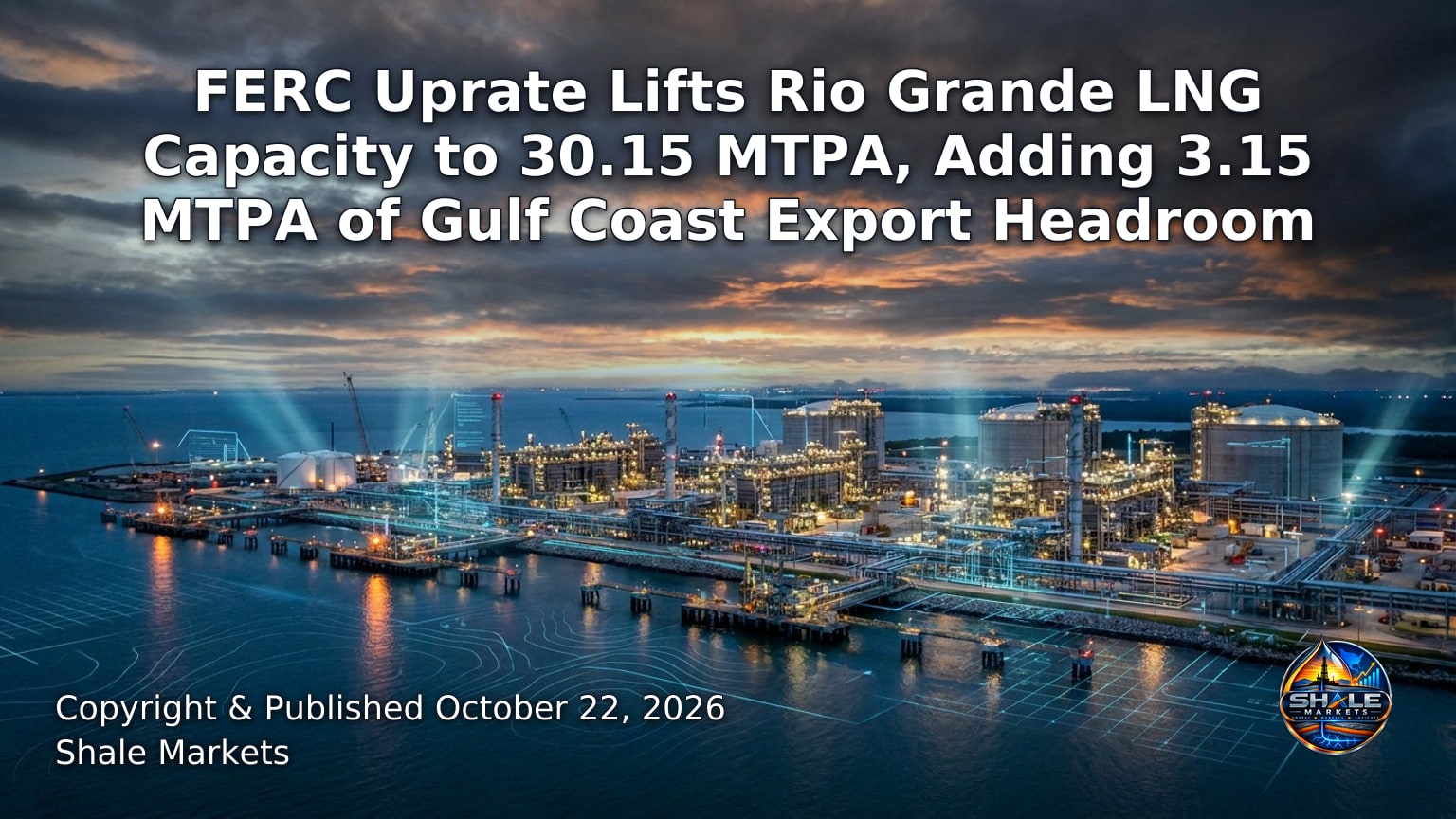
Original illustration created for Shale Markets.

FERC Uprate Lifts Rio Grande LNG Capacity to 30.15 MTPA, Adding 3.15 MTPA of Gulf Coast Export Headroom
The uprate does not add trains, tanks or compression. It reclassifies what the five trains already being built by Bechtel are expected to do.
What the filing actually changed
NextDecade's underlying application asked the commission to raise the terminal's authorized maximum to 30.15 MTPA to "align the approved production capacity of the Terminal with the actual anticipated liquefaction capability" of each train — about 6.03 MTPA, up from the 5.4 MTPA figure originally authorized. The application was explicit that the new number reflects peak operating performance under optimal conditions, not a physical expansion of the authorized footprint.
That distinction matters for anyone modeling the terminal against its permits. The 3.15 MTPA increment is a paper reconciliation between what regulators had approved and what the Air Products C3MR liquefaction technology installed on Trains 1 through 5 is now expected to deliver at full tilt.
A queue that just got more crowded
S&P Global Commodity Insights reported on August 29, 2025 that FERC's reaffirmation of Rio Grande LNG's approvals, following a D.C. Circuit remand, let NextDecade preserve its construction schedule for the first three trains while advancing commercialization of Trains 4 and 5. The September 2026 uprate builds on that footing rather than reopening it — FERC was adjusting a capacity ceiling on a project it had already cleared, not revisiting the underlying authorization.
Natural Gas Intelligence placed the Rio Grande order in a broader regulatory context on October 15, 2026, reporting that FERC has proposed a "blanket authorization" program that would let LNG terminals make routine capacity increases without case-by-case approval. NGI described the Rio Grande uprate as the individual precedent behind that proposal, with the commission framing such adjustments as necessary "headroom" for the Gulf Coast export queue as feed-gas demand is projected to reach record levels by 2028. If FERC adopts that blanket process, the next wave of uprates across the Gulf Coast would clear in weeks rather than through a standalone docket like CP26-31-000, and Rio Grande becomes the template rather than a one-off.
Where the five trains stand
Phase 1 — Trains 1 through 3 — reached a positive final investment decision in July 2023, according to Global Energy Monitor's May 2, 2026 project page. NextDecade's fourth-quarter 2025 business update, issued March 2, 2026, disclosed that engineering on Trains 1 and 2 was 97.8% complete as of January 2026, with first gas into the facility targeted for the second half of 2026. Trains 4 and 5 followed with their own positive FID in 2025, the same March update said.
By the time of NextDecade's second-quarter 2026 update on July 30, 2026, Chairman and CEO Matt Schatzman told investors that construction on Phase 1 was "tracking ahead of schedule," with first LNG production expected in the first half of 2027. That later date is not a slip against the earlier guidance: "first gas into the facility" in the March update refers to initial feed-gas introduction for commissioning, while "first LNG production" in the July update marks the first liquefied cargo-ready output, a milestone that follows commissioning by design.
The feed-gas math
Rio Grande LNG draws feed gas through the 137-mile Rio Bravo Pipeline, which connects to the Agua Dulce hub and, from there, to Permian Basin and Eagle Ford Shale supply, according to Global Energy Monitor. LNG Industry reported on September 30, 2026 that the Rio Bravo system is also the designated supply route for the project's proposed Train 6, which the outlet said would push total site capacity to 48 MTPA. That figure does not reconcile cleanly against the per-train math the FERC docket establishes: if Trains 1 through 5 run at 6.03 MTPA apiece for 30.15 MTPA combined, a Train 6 large enough to reach 48 MTPA would need to run close to 17.85 MTPA on its own — nearly three times the size of any of the first five trains. LNG Industry is the only outlet reporting the 48 MTPA figure, and NextDecade's own public filings in this record do not state a Train 6 capacity number. The figure should be treated as that single outlet's reporting until NextDecade's Train 6 application or a FERC docket confirms it.
What is not in dispute is the direction of the feed-gas call. Reclassifying Trains 1 through 5 at their higher authorized rate raises the physical volume Rio Bravo has to deliver to Agua Dulce once the terminal runs at the newly authorized ceiling — gas that gatherers and intrastate operators in the Eagle Ford and South Texas corridor will see the moment the trains hit that rate, not a separate project to track later.
Links Verified at Time of Publish.
Sources
This article was reported from the following sources.
- NextDecade Provides Second Quarter 2026 Business Update — NextDecade Corporation, 2026-07-30
- NextDecade receives permit for Rio Grande LNG train 6 expansion project — LNG Industry, 2026-09-30
- US regulators issue key permits for Rio Grande, Commonwealth LNG projects — S&P Global Commodity Insights, 2025-08-29
- NextDecade Provides Fourth Quarter 2025 Business Update — NextDecade Corporation, 2026-03-02
- Rio Grande LNG Terminal - Global Energy Monitor — Global Energy Monitor, 2026-05-02