US LNG Exporters Watch China Tariff Talks as New Gulf Coast Capacity Nears Online
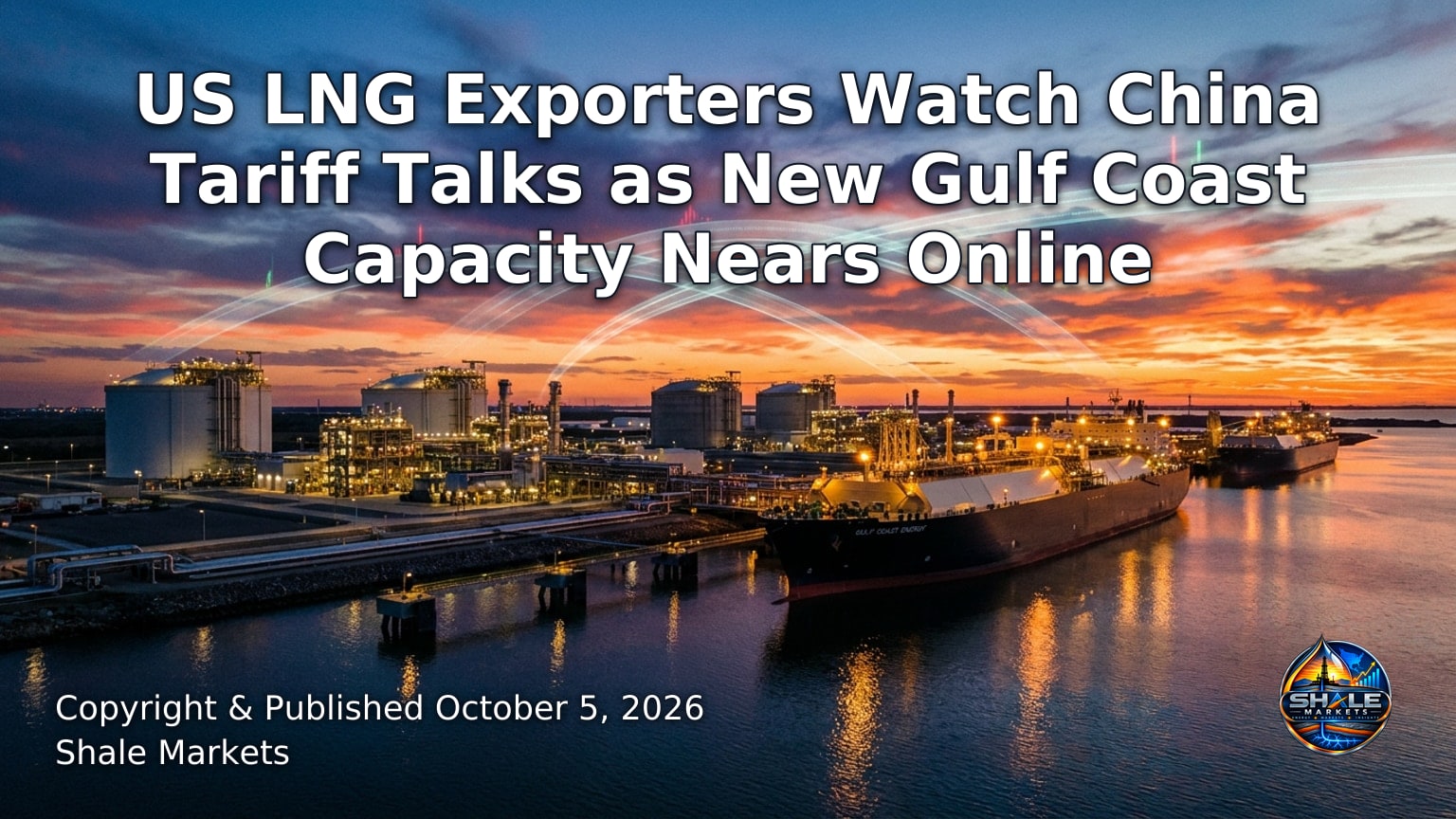
Original illustration created for Shale Markets.

US LNG Exporters Watch China Tariff Talks as New Gulf Coast Capacity Nears Online
About 24.5 million tonnes per year of Gulf Coast LNG capacity now under construction has no long-term buyer attached to it, according to Reuters reporting cited by Forbes on September 21. That overhang sits behind the headline from the Trump-Xi summit: China's 15% retaliatory tariff on U.S. LNG, in place since February 2025, was not included in the tariff relief the two governments negotiated this month.
The sequence matters for anyone pricing the next tranche of Gulf Coast supply. Reuters reported on September 19, via the Daily Star, that a tariff cut on LNG was under discussion as part of a broader package ahead of the September 24 Trump-Xi summit. The U.S. Trade Representative's office released final reciprocal product lists on September 28, with tariffs on most goods returning to most-favored-nation levels, the Associated Press reported via PBS the same day. LNG was not on either list. China's 15% levy on U.S. cargoes stands unchanged.
Direct cargo flows from Gulf Coast terminals to Chinese buyers have been at zero since the tariff took effect, down from 64 vessels in 2024, Visual Capitalist reported on September 30 using Census Bureau trade data.
Contracted gas, resold rather than delivered
The standstill has not stopped Chinese buyers from taking delivery of contracted volumes — just not onshore. Beijing's existing long-term contracts for U.S. gas total roughly 14 million tons per year, worth approximately $6 billion at long-term prices, Energy Connects reported on September 21. Chinese counterparties have continued to fulfill those contracts since the tariff hit, but have been reselling the cargoes into Europe and other Asian markets rather than importing the gas, according to the same report, which did not break out how much of the 14 million tons has moved into which market. CSIS senior fellow Jane Nakano told Energy Connects that resuming direct trade would support "the sustained growth of the U.S. LNG industry" by correcting the imbalance behind the dispute.
A tariff removal was viewed in the Forbes/Reuters account as a mechanism to convert some of the 24.5 million tonnes of uncontracted capacity into term agreements with Chinese buyers, who have so far treated U.S. cargoes as a flexible portfolio asset to reroute around the levy rather than a committed source of supply. Without a deal, that volume keeps finding spot buyers in Asia and Europe. It does not give developers the contracted revenue base that underwrites project financing for a new train the way a 20-year offtake agreement does.
The capacity coming online regardless
Energy Secretary Chris Wright said. Wright attributed part of the growth to Venture Global's Plaquemines facility, which received a 13% authorized capacity increase to 3.85 Bcfd in March 2026 — early trains at the site are ramping toward that authorization even as the project overall still appears on FERC's under-construction list. Wright credited the resumption of federal export approvals on January 20, 2025, for stabilizing the industry's growth trajectory.
Reuters reporting carried by the Daily Star on September 19 put total U.S. LNG capacity growth at 10 Bcfd through 2027, spread across Cheniere, Venture Global, Sempra, NextDecade, and ExxonMobil. Not every project in that pipeline is moving at the same pace. Gulf LNG Liquefaction Company filed with DOE on March 31, 2026, for an extension of its export commencement deadline, telling regulators it continues to pursue tolling or supply agreements but has not secured the commitments it needs; the company said it expects Phase I and II in service before the end of 2030 if those agreements materialize, according to the April 23 Federal Register notice.
Where the diverted cargoes land
Europe remains a primary outlet for volume that would otherwise target Asia, and incoming EU methane rules effective January 1, 2027 are the reason U.S. exporters pushed to get LNG into the tariff package in the first place, bne IntelliNews reported on September 20. How much of that incoming regulatory pressure actually curbs European offtake is not yet established in reporting; the rules have not taken effect. Japanese, South Korean, and emerging Southeast Asian buyers are also absorbing spot and short-term cargoes, per bne IntelliNews, which did not report a price level or date for the Asian spot market it described as elevated. No source has quantified how much of the uncontracted 24.5 million tonnes per year has gone to those buyers specifically, which is the number that would turn this into a netback story rather than a directional one.
What it means for the next wave of FIDs
Golden Pass, Port Arthur, and Rio Grande all remain in construction per FERC's September filing, meaning the capital already committed to the current generation of projects is locked in regardless of the tariff outcome. The open question is what happens to proposed terminals that have not yet reached FID, where a 24.5 million tonne overhang of uncontracted existing and under-construction capacity complicates the case for sanctioning more supply before current trains find term buyers.
If the tariff comes off in a later round of talks, the 14 million tons per year of existing Chinese contracts would resume direct delivery rather than reselling through third markets, according to the Energy Connects account. That would reallocate flows that already exist on paper rather than add new liquefaction capacity. For now, the 15% tariff stands and construction keeps moving without it.
Links Verified at Time of Publish.
Sources
This article was reported from the following sources.
- U.S.-China Tariff Deal Leaves LNG Out — Roic News, 2026-09-30
- US LNG exports on track to top 120 million tonnes in 2026, Energy Secretary says — U.S. Department of Energy (via Energy.gov/X), 2026-09-23
- A Tariff Deal Could Turn U.S. LNG Into China's Strategic Option — Forbes, 2026-09-21
- Trump-Xi Talks Could Mean $6 Billion of US Natural Gas for China — Energy Connects, 2026-09-21
- US, China discuss cutting tariffs on US LNG ahead of Xi visit — The Daily Star / Reuters, 2026-09-19
- U.S. and China release product lists for tariff cuts after Trump-Xi meeting — PBS / Associated Press, 2026-09-28
- US and China open talks on scrapping tariffs on US LNG — bne IntelliNews, 2026-09-20
- U.S. LNG Export Terminals – Existing, Approved not Yet Built, and Proposed — Federal Energy Regulatory Commission (FERC), 2026-09-23
- Mapped: How U.S.-China Trade Changed by U.S. State — Visual Capitalist, 2026-09-30
- Gulf LNG Liquefaction Company, LLC; Request for Extension of Export Commencement Deadline — Federal Register / Department of Energy, 2026-04-23