U.S. Shale Growth Has Fallen to a Trickle, and Only the Permian Is Still Adding Barrels
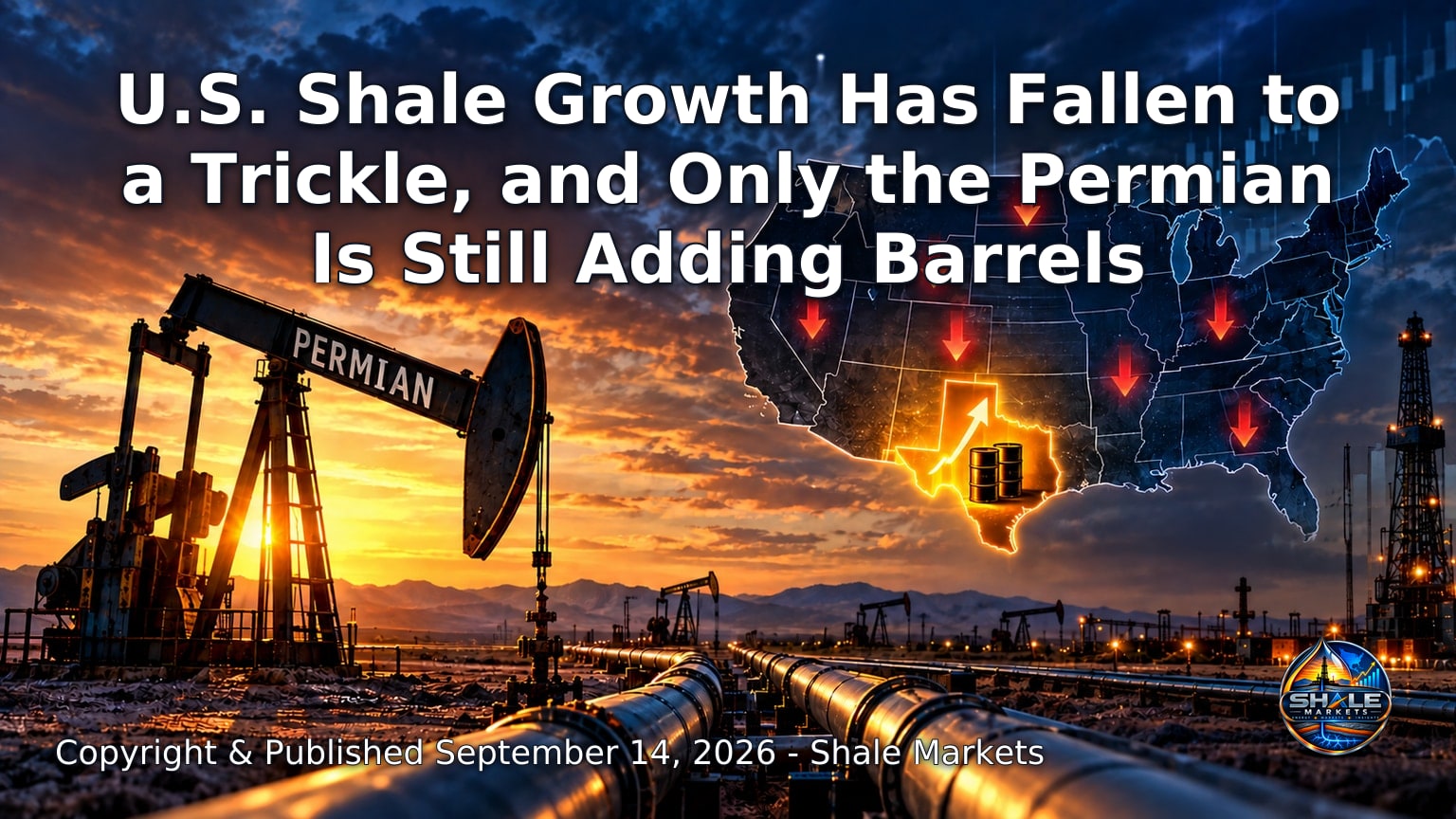
Original illustration created for Shale Markets.

U.S. Shale Growth Has Fallen to a Trickle, and Only the Permian Is Still Adding Barrels
U.S. crude production is set to average 13.8 million b/d in 2026, up 200,000 b/d from the 13.6 million b/d record set in 2025, according to the EIA's August 12, 2026 outlook. That compares with 1.0 million b/d of growth added in 2023, per EnergyNow's August 29, 2026 analysis of shale capex trends.
Both figures land in the same range: growth this year is a small fraction of what the industry added three years ago, and nearly all of what remains is coming from one basin.
The Permian Is Carrying the Growth Alone
Peak Oil Barrel's analysis of the EIA Drilling Productivity Report through July 2026, published September 6, 2026, found production in Lower 48 onshore basins essentially flat once the Permian is excluded. Legacy decline curves in mature plays are now largely offsetting whatever new wells add elsewhere. Operators there are managing drilled-but-uncompleted well inventories as a short-term reserve for keeping completion crews busy, the same report found, rather than as a source of new supply once that inventory is drawn down.
Fewer Rigs, Same Basin
Baker Hughes data reported by Reuters on September 7, 2026, showed the total U.S. oil and gas rig count adding for the sixth time in seven weeks, reaching 588 for the week ending September 4 — a figure the same report describes as 9% above the year-earlier level, even though it also cites overall declines of 5% in 2024 and 7% in 2025. Those two claims sit awkwardly together within the same release, and Baker Hughes' own weekly series was not available to reconcile the gap. The report noted rig activity concentrating in the Permian while the Utica and Eagle Ford showed more volatile or stagnant counts.
The Permian itself has not been immune to the pullback. East Daley reported on March 10, 2026, that Permian rig counts fell from a peak of 297 in April 2025 to 240 by early 2026, even as ExxonMobil was expected to lead the basin's supply growth for the year. Fewer rigs producing more growth than every other basin combined points to efficiency, not rig additions, doing the work — and that efficiency gain is itself slowing. Deloitte's 2026 Oil and Gas Industry Outlook, published October 29, 2025, found new well oil production per rig rose less than 2% between mid-2024 and mid-2025, a pace Deloitte tied to hydraulic fracturing technologies approaching practical limits.
4.7 Bcf/d of New Pipe Into a Basin Growing 200,000 b/d
The Permian's associated gas takeaway constraint is about to get a large capacity injection regardless of how slowly oil volumes grow. RBN Energy reported September 7, 2026, that the Blackcomb Pipeline (2.5 Bcf/d) and Hugh Brinson Pipeline (2.2 Bcf/d) are set to enter service in late 2026 and early 2027, together adding 4.7 Bcf/d of new outbound gas capacity. RBN's own report is the sole source on file for the Hugh Brinson figure at 2.2 Bcf/d; it does not specify whether that number reflects day-one capacity or a fully expanded build, a distinction that matters for anyone modeling Waha basis into next year.
East Daley's March 10 report identified associated gas takeaway as the binding constraint on further Permian growth, with producers waiting on those same projects to reach completion in the fourth quarter of 2026. RBN's own read on the timing is blunt: the buildout could produce what it called a capacity glut by 2031 if Permian production growth does not accelerate beyond the modest pace now showing up in EIA and OIES forecasts alike. Pipeline capacity was sized for a basin growing faster than the one now in the data — the projects were sanctioned when 2023's 1.0 million b/d annual gains looked like the baseline, not the exception.
EIA's Own Forecast Has Moved Twice This Year
The EIA's outlook shifted materially between January and August 2026. Its January 22 forecast expected crude production to hold near the 2025 record of 13.6 million b/d through 2026 before potentially falling 2% in 2027, citing WTI prices sliding toward $52/b as the primary drag on drilling incentives. By August 12, the agency had revised that up slightly, to the 13.8 million b/d figure cited above, with growth still concentrated almost entirely in the Permian, where a rising gas-to-oil ratio in maturing reservoirs is doing part of the work.
Two EIA forecasts seven months apart, moving from flat-to-down to modestly up, says more about how sensitive the growth outlook is to price and capex assumptions than about geology. EnergyNow's August 29 reporting found Chevron, ConocoPhillips, and Occidental Petroleum cutting shale capex by 10% to 20% to prioritize free cash flow over volume growth — the kind of capital decision that can move the EIA's own number again before year-end.
What to Watch
The Blackcomb and Hugh Brinson pipelines are scheduled to enter service in the fourth quarter of 2026 and early 2027; their in-service dates will show whether Permian associated gas was actually the binding constraint East Daley described, or whether producer capital discipline keeps growth muted regardless of available capacity. Baker Hughes' next weekly rig count will show whether the run of gains in six of the past seven weeks continues or reverses toward the multi-year decline trend the same report cited. And the EIA's next quarterly Short-Term Energy Outlook will show whether the August revision to 13.8 million b/d for 2026 holds.
Links Verified at Time of Publish.
Sources
This article was reported from the following sources.
- United States on track for record natural gas production in 2026 — U.S. Energy Information Administration (EIA), 2026-08-12
- US Oil Growth Faces Headwinds as Shale Producers Cut Spending — EnergyNow, 2026-08-29
- US Energy Firms Add Rigs for Sixth Time in Seven Weeks, Says Baker Hughes — Baker Hughes / Reuters, 2026-09-07
- Solitude, Encore Edition – New Natural Gas Pipeline to Overwhelm the Permian Basin with Outbound Capacity — RBN Energy, 2026-09-07
- US June Oil Production Rose — Peak Oil Barrel, 2026-09-06
- Global oil supply to grow more slowly in 2026, OIES says — Trend News Agency / Oxford Institute for Energy Studies, 2026-02-24
- EIA forecasts near-term U.S. crude oil production will remain near 2025 record — U.S. Energy Information Administration (EIA), 2026-01-22
- 2026 Oil and Gas Industry Outlook — Deloitte Insights, 2025-10-29
- Exxon Leads the Pack for 2026 Permian Supply Growth — East Daley, 2026-03-10
- EIA refines estimates for Permian tight oil and shale gas production — U.S. Energy Information Administration (EIA), 2026-03-17