UT Austin Puts a Number on Permian Wastewater's Data-Center Cooling Potential: 790 Million Gallons a Day
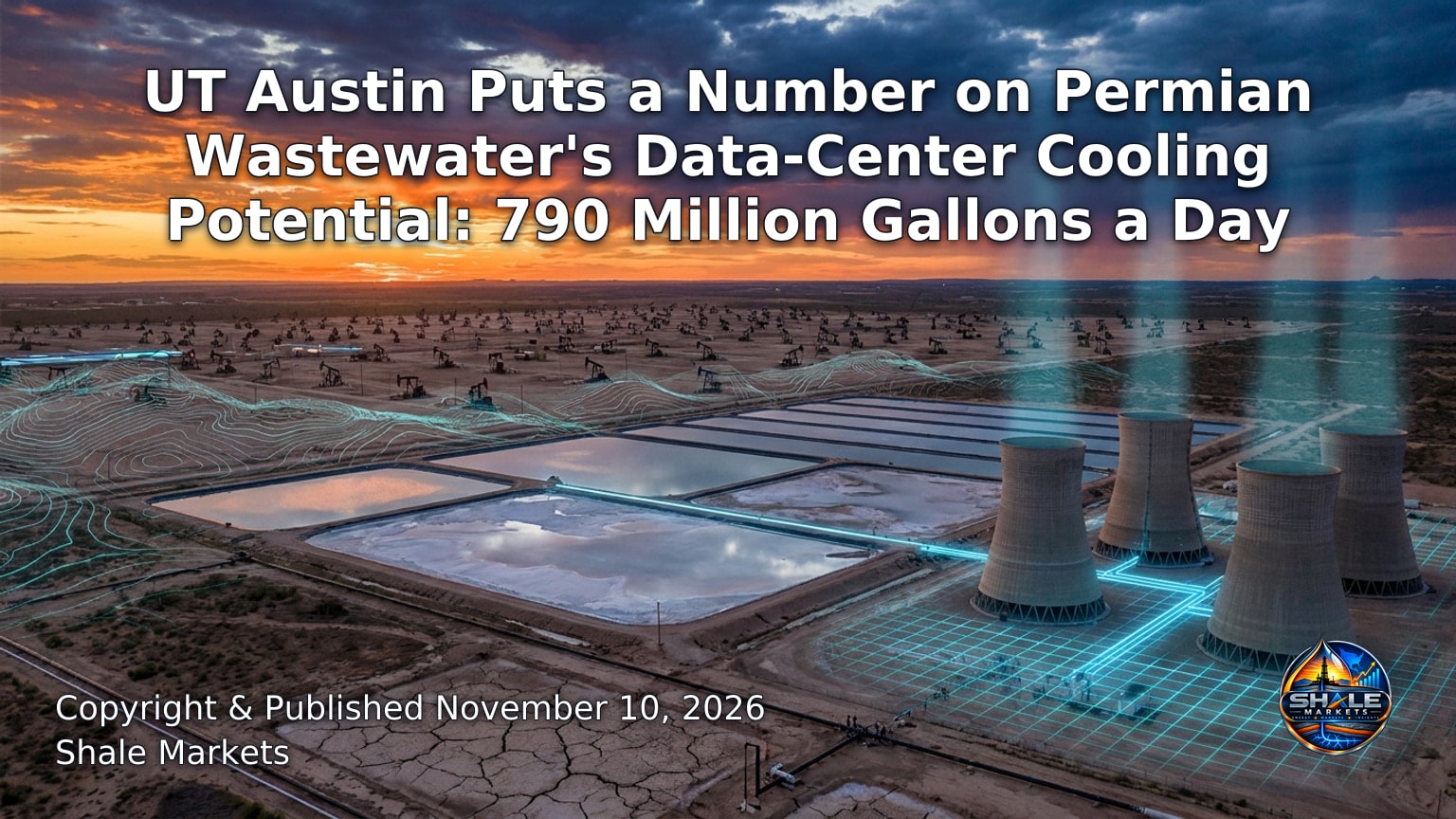
Original illustration created for Shale Markets.

UT Austin Puts a Number on Permian Wastewater's Data-Center Cooling Potential: 790 Million Gallons a Day
The Permian Basin is running out of room to bury its wastewater underground, and University of Texas at Austin researcher Vaibhav Bahadur puts a date on it. "The region is running out of space to bury that water, by as early as 2030," Bahadur said in an October 8, 2026 release from the Cockrell School of Engineering accompanying his desalination study in the journal Water Research. The basin produces roughly 790 million gallons of wastewater a day, the study found — enough, in principle, to supply cooling water to well over 100 large data centers, since a single hyperscale facility uses up to 5 million gallons a day, OilPrice.com reported October 17, 2026. That comparison assumes full treatment yield on brine that is often saltier than seawater, a quality that rules out simple reverse osmosis and forces energy-intensive distillation instead.
How Big Is the Volume, Really
Converted to a common basis, the published estimates for Permian produced water cluster, but not perfectly. UT Austin's 790 million gallons a day works out to roughly 18.8 million barrels a day. The Bureau of Economic Geology's COMPASS consortium, in a white paper published December 3, 2025, put current daily volume above 20 million barrels — close enough to UT Austin's figure to treat as the same number stated two ways. Forward projections sit higher: a March 1, 2026 report from Shamrock Precision puts the basin at 26 million barrels a day by 2030.
One figure does not fit that range. The Produced Water Society's Rajendra Ghimire, writing May 26, 2026, cited annual Permian output above one trillion gallons — a number that, converted to barrels a day, implies roughly 65 million barrels, more than triple UT Austin's current figure. Nothing in the published record explains the gap, whether it reflects a broader geographic boundary or a different measure of gross fluid. A reader sizing disposal or treatment economics should anchor to the 19-million-barrel current figure and the 26-million-barrel forward range; the trillion-gallon number does not reconcile with either and should not be used for sizing.
The demand side has its own range, and it is larger relative to supply than the disposal framing suggests. Ning Lin, chief economist at the Bureau of Economic Geology, told the Texas Real Estate Research Center's Tierra Grande publication on September 17, 2026, that Texas data centers currently use about 33 billion gallons of water annually, with high-end 2030 projections reaching 161 billion gallons, or 494,000 acre-feet. Converted to the same yearly basis as UT Austin's daily figure — 790 million gallons a day works out to roughly 288 billion gallons a year — that high-end 2030 case is about 56% of total Permian output, putting statewide data-center demand within the same order of magnitude as the basin's entire brine stream rather than a rounding error against it.
A Disposal Deadline Driving the Pitch
Bahadur's case for reuse rests on a hard constraint, not just an opportunity. That framing matters to operators who have treated saltwater disposal wells as a fixed cost rather than a scarce resource.
Shamrock Precision's March 1, 2026 report, citing the Railroad Commission of Texas's 2025 acknowledgment of what it called widespread underground pressure problems, projects volumes reaching 26 million barrels a day by 2030; Shamrock is the only source making that specific forecast.
The Treatment Gap
Volume was never the obstacle. Permian produced water is often saltier than seawater, which rules out reverse osmosis on its own and requires heat-based distillation, OilPrice.com reported October 17, 2026. That raises the energy cost of treatment, and it is the reason researchers have started looking at data centers themselves as a heat source rather than just a water customer. Alex Procyk, Upstream editor at Oil & Gas Journal, discussed in a July 7, 2026 podcast how emerging technologies could route data-center waste heat into the desalination process for produced water, calling the pairing a "symbiotic relationship" that addresses the extreme salinity that makes conventional treatment expensive.
Infrastructure Still Has to Get Built
None of this moves without pipe, and the overlap between existing oilfield water networks and data-center siting is doing a lot of the argument's work. Ghimire's May 26 piece pointed to exactly that overlap, noting that infrastructure corridors between oilfield water-gathering systems and proposed hyperscale sites already run close enough together to make pipeline integration plausible without greenfield rights-of-way. That is a cost advantage, not a guarantee; treatment plants, storage, and the quality-assurance systems a data-center operator would demand before accepting brine-derived cooling water still have to be designed, permitted, and financed.
A foundational 2022 report from the Texas Produced Water Consortium, filed with the state legislature, estimated that up to 4 billion barrels per year of treated produced water could be made available for beneficial use outside the oilfield, with industrial cooling named as a primary candidate contingent on pilot projects proving out economics and safety. Mariam Arzumanyan, a postdoctoral fellow at the Bureau of Economic Geology, told UT News on May 6, 2026, that data-center water demand estimates vary widely depending on cooling technology and energy source, and that the COMPASS consortium exists specifically to coordinate between the data-center industry and state policymakers as that 3% to 9% share of statewide water demand materializes by 2040.
What Changes for Operators
For E&Ps paying disposal fees, a buyer willing to pay for treated water rather than charge for its burial would flip a cost line into a revenue line. That math has not been tested at scale, and no published figure puts a dollar cost on the distillation step that hypersaline Permian water requires. Texas's own framework for surface discharge and industrial reuse of oilfield-origin water remains the open regulatory question, and the Tierra Grande piece from September 17, 2026 frames the real hurdle not as supply but as who pays to clean it.
The 2030 disposal-space ceiling that Bahadur describes gives this debate a deadline it has not had in prior produced-water reuse proposals. Whether treatment technology and pipeline capital arrive on that timeline is the part the research answers least.
Links Verified at Time of Publish.
Sources
This article was reported from the following sources.
- Can Salty, Dirty Water Cool Data Centers? — Cockrell School of Engineering, The University of Texas at Austin, 2026-10-08
- Texas Researchers Say Permian Wastewater Could Cool AI Data Centers — OilPrice.com, 2026-10-17
- Water Use Requirements for Data Centers in Texas — Bureau of Economic Geology, The University of Texas at Austin, 2025-12-03
- The Permian's Next Boom Has a Water Problem — Produced Water Society, 2026-05-26
- UT Austin study: desalinated Permian wastewater could cool Texas data centers — Solmar Insights, 2026-10-19
- Analysis: Texas Pumps Up a Billion Gallons of Wastewater a Day. The Only Question Left Is Who Pays to Clean It. — Texas Real Estate Research Center / Tierra Grande, 2026-09-17
- Permian Wastewater Could Cool AI Data Centers, Texas Study — Emergent, 2026-10-17
- Data Centers Are Growing in Texas, But Big Questions Remain About Water Use — UT News, 2026-05-06
- Insights: Permian produced water, data centers can form symbiotic relationship — Oil & Gas Journal, 2026-07-07
- Permian Basin Produced Water Crisis — Shamrock Precision, 2026-03-01
- 2022 Texas Produced Water Consortium Report — Texas Produced Water Consortium, 2022-12-31