
Why Domestic Refining Capacity, Not New Shale Wells, Is Now the Binding Constraint on U.S. Crude Realization
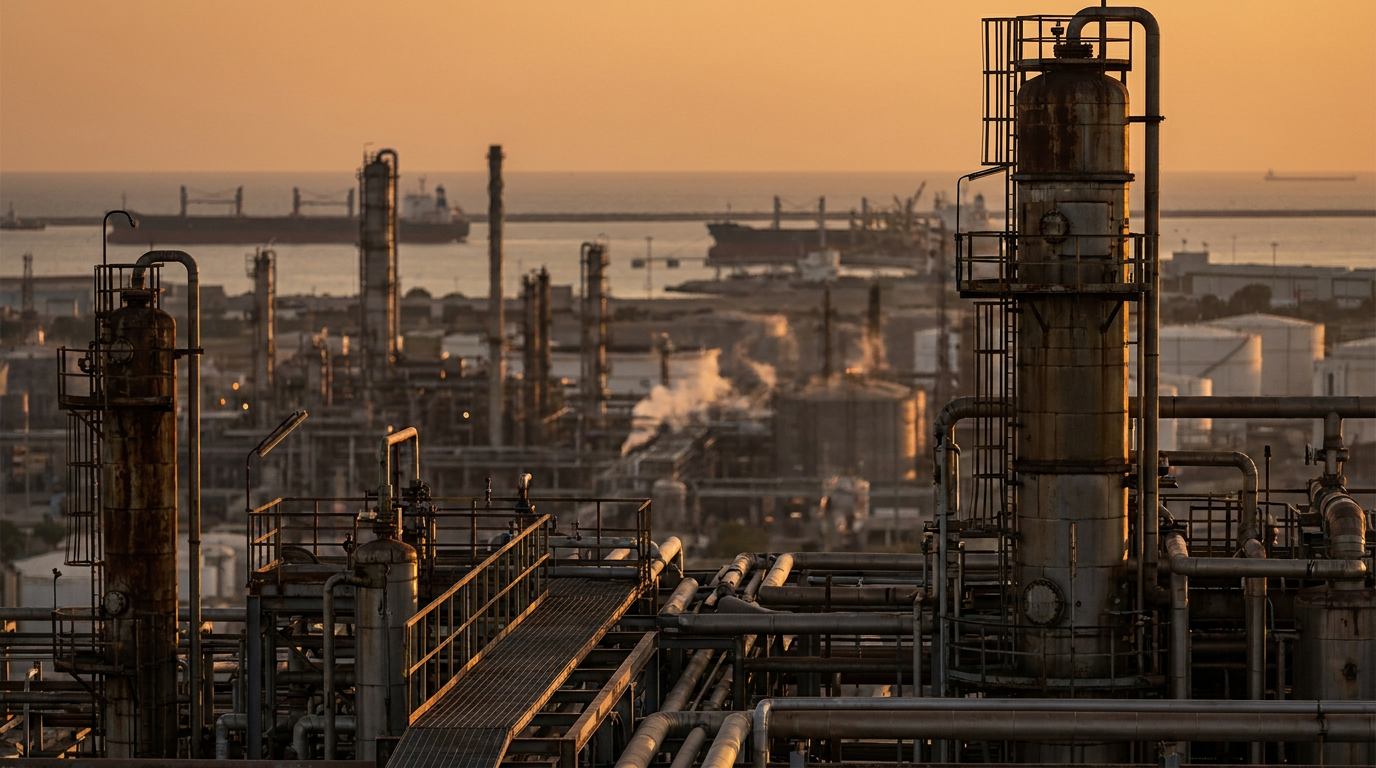
Original illustration created for Shale Markets.

Operable U.S. atmospheric crude distillation capacity fell to 18.2 million barrels per calendar day as of January 1, 2026, a drop of more than 250,000 b/cd from a year earlier, according to the Energy Information Administration's June 29, 2026 report. The closures behind that number are specific: LyondellBasell's 263,776-b/cd Houston refinery and Phillips 66's 138,700-b/cd Los Angeles facility both shut. The EIA is explicit that this happened despite record domestic crude production.
That gap between what shale produces and what the domestic system can process is now the operating condition for the whole sector, not a temporary anomaly. Refiners are running flat out, upstream operators are holding capital budgets flat, and the barrels that can't clear a U.S. still are heading to a dock instead of a domestic unit.
Refiners are already at the ceiling
EIA's monthly data put U.S. refinery utilization at 96.5% in June 2026, with gross inputs to distillation units averaging 17.38 million barrels per day; weekly figures for late August 2026 show utilization peaking at 97.4%, per EIA's August 31, 2026 release. Mansfield Energy, in a September 3, 2026 note, put a finer point on the duration: utilization stayed above 95% for 11 consecutive weeks through mid-August, a stretch it called rarely seen in EIA's records. Mansfield's concern is concentration risk — the Gulf Coast holds half of U.S. capacity, and the system has "limited spare room" if a storm takes any of it offline during hurricane season.
Individual refiners are posting numbers that confirm the same squeeze from the inside. BIC Magazine reported on September 2, 2026 that Shell hit a record 102% refinery utilization in the second quarter, while Valero and Chevron both ran above 97%. A refinery above 100% utilization is running beyond its nameplate rating on sustained throughput — there is no slack left to absorb an unplanned outage or a demand spike.
The barrels that can't clear a U.S. refinery go to the dock
With domestic units full, the marginal barrel of light, sweet shale crude is increasingly finding a buyer overseas rather than a U.S. refinery. EIA reported on July 8, 2026 that total U.S. petroleum exports hit a record 13.6 million b/d in April 2026, with crude oil exports specifically reaching 5.6 million b/d — a 21% jump over the prior record. Kpler data cited by Reuters on September 3, 2026 shows crude exports at 5.48 million b/d in May, nearly triple pre-war shipment levels to Asia. Reuters frames the constraint plainly: the U.S. is the world's top producer, but its ability to stabilize global markets is limited by the physical capacity of its own refining and export infrastructure.
Crux Investor's July 17, 2026 analysis ties this directly to crude quality. Refining constraints are increasing demand for light, sweet shale grades because they require fewer processing steps, but the lack of domestic capacity is forcing those barrels to compete in the export market rather than a domestic refinery, which reprices them relative to how they'd have cleared five years ago.
Refiners are booking the margin; producers are holding the budget
The financial split between the two ends of the barrel is stark and dated. Industrial Info Resources reported on August 13, 2026 that Marathon Petroleum, Valero, and Phillips 66 collectively earned $12.6 billion in the second quarter, their best combined result since 2022, with the ULSD crack spread hitting $93.84 per barrel on August 10, 2026. Oil & Gas Journal's September 2, 2026 outlook projects independent refiners heading into a "rebound in refining profitability" as global supply disruptions widen crack spreads further, even as domestic capacity itself stays flat.
Upstream, the response looks different. EOG Resources reported record second-quarter 2026 net income of $2.72 billion and free cash flow of $2.8 billion on August 4, 2026, on strong volumes of 548.8 MBod of oil — but capex guidance for the year held at $6.5 billion. CEO Ezra Yacob framed the company's posture as capital discipline rather than aggressive volume growth, a stance the company's own release links to midstream and downstream constraints rather than reservoir economics. East Daley Analytics reached a related conclusion for Permian producers broadly in its March 14, 2026 analysis: even at high WTI prices, operators are "unlikely to materially increase capital budgets" given a backwardated forward curve and infrastructure bottlenecks that sit outside the wellhead.
Washington has a bill; it doesn't have a fix yet
The policy trade group most focused on this gap is AFPM, and its argument is that regulatory uncertainty, not economics, is what has kept refiners from building new capacity for two decades. Congressman Bob Latta's REFINER Act, reintroduced April 30, 2025, directs the National Petroleum Council to identify the regulations behind an estimated loss of one million barrels of fuel per day in North American capacity and to recommend how to expand it. AFPM president Chet Thompson backed the bill in a November 19, 2025 statement built on that same one-million-barrel figure.
API vice president Will Hupman argued on March 27, 2026, in response to EPA's final Renewable Fuel Standard volumes for 2026–2027, that reallocating compliance volumes from small refineries onto larger ones "distorts the marketplace" and "disadvantages the majority of refiners," calling instead for legislative reform to give the sector certainty for long-term investment. AFPM separately estimated that the 2026–2027 RFS mandates could push total compliance costs toward $150 billion. API CEO Mike Sommers made the broader case in the group's January 14, 2026 State of American Energy address, describing the U.S. as being in a "demand decade" that requires "certainty, stability, and clear rules" to sustain, and warning that record production alone won't prevent price shocks without permitting reform and downstream infrastructure investment.
Senator Bill Cassidy, R-Louisiana, put the same dynamic in plainer terms in comments cited by Shale Directories on September 4, 2026, saying the pressure on fuel prices reflects a "global shortage of refined products" rather than a crude shortage. That statement matches what the EIA and Kpler data show: U.S. crude is abundant and exportable, but the products market is where the system is tight.
What to watch
EIA's Short-Term Energy Outlook, published August 11, 2026, expects refinery inputs to stay near the top of the five-year range through year-end, with commercial crude inventories held below the five-year low because high runs and lower net imports keep draining stocks to meet both domestic demand and export orders. That leaves two open variables worth tracking directly rather than through a forecast. The first is hurricane season: Mansfield's warning about the Gulf Coast's concentrated capacity and 11 straight weeks above 95% utilization means any storm-driven outage this fall would hit a system with no cushion. The second is the National Petroleum Council's study under the REFINER Act — Congress has not set a public deadline for that report, and until it lands, the regulatory uncertainty AFPM and API cite as the reason capacity hasn't been rebuilt remains unresolved.
Sources
This article was reported from the following sources.
Refining capacity: The next energy bottleneck — BIC Magazine, 2026-09-02
U.S. refining capacity decreased during 2025 — U.S. Energy Information Administration (EIA), 2026-06-29
U.S. Refinery Utilization and Capacity — U.S. Energy Information Administration (EIA), 2026-08-31
U.S. Refining Margins Drive Record Profits — Industrial Info Resources, 2026-08-13
Refining Constraints Keep Fuel Margins Near Four-Year Highs, Repricing Light, Sweet Crude — Crux Investor, 2026-07-17
AFPM: REFINER Act spotlights liquid fuels, downstream energy manufacturing as a national security asset — American Fuel & Petrochemical Manufacturers (AFPM), 2025-11-19
EOG Resources Reports Second Quarter 2026 Results — PR Newswire / EOG Resources, 2026-08-04
U.S. exports of crude oil and petroleum products reached record in April — U.S. Energy Information Administration (EIA), 2026-07-08
AFPM: The only lawful, acceptable number for RFS reallocation is zero — American Fuel & Petrochemical Manufacturers (AFPM), 2025-11-03
State of American Energy 2026: Meeting the Demand Decade — Energy In Depth / API, 2026-01-14
The Market Wants More Oil. Shale May Not Deliver — East Daley Analytics, 2026-03-14
US Crude and Fuel Exports Surge to Record Highs, But it's Not Enough — Reuters / Kpler, 2026-09-03
Latta Introduces REFINER Act to Increase U.S. Refinery Capacity — Office of Congressman Bob Latta, 2025-04-30
US refiners set for sharp 2026 profit growth — Oil & Gas Journal, 2026-09-02
API Statement on EPA's Final RFS Volumes for 2026–2027 — American Petroleum Institute (API), 2026-03-27
The Surge in US Oil Exports — Robin J Brooks (Substack), 2026-06-10
Is the U.S. Refining System Being Pushed Too Hard? — Mansfield Energy, 2026-09-03
Short-Term Energy Outlook for petroleum products — U.S. Energy Information Administration (EIA), 2026-08-11
AFPM Lobbies Against EPA Renewable Fuel Standards — Legis1, 2026-07-29
The Refining Challenge Behind Today's Fuel Prices — Shale Directories, 2026-09-04
All source links verified at time of publish.