
Shale Markets Briefing — August 21, 2026
Friday, August 21, 2026
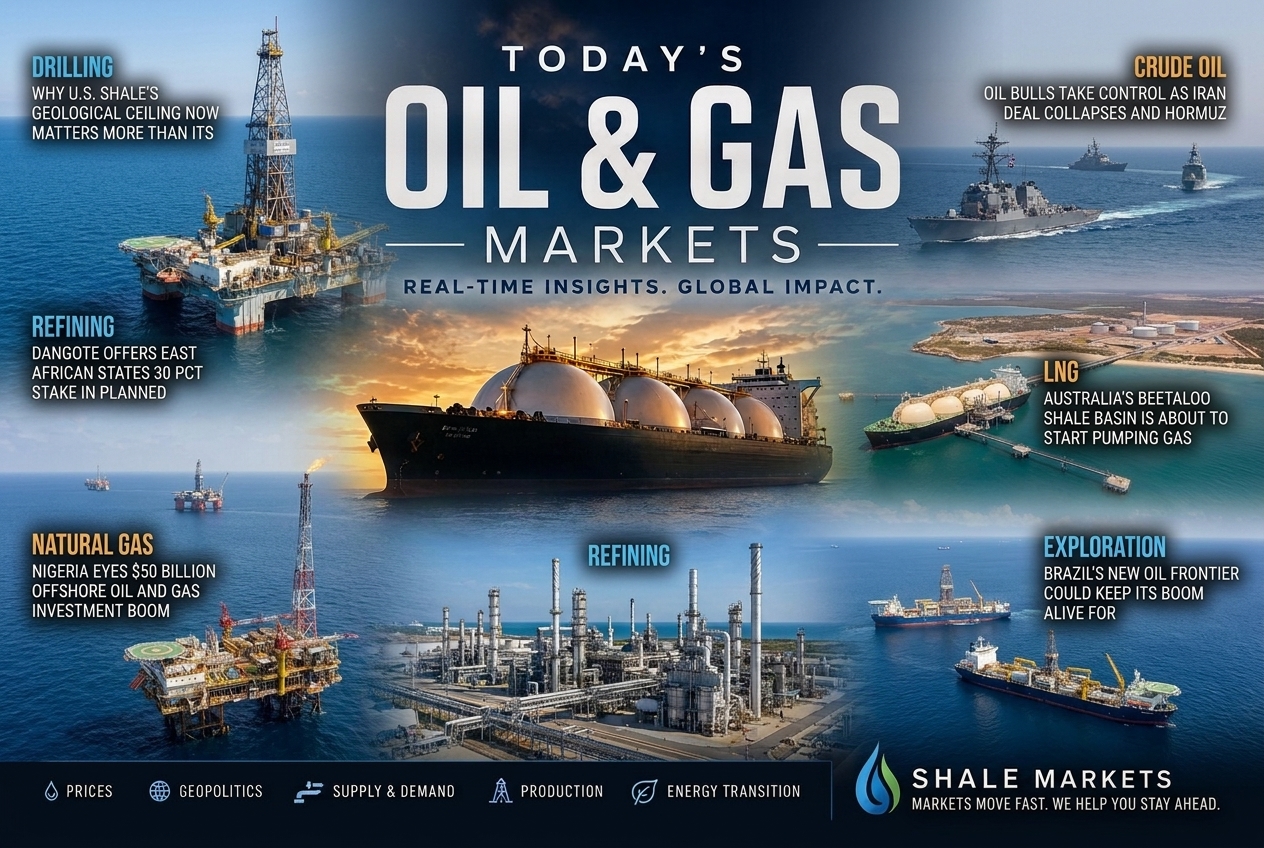
Today's briefing brings you 27 stories across drilling, policy, markets and midstream from across the global oil and gas market. Leading today: Why U.S. Shale's Geological Ceiling Now Matters More Than Its Rig Count.
Drilling
As Permian decline curves outpace rig-count efficiency gains, operators are shifting 2027 budgets from new drilling toward base-decline management.
From Our Desk
A new offshore discovery at Brazil’s Amazon margin points to a longer runway for Petrobras-led development and keeps upstream capital focused on deepwater frontier acreage rather than a near-term shift toward lower-risk basins. For executives, it signals that Brazil may remain a major source of long-cycle oil supply growth and a stronger competitor for global capital.
OilPrice.com
The deal signals continued capital migration into the Midland Basin, where buyers are still paying for operated inventory and oily production mix rather than just acreage. For executives, it reinforces that scale and drilling visibility in the Permian remain a key competitive advantage for independents looking to sharpen their portfolio.
OilPrice.com
Mexico’s deepwater and subsalt exploration remains a capital-intensive bet that could reshape reserve replacement for the country’s major producers if it works. For executives, this signals a willingness to commit scarce exploration dollars to long-dated offshore prospects rather than near-term output growth.
RigZone
Longer Permian wells signal a capital-allocation shift toward manufacturing-style development, where operators can hold output steadier without adding rigs or crews at the same pace. For executives, that points to stronger demand for drilling and completion efficiency, but also a more competitive basin where service intensity and well design matter more than simple activity counts.
World Oil - Latest News
A relaxation of drilling limits near a world heritage site would signal that political risk can override environmental constraints, which could reopen acreage and shift capital toward more contested onshore positions. For executives, it also raises the likelihood of permitting fights, reputational pressure, and potential delays for nearby projects.
The Guardian
This signals a regulatory shift that could weaken landowner visibility into subsurface drilling activity, raising permitting and access-risk questions for operators on split-estate acreage. For executives, it matters because changes in notification practices can affect project timelines, stakeholder friction, and the political scrutiny around basin development.
High Country News
An expected pickup in North Dakota field activity suggests operators are planning more work in the Bakken, which points to firmer capital spending and service demand in one of the key U.S. crude basins. For executives, it is a read on near-term rig and completion activity that can tighten local service capacity and influence regional production trends.
EnergyNow.com
This ranking signals where U.S. land drilling capital is concentrating, which helps executives gauge which contractors and operators are winning activity as budgets are allocated. It is also a quick read on basin-level momentum and competitive positioning across the drilling market.
RigZone
This signals continued local and regional political resistance to offshore drilling, which can complicate permitting, leasing, and investment timing along the California coast. For operators and service providers, it reinforces the risk that offshore assets face sustained policy and reputational headwinds even when commodity prices support development.
New Times San Luis Obispo
This points to a continued push to lower the cost and uncertainty of exploration spending by moving seismic modeling and survey design into a more integrated digital workflow. For executives, that signals software and data tools are becoming part of the competitive advantage in deciding where to allocate capital and how efficiently to high-grade acreage.
World Oil - Latest News
Policy
Higher crude prices tied to stalled Iran diplomacy and tighter access through Hormuz signal more geopolitical risk premium in the market. For executives, that raises feedstock-cost uncertainty, supports near-term upstream cash flow, and can shift capital discipline toward assets with quicker payback and lower export risk.
OilPrice.com
China’s push to expand oil and gas output alongside its renewable buildout signals a long-term priority on energy security over a rapid fossil-fuel retreat. For producers and LNG exporters, it points to a market where domestic supply growth could slowly trim import demand and sharpen competition for seaborne barrels and molecules.
OilPrice.com
An article framed around boosting oil and gas supply for energy security signals continued policy support for upstream output and infrastructure rather than a near-term push to constrain hydrocarbons. For executives, it suggests the market is still treating domestic or regional supply reliability as a strategic priority, which can support capital allocation into production and midstream capacity.
chinadailyasia.com
Markets
Nigeria signaling a large offshore investment push suggests capital may be rotating toward lower-risk deepwater opportunities where scale and export access can support returns. For executives, it points to potential competition for rigs, subsea equipment, and project capital in an African basin that can influence future crude and gas supply balances.
OilPrice.com
This signals a push to de-risk a large refining project by bringing host governments in as equity partners, which can improve permitting, political support, and financing access. For executives, it also points to growing downstream competition in East Africa and a potential reordering of regional fuel supply control.
RigZone
This signals another capital move into Vaca Muerta, where operators are still competing for scale and long-life inventory outside the United States. For executives, the key implication is that Argentina remains attractive enough to draw international partnership capital toward production growth rather than pure exploration.
World Oil - Latest News
This signals a potential shift in Venezuela’s upstream investment climate, which could attract international capital into mature assets and infrastructure that have been underinvested for years. For executives, the key issue is whether regulatory openness can translate into sustained production growth and a larger crude supply source for the market.
World Oil - Latest News
This shows ConocoPhillips can bring new Alaska barrels online on time and with cost discipline, which supports cash flow and signals healthy project execution in a mature basin. For peers, it is a reminder that selective investment in legacy shale and conventional assets can still add supply without requiring outsized capital risk.
World Oil - Latest News
The EIA’s swing from a tighter market in 2026 to oversupply in 2027 signals that upstream spending, hedging, and production plans may need to be adjusted for a shorter window of favorable prices. For executives, it points to a likely shift in capital allocation toward projects that can return cash before the market softens and away from growth that would land into a looser balance.
RigZone
Forward gas price weakness in the Permian and East while Western hubs rally signals that regional basis and transport constraints are still shaping realizable value. For an executive, it points to shifting capital and hedging priorities across basins and suggests the market is rewarding supply positions tied to tighter Western balances.
Natural Gas Intelligence
A small-scale refinery would let Buru monetize stranded crude closer to demand, which can improve netbacks and reduce reliance on third-party logistics in a remote basin. For executives, it signals that infrastructure constraints and local market access are becoming part of the capital allocation decision, not just reservoir quality.
RigZone
Midstream
First production from Beetaloo signals a new non-U.S. shale gas source that could add supply to the LNG and domestic gas balance in Asia-Pacific. For executives, it is a test of whether the basin can attract capital and infrastructure needed to compete with established export hubs.
OilPrice.com
Europe’s reserve system holding through a major supply disruption signals that mandated stockholding and coordination can reduce near-term import risk. For executives, the harder test is whether those buffers and logistics plans still protect margins and refinery runs when disruptions last longer or hit a wider set of products.
OilPrice.com
Higher lubricant prices raise the operating cost of trucking fleets and can pressure maintenance budgets, which in turn can affect freight carriers' margin discipline and replacement timing. For oil and gas executives, it is a reminder that downstream demand from transportation stays sensitive to base-oil and additive cost inflation even when fuel is not the only pressure point.
Commercial Carrier Journal
Technology
A successful field trial of a downhole scale remediation tool suggests operators are still spending on production-efficiency technologies that can reduce intervention costs and downtime. If the tool commercializes, it could take share in mature assets where scale management is a recurring constraint on output and well economics.
World Oil - Latest News
This signals that any Venezuelan recovery will depend as much on operating capability, compliance, and political risk management as on financing. For executives, it highlights a potential opening for service, technology, and advisory players, but only if capital can be deployed without triggering sanctions or execution failures.
OGJ - Drilling & Production