Today’s Briefing

The latest drilling, deal-flow, and regulatory news across the globe

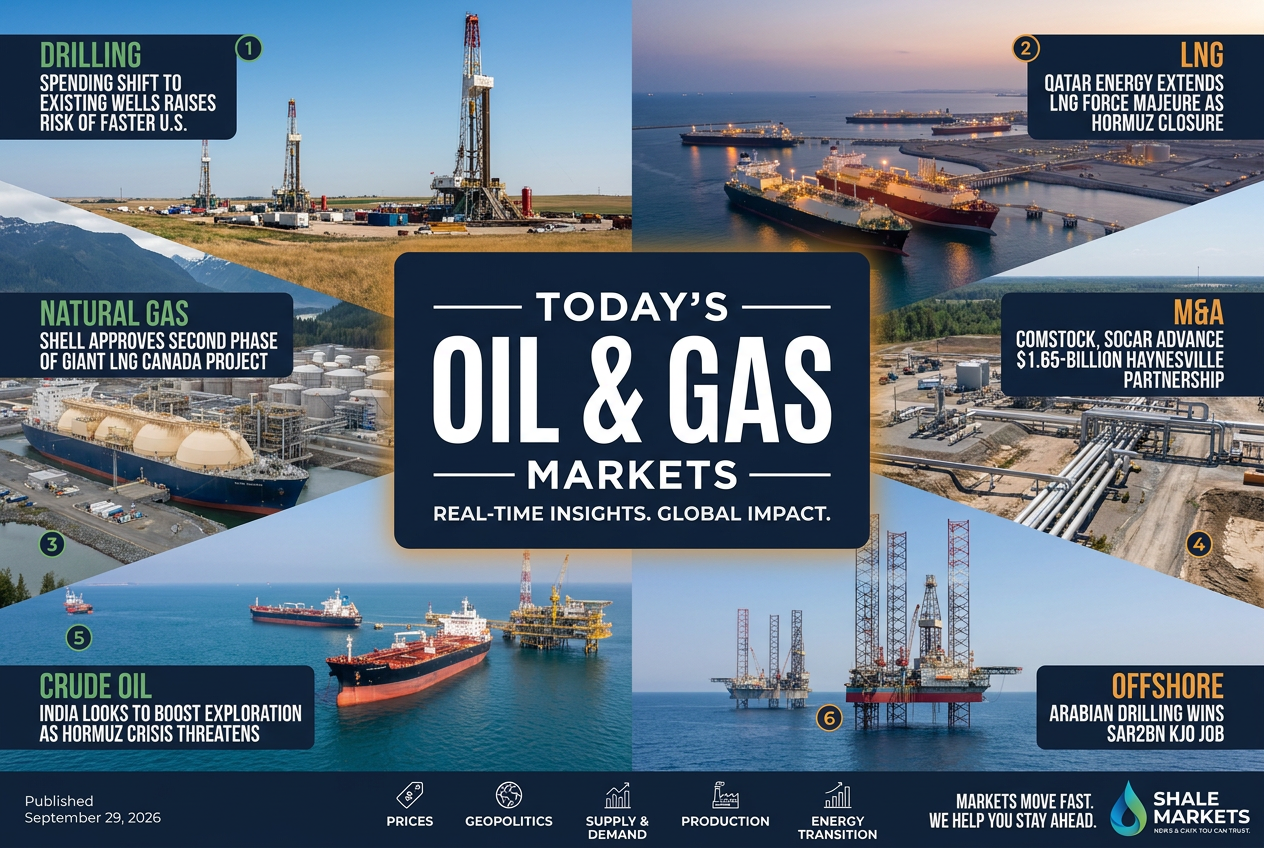
Illustrated summary of the top stories in the Shale Markets Briefing — September 29, 2026 briefing

Monday, August 17, 2026

Shale Markets Original

Q2 Rundown: EQT (NYSE:EQT) Vs Other Upstream Natural Gas E&P Stocks

EQT is a bellwether for Appalachian gas capital allocation and cash generation, so a quarterly comparison against peers helps executives judge whether dry-gas spending and returns are improving relative to the group. It also signals whether gas-focused E&Ps are holding leverage to pricing, hedge books, and operating efficiency in a market where basin discipline matters.

Sunday, August 16, 2026

AI Set to Extend Fossil Fuel Dominance

AI buildouts are increasing power demand faster than utilities and gas producers can plan for, which supports incremental demand for reliable generation and midstream capacity. For executives, the key signal is that data-center growth can prolong the need for gas and other firm power even as decarbonization pressures continue.

Petrobras awards gas compression contract for Sergipe-Alagoas basin development

This signals continued capital commitment to a large offshore development with long lead times, which can support future production growth and keep Petrobras’s upstream spending concentrated in Brazil. For service and equipment suppliers, the award confirms demand for high-specification offshore systems tied to new FPSO buildouts rather than short-cycle activity.
OGJ - Exploration and Development · 10:05 PM

Santos loads first crude cargo from Alaska's Pikka Phase 1

The first cargo from Pikka shows a new North Slope supply source entering the market, which can affect West Coast crude availability and regional pricing dynamics. For executives, it signals that upstream capital is converting into barrels and that Alaska is adding competitive supply in a market where incremental domestic production matters.
Sponsored
AI-Driven Interactive Websites
OGJ - Exploration and Development · 10:05 PM

LLOG sanctions Gulf of Mexico Who Dat East development

This signals that offshore Gulf of Mexico tieback opportunities are still attracting capital when new volumes can be brought online through existing infrastructure, which lowers development cost and shortens cycle time. For executives, it points to continued competition for lower-risk deepwater inventory that can add barrels without a major standalone facility build.

Get the daily briefing

Join oil & gas executives who start their day with Shale Markets.

Petrobras makes ultra-deepwater discovery offshore Amapá, Brazil

A new ultra-deepwater discovery in a frontier basin signals that Petrobras may be willing to keep capital flowing into high-risk exploration rather than concentrating only on proven offshore core areas. For executives, it matters because success in Amapá could expand Brazil’s future supply base and influence competition for rigs, subsea capacity, and exploration dollars in the region.

Shadow Tanker Relays Keep Oil Flowing Amid Hormuz Strikes

The report signals that shipping workarounds can keep Gulf crude moving even under attack risk, which helps cap immediate price spikes but raises freight and security costs across the supply chain. For executives, it is a reminder that Middle East disruption can quickly affect export flows, tanker availability, and near-term crude pricing rather than just local security conditions.

Emerson wins bp automation contract for $2.9 billion Shah Deniz project

The contract shows operators are still spending on large-scale offshore gas infrastructure to keep mature fields flowing, which supports service demand and extends basin life rather than redirecting capital to new frontier drilling. For suppliers, it signals that automation and controls remain a competitive wedge in complex international projects where uptime and debottlenecking drive returns.
Sponsored
Newsletters Automation & Hosting Platform

The four major oil refiners swung to an 8.8 trillion won profit from a 1.2 trillion won loss, while petrochemical firms worry that the more they sell, the more they lose

Higher refining profits suggest a stronger earnings backdrop for fuel makers and better cash generation for downstream capital spending. The petrochemical weakness signals oversupply or weak margins in that segment, which can push capital away from new chemical capacity and toward refining and integration advantages.

Saturday, August 15, 2026

Saudi crude shipments to the U.S. hit zero as Hormuz disruption reshapes global freight costs

A halt in Saudi crude flows to the U.S. is a signal that geopolitical risk is already changing trade routes and freight economics, which can reshape landed crude costs for refiners and traders. For executives, the key issue is whether higher shipping costs and tighter Atlantic Basin sourcing will alter crude procurement, margins, and regional differentials.

Get the daily briefing

Join oil & gas executives who start their day with Shale Markets.

Russia's Oil Industry Is Running Out of Room to Absorb More Shocks

Russia’s upstream sector appears less able to cushion further supply or operational disruptions, which raises the risk of tighter export availability and more volatile crude balances. For an executive, that means sanctions pressure, infrastructure strain, or field decline in Russia could have a larger effect on global prices and on competitor market share than before.

Week 33 Shipping and Oil Market Analysis: Hormuz Tensions, Oil Prices, and Recycling Trends - News and Statistics

Hormuz risk matters because it can tighten seaborne crude flows and lift freight and insurance costs, which directly affects delivered barrel economics and trading margins. For executives, the relevant signal is whether geopolitical disruption is starting to reshape near-term price, transport, and inventory decisions rather than just headline sentiment.

US oil rig count up for week ending Aug. 14

An increase in the U.S. oil rig count signals that producers are leaning into near-term drilling activity, which can translate into future supply growth if prices and well economics hold. For executives, it is a reminder that capital is still being directed toward maintaining or expanding crude output rather than preserving cash.
Sponsored
AI-Driven Interactive Websites

Showing 851–875 of 1081