
Shale Markets Briefing — September 29, 2026
Tuesday, September 29, 2026
Today's briefing brings you 23 stories across drilling, lng, crude oil and refining from across the global oil and gas market. Leading today: Spending Shift to Existing Wells Raises Risk of Faster U.S. Shale Output Drop.
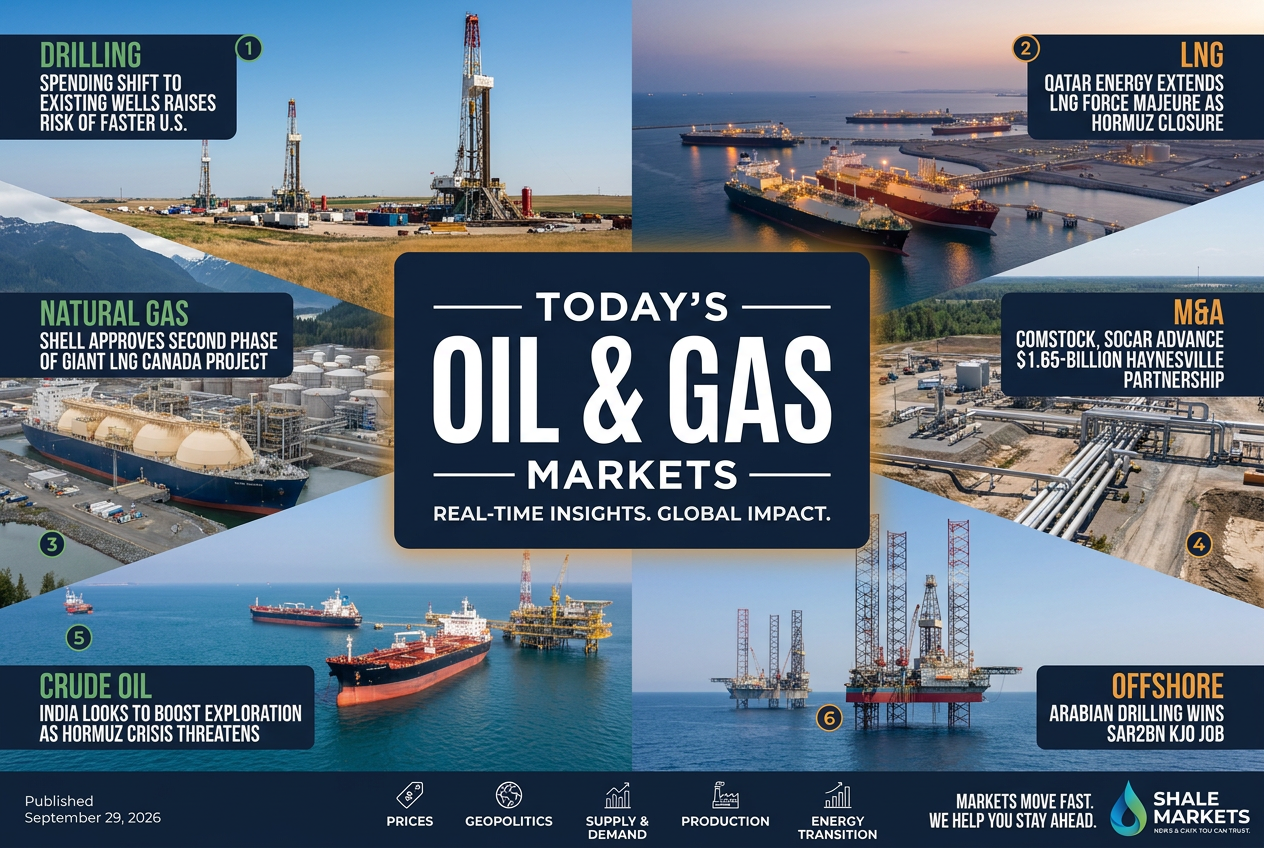
Drilling
Falling rig counts and 2026 capex cuts are pushing U.S. shale operators toward DUC inventories and existing wells, raising the risk of a faster production decline once that cushion runs out.
From Our Desk
The award points to continued jackup demand in Saudi Arabia and supports activity for offshore-focused contractors in the Gulf. For executives, it signals that regional operators are still committing capital to maintain or expand drilling capacity rather than pulling back.
Oil & Gas Middle East
The piece signals a low-cost production enhancement that could lift well performance without a major new drilling program. For operators, that kind of incremental gain matters because it can improve returns on existing acreage and influence completion equipment choices across comparable wells.
OGJ - Drilling & Production
lng
A prolonged force majeure at QatarEnergy signals tighter LNG availability from one of the world’s key suppliers and raises the risk of contract disruptions for buyers that rely on Gulf exports. It also shows how any sustained chokepoint risk in Hormuz can ripple through gas flows, shipping schedules, and near-term supply planning across Asia and Europe.
Energy Update
Proceeding with the second phase of LNG Canada signals more long-cycle capital being committed to export capacity, which matters for gas producers and midstream players that need new outlets for growing supply. It also tightens the link between Canadian upstream development and Asia-facing LNG competition, reinforcing Canada’s role as a future export basin.
Upstream Online
The framework agreement signals more capital being committed to Haynesville gas at a time when producers are still looking for the best outlet for incremental supply. The LNG marketing angle also suggests the basin could be tied more directly to export demand, which matters for takeaway capacity, pricing leverage, and who controls future gas volumes.
World Oil - Latest News
The FEED award advances Argent LNG’s proposed export project toward a final investment decision, which matters because it signals whether another Louisiana liquefaction site can secure engineering, permitting, and capital behind it. For executives, it is a read on Gulf Coast LNG buildout momentum and future competition for feedgas, EPC capacity, and export volumes.
OGJ - Pipelines and Transportation
crude-oil
India’s push to step up exploration signals a policy shift toward domestic supply security as the Hormuz risk exposes how exposed the country is to imported barrels and gas. For upstream operators and service providers, it points to a higher priority on acreage, drilling, and reserve replacement inside India rather than relying on volatile seaborne flows.
OilPrice.com
Rebounding Middle East exports point to a looser physical supply picture even with prices still firm, which matters for traders and producers watching how much spare capacity is actually reaching market. For executives, it signals that regional flows and shipping routes remain central to crude balance and to how quickly supply can offset disruptions.
The New York Times
Rerouting cargoes around the Cape shows how disruption in Hormuz can reshape tanker and shipping patterns, but it also highlights that extra miles do not automatically translate into a bigger bunkering or port-services payoff. For energy executives, the signal is that route risk is creating cost and logistics pressure across crude and product flows, while local beneficiaries may be overestimated.
OilPrice.com
The shrinking SPR signals the federal government has far less cushion to blunt a supply shock, which matters for traders and producers watching how much crude can be released in a disruption. It also highlights how past drawdowns have reduced a strategic backstop that can influence domestic supply balance and policy decisions.
OilPrice.com
The report signals that U.S. shale operators may be producing efficiently but still not adding enough reserves to sustain long-cycle growth, which pressures future capital allocation toward the basins and plays that can replace inventory. It also suggests gas remains better supplied than oil, a setup that could keep dry-gas operators and gas-rich acreage relatively more competitive in the near term.
OGJ - General Interest
Positive free cash flow at Tullow signals better self-funding capacity and less near-term reliance on outside capital, which matters for a producer that has been under pressure to keep debt and spending in check. The Ghana output gain also points to a stronger operating base in a core African asset, even if the headline tailwind from higher oil prices may not be durable.
cnbcafrica.com
Yangarra is deepening development in Alberta rather than simply holding acreage, which points to continued capital being directed toward repeatable inventory in a Canadian oil window. The higher well productivity also suggests the company is trying to improve returns and extend the life of the Belly River program.
World Oil - Latest News
Persistent drilling activity in Oklahoma signals that operators still see enough economics in the state to keep rigs working despite a broader cycle of capital discipline. For executives, that points to continued basin competition for rigs, services, and acreage attention in the Anadarko-focused part of the market.
Oklahoma Energy Today
Rising theft risk raises operating costs and can disrupt production, especially for smaller operators with limited security resources. It also signals that regulators are focused on protecting output and assets, which can affect field-level compliance and lease economics in Texas.
RigZone
refining
A U.S. diesel export ban would be a refinery and trade policy shock, not just a consumer-price story. It would likely force lower refinery runs, worsen domestic storage pressure, and tighten supply abroad, which matters for margins and export-oriented operators along the Gulf Coast.
OilPrice.com
exploration
Assuming operatorship gives Navitas more control over appraisal timing, capital deployment, and partner coordination on a large offshore exploration position. For executives, it signals that the Orange basin is moving from prospect inventory toward a drilling-led value creation phase, with material upside if the planned wells de-risk the resource estimate.
World Oil - Latest News
Venezuela is using its reworked hydrocarbons rules to pull back international capital, which signals a possible reopening of upstream spending after years of underinvestment. For operators like Eni, Chevron, and GeoPark, the point is not just access to reserves but a chance to secure early positions if production recovery gains traction.
World Oil - Latest News
Midstream
Lower pipeline build costs suggest midstream sponsors may be finding a better window to advance new takeaway and gathering projects. A jump in proposed projects points to stronger capital commitment to North American pipeline capacity, even as the sector still has to prove those plans can clear permitting, contracting, and execution risks.
OGJ - Pipelines and Transportation
offshore
The agreement points to another operator investing in lower-emissions field infrastructure rather than stepping back from offshore Brazil. For industry executives, it signals that the Campos Basin is still attracting capital for asset-life extension and efficiency upgrades, which can support continued production from mature offshore assets.
RigZone
An electrical fault forcing intervention at a Brazilian offshore field signals near-term production risk and the kind of operational disruption that can push operators to spend on repairs rather than growth. For executives, the key issue is whether the outage is contained or points to broader reliability exposure in the asset base.
Offshore Energy
oilfield-services
Real-time ESP sensor data points to more disciplined well interventions, with operators using downhole information to reduce risk and improve execution during kill operations. That matters because it can lower nonproductive time and protect producing assets, which is a direct operating-cost advantage in mature basins.
OGJ - Drilling & Production