At ShaleInsight 2026, Appalachian Producers Talk Pipelines and Power Contracts, Not Just Barrels
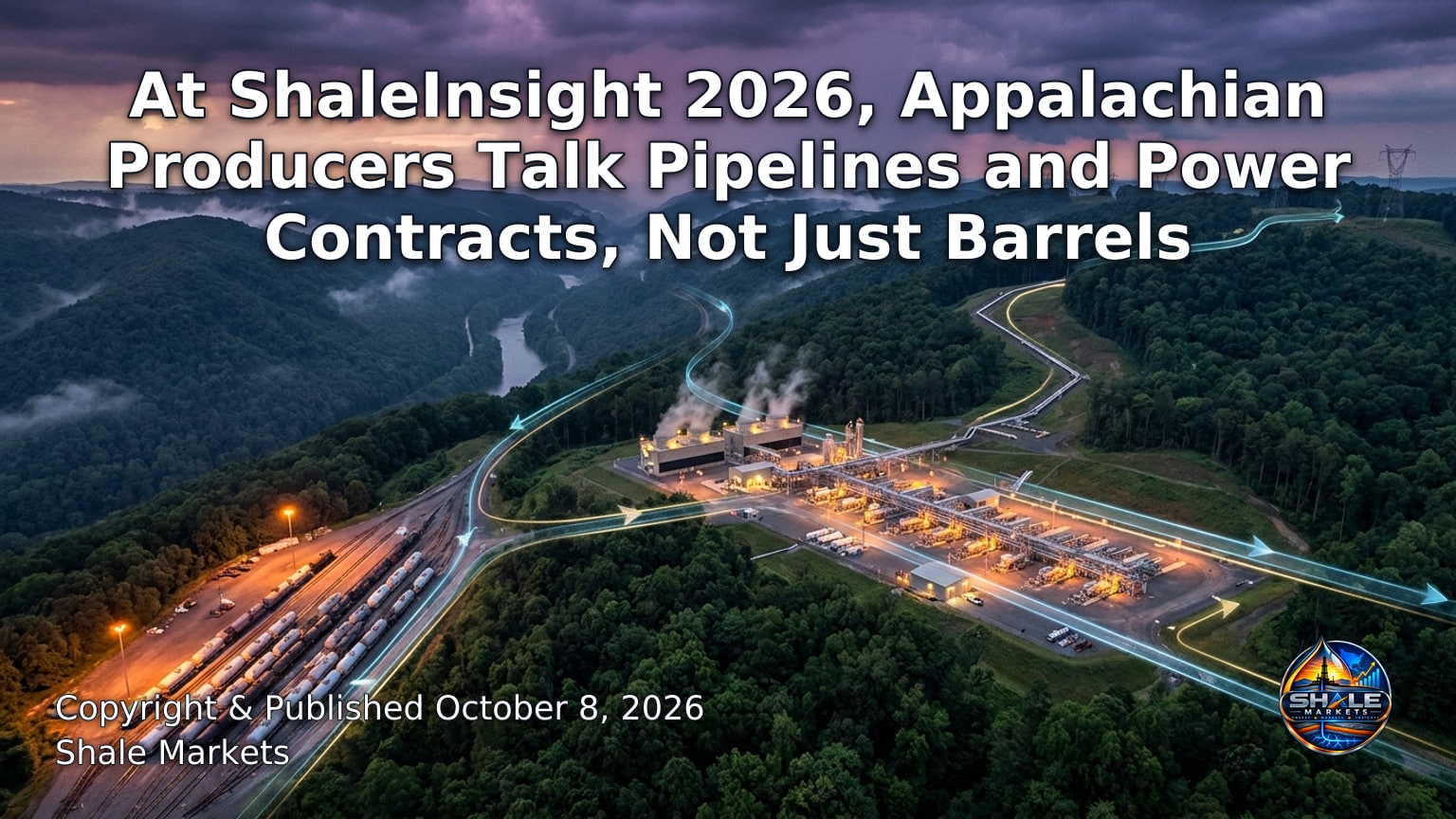
Original illustration created for Shale Markets.

Expand Energy is telling two different stories about Appalachia within the same two weeks. CFO Marcel Teunissen told Natural Gas Intelligence that the company is steering its LNG-linked growth toward the Haynesville rather than its home turf in the Marcellus and Utica, citing proximity to Gulf Coast terminals and fewer infrastructure bottlenecks. Nine days later, an AEGIS Hedging fundamentals report dated October 2 quoted Expand management saying it has "more appetite" to grow Appalachian volumes now that the company's Twin Eagle origination platform is in-house. Those are not easily reconciled positions from the same producer, and the gap between them is a reasonable proxy for how unresolved the basin's export math still is.
That tension sat underneath the Marcellus Shale Coalition's ShaleInsight 2026 conference, where MSC President Jim Welty told the room, in remarks published September 29, that "the leaders gathering here will determine what gets built next." The framing was pointed: Appalachian gas has the resource base. What it does not yet have, consistently, is a settled answer on where that gas goes next.
LNG, not power load, is what Expand is building toward
Teunissen was blunter about his own view of near-term demand than the conference remarks suggested. Speaking to NGI, he called his outlook on data center-driven power demand "bearish," predicting it would arrive more slowly than the market expects because of local resistance to new generation and transmission siting. He described LNG exports as the "most predictable and reliable predictor" of new gas demand.
The Haynesville prioritization that followed from that view is the more concrete fact: an operator with substantial Marcellus and Utica acreage choosing to grow its export-linked volumes somewhere else. The Twin Eagle comment four weeks later complicates, but does not reverse, that signal.
EQT and CNX take different approaches to the same guidance window
EQT has signed a 10-year supply contract tied to power prices rather than conventional gas benchmarks, Simply Wall St reported October 8, alongside raised 2026 production guidance of 2,375 to 2,450 Bcfe. That report is the only account of the contract available here, and it does not disclose a counterparty, a volume, a delivery hub, or a start date — details a trader pricing the structure would need before treating it as more than a headline.
CNX Resources held its 2026 guidance flat at 605 to 620 Bcfe, according to the same AEGIS Hedging report cited above, published October 2, choosing to manage the basin's wide price differentials rather than chase incremental volume. That figure likewise rests on a single hedging-advisory note rather than a CNX disclosure.
AEGIS put a number on the demand case for patience: it projects 4 to 6 Bcf/d of incremental power-sector gas demand across Appalachia and the Gulf Coast by 2030. That estimate is AEGIS's own and has not been checked against a second forecaster here.
M&A money is already betting on load, not acreage
Mercer Capital's October 1 review of Appalachian M&A activity from October 2025 through September 2026 found that transactions have shifted toward assets offering strategic alignment with gas-powered data center development, even as broad consolidation has slowed. The report named Alpha Compute as a buyer linking upstream gas acquisitions directly to data center real estate in Pennsylvania, describing the logic as securing "clean, affordable, and abundant energy resources" for hyperscale developers.
Buyers in these deals are not underwriting drilling inventory in the traditional sense. They are underwriting proximity to a power customer that has not finished building its own facility yet.
What the next twelve months settle
ClearView Energy Partners Managing Director Kevin Book framed the stakes in a keynote titled "Fragmentation, Fracking, and the Future," which the coalition's conference schedule described as examining U.S. production through the lens of "two wartime supply shocks in five years," tying Appalachian output to global energy security amid AI data center growth and reindustrialization.
EQT's power-indexed contract and CNX's flat guidance both read as hedges against an unresolved timeline rather than bets that it resolves soon.
Links Verified at Time of Publish.
Sources
This article was reported from the following sources.
- SHALE INSIGHT 2026 ® What Comes Next for Appalachia — Marcellus Shale Coalition, 2026-09-29
- Expand Energy Sees LNG Demand in Driver’s Seat as Data Center Resistance Grows — Natural Gas Intelligence (via Moomoo/Trade Feed), 2026-09-23
- SHALE INSIGHT® 2026 Schedule — Marcellus Shale Coalition, 2026-09-22
- Should Higher 2026 Output Require Action From EQT Stock Investors? — Simply Wall St, 2026-10-08
- Appalachian Basin Gas Price and Fundamentals Report — AEGIS Hedging, 2026-10-02
- Appalachian Basin Mergers and Acquisitions Update: October 2025 Through September 2026 — Mercer Capital, 2026-10-01
- SHALE INSIGHT® 2026 Convenes the Nation’s Energy, Tech Leaders — PR Newswire, 2026-09-16