Bakken Gas-to-Oil Ratios Hit a Record High, Testing North Dakota's 91% Capture Mandate Under Order 25417
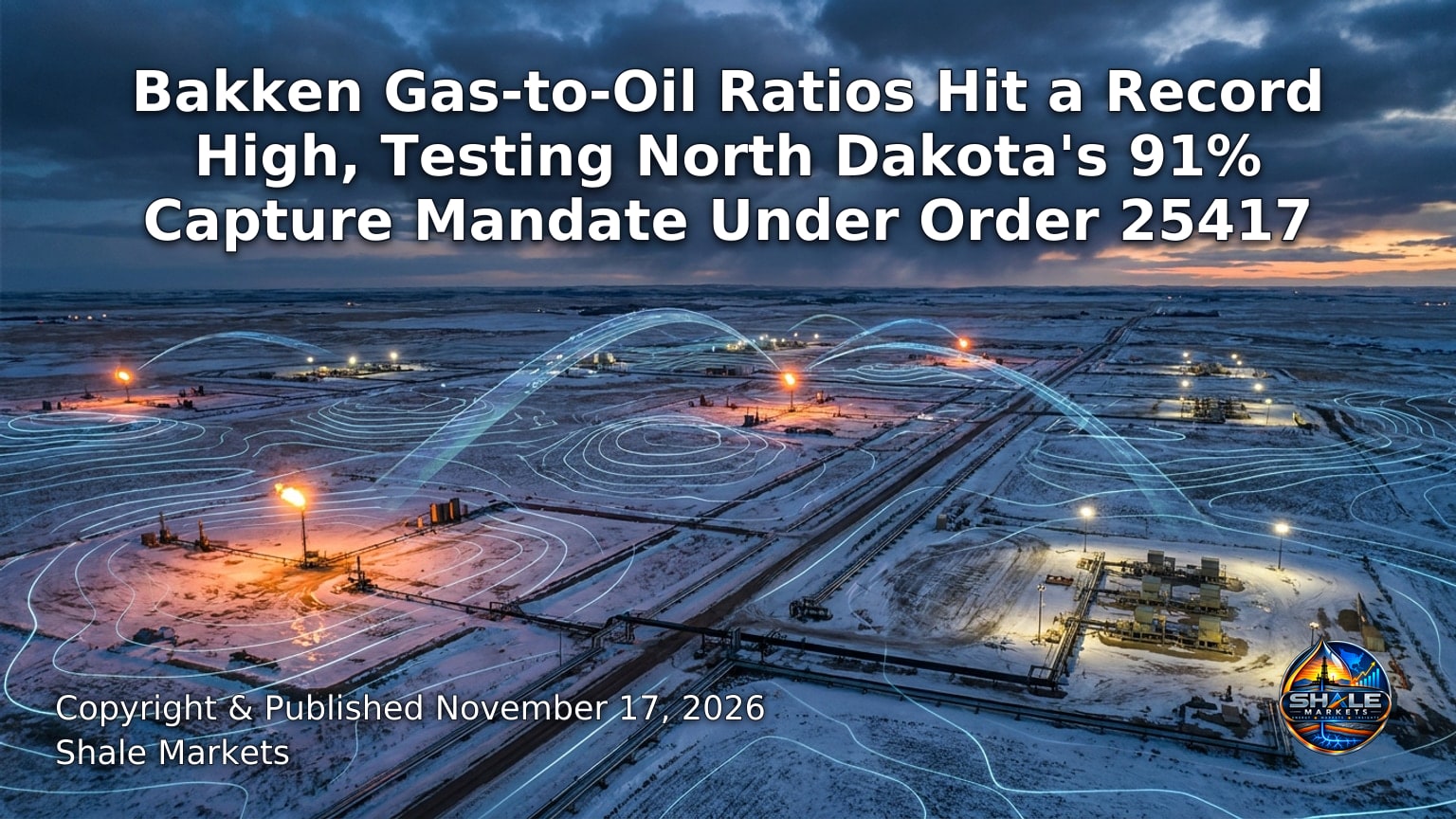
Original illustration created for Shale Markets.

Bakken Gas-to-Oil Ratios Hit a Record High, Testing North Dakota's 91% Capture Mandate Under Order 25417
The basin is producing more gas for every barrel of oil it lifts than it ever has, and the infrastructure built to move that gas has not kept pace.
Bakken East Reaches Its Final Investment Decision
The industry's answer to rising GORs reached a milestone this fall. RBN Energy reported on October 14, 2026 that the Bakken East Pipeline, a $3 billion intrastate project designed to move roughly 1 Bcf/d of gas to southeastern North Dakota, had reached a final investment decision — dating the sanction to later in the year than its own report, a detail RBN did not resolve further. Raptor Energy Partners put the project's cost at $3 billion in its October 16, 2026 outlook, corroborating RBN's numbers on both cost and capacity.
The North Dakota Pipeline Authority confirmed in a September 30, 2026 capacity update that the state has executed a ten-year precedent agreement for capacity on the project. Justin Kringstad, the authority's director, has said that without new gas pipeline infrastructure, rising GORs would reduce oil production, investment and state tax revenue.
That sequencing — a pipeline sanctioned only after the state's own infrastructure authority flagged production risk — tells you how close the basin was running to its gas-handling ceiling before the FID. Bakken East does not solve the problem by itself; it buys the basin incremental gas takeaway while the GOR keeps climbing underneath it.
The ratio that keeps climbing
Justin Kringstad told NGI he expects GORs to keep rising for years as operators move into gassier portions of the play. That is not a cyclical blip tied to a particular well or county — it is the trajectory of a maturing basin where associated gas grows faster than crude.
Bakken natural gas production reached 3.583 billion cubic feet per day in June 2026, according to Raptor Energy Partners' October 16, 2026 report — a figure that report presents without corroboration elsewhere in the record. Raptor noted gas output is growing faster than oil output. Oil, meanwhile, has settled into what Raptor called a "high plateau" of roughly 1.1 million barrels per day, with operators shifting capital from drilling toward gas takeaway and enhanced recovery.
Order 25417's conditioning requirement
The legal mechanism behind any crude restriction is not new. The North Dakota Industrial Commission's Order No. 25417, issued December 9, 2014, requires every well in the Bakken Petroleum System to be produced through equipment that separates gas from liquid hydrocarbons and caps crude vapor pressure at 13.7 psi at custody transfer. The order prohibits production from any well that is not in conformity with those conditioning standards, which is the regulatory basis for curtailing a well if the gas coming off it cannot be captured or conditioned properly.
The Commission has since amended that framework. Order No. 29398 lets the NDIC set oil conditioning requirements and test frequencies through policy guidance rather than a fresh rulemaking each time, according to the Department of Mineral Resources' public FAQ, published January 2019. In practice, that gives regulators a faster lever to pull as GORs rise, without the commission needing a new case docket for each basin-wide shift.
Operators are already budgeting around it
Drilling activity has not accelerated to match the price environment. Mark Bohrer, assistant director of the NDIC's Oil and Gas Division, said North Dakota operators are moving cautiously on ramping up activity despite oil trading at $96.60, according to EnergyNow.com on November 16, 2026, though the report did not specify which crude benchmark it was quoting. Most producers are holding to budgets set at the end of 2025, with Bohrer citing the regulatory environment and infrastructure limits as factors in the measured pace, even as completions could nudge output modestly higher.
That caution is consistent with a basin where the binding constraint has shifted from drilling economics to gas-handling capacity. An operator adding a well in a gassier section of McKenzie County today is adding associated gas volume that has to be conditioned, captured and moved before the crude can be sold at all — a different capital calculation than the one that governed the basin's growth years.
Crack the Code 2.0 takes a different approach
Governor Kelly Armstrong and industry leaders are backing a separate response: a $157 million enhanced oil recovery research initiative called "Crack the Code 2.0," the North Dakota Monitor reported November 17, 2026. The project uses gas injection to repressurize reservoirs and extract more oil from existing wells rather than drilling new ones. Chord Energy CEO Danny Brown told the Monitor that the Bakken's next era depends on overcoming infrastructure challenges and finding cost-effective ways to manage the field's maturing, gassier profile.
That framing is notable because it treats rising GOR not purely as a nuisance to be piped away, but as a resource to be reinjected. If gas injection scales, it could reduce the volume of associated gas that needs new pipeline capacity in the first place, while also lifting recovery from wells already drilled — though the research program is still in its early phase and has not yet produced field results.
What the compliance data actually shows
No document shows a specific well, lease or operator currently under a production cap tied to Order 25417. The margin between compliance and constraint is narrower than the headline capture rate suggests, and it narrows further every time the basin's GOR ticks up.
The Bakken East Pipeline's 1 Bcf/d of new capacity, once operational, will relieve some of that pressure. Whether it is enough depends on how fast the GOR keeps rising — a trajectory Kringstad has said he expects to continue for years, not quarters.
Links Verified at Time of Publish.
Sources
This article was reported from the following sources.
- Natural Gas Pipeline Capacity Update — North Dakota Pipeline Authority, 2026-09-30
- Director's Cut | July 22, 2026 - North Dakota Department of Mineral Resources — North Dakota Department of Mineral Resources, 2026-07-22
- Oil and Gas Contractor Services in North Dakota — Authority Network America LLC, 2026-01-01
- New Bakken Projects in North Dakota (2026–2030) — Raptor Energy Partners, 2026-10-16
- U.S. Oil Operators in North Dakota Cautious on Drilling Despite Price Rise — EnergyNow.com, 2026-11-16
- Bakken Gas-to-Oil Ratios Reach New Record as Natural Gas Pipeline Projects Advance — Natural Gas Intelligence (NGI), 2025-09-29
- North Dakota officials are jumpstarting next phase of effort to boost Bakken oil production — North Dakota Monitor, 2026-11-17
- BEFORE THE INDUSTRIAL COMMISSION OF THE STATE OF NORTH DAKOTA CASE NO. 23084 ORDER NO. 25417 — North Dakota Industrial Commission, 2014-12-09
- How Will I Know – Will a Newly Sanctioned Pipeline Give the Bakken a Big Surplus of Gas Takeaway? — RBN Energy, 2026-10-14
- Oil and Gas Division - North Dakota Department of Mineral Resources (FAQ) — North Dakota Department of Mineral Resources, 2019-01-01