
Shale Markets Briefing — August 25, 2026
Tuesday, August 25, 2026
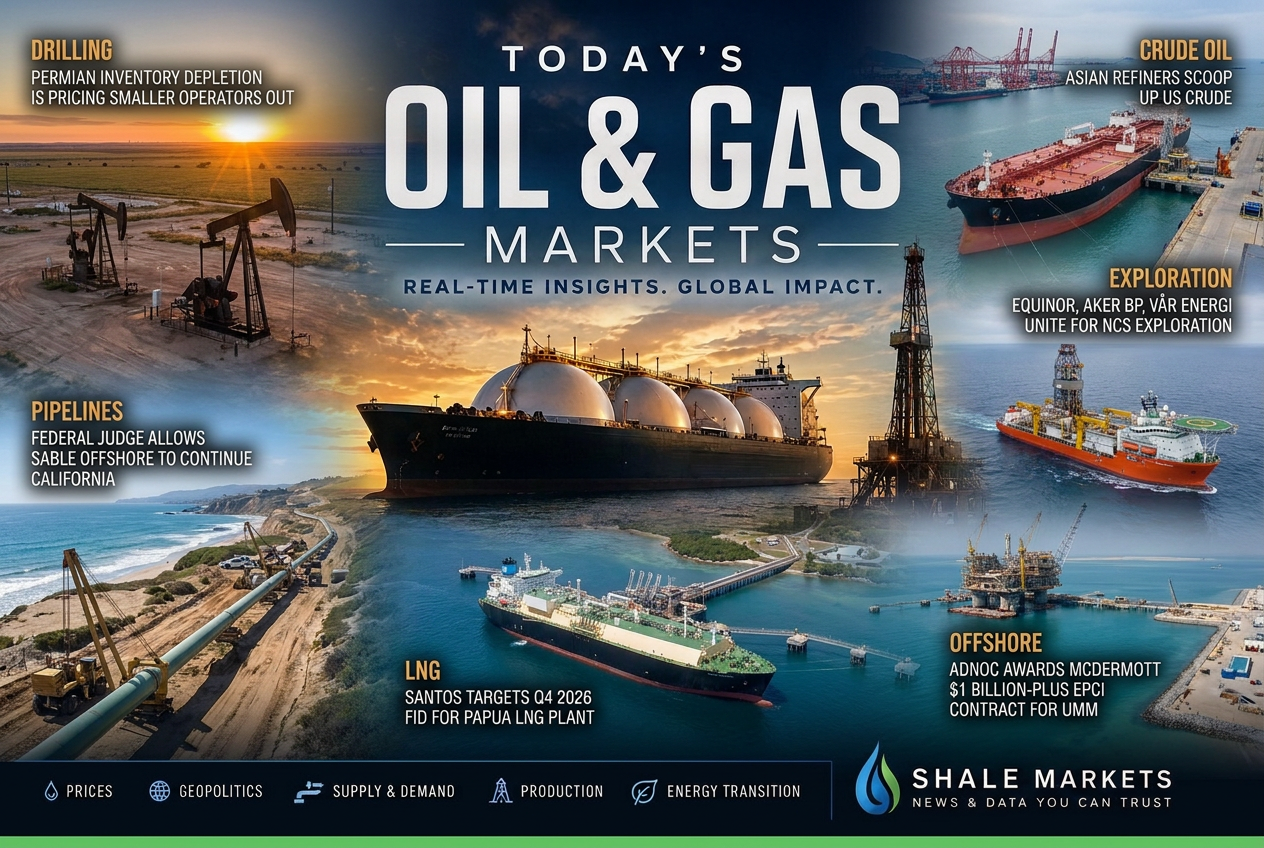
Today's briefing brings you 42 stories across drilling, crude oil, exploration and pipelines from across the global oil and gas market. Leading today: Permian Inventory Depletion Is Pricing Smaller Operators Out of the Market.
Drilling
The Birch and Paloma deals show that Permian consolidation is being driven by capital structure — private-equity exits meeting buyers with existing scale — rather than by new bidders chasing undeveloped rock.
From Our Desk
Norway is signaling that Arctic upstream investment will continue even if European policy remains cautious, which matters for executives watching future North Sea and Barents supply. It also reinforces that Norway intends to keep supporting Europe’s gas balance, preserving competition for capital and drilling activity in a region with strategic export value.
OilPrice.com
Exxon is using automation to improve drilling efficiency in the Permian, which signals continued capital focus on the basin even as operators look for lower-cost growth. For competitors, it underscores that technology and operational execution are becoming as important as acreage in lifting output.
Reuters
Ring is signaling that it can grow production in the Central Basin Platform while cutting capital intensity, which matters to operators competing for investor cash and planning drilling budgets. More horizontal and multi-bench activity points to a basin where efficiency gains can support output even as spending eases.
OGJ - General Interest
Additional funding for engineering and well work suggests Zephyr is trying to improve initial well performance before scaling the Paradox basin gas project. For executives, that signals continued capital is being directed into a U.S. gas play where early production results will influence development pace and commercial competitiveness.
OGJ - Pipelines and Transportation
Natural gas drilling that increases salinity in produced or nearby water can raise treatment, disposal, and compliance costs for operators. It also highlights an environmental liability that can affect permitting, basin access, and local opposition to development.
EurekAlert!
crude-oil
Asian buying of U.S. crude points to tighter competition for Atlantic Basin barrels and supports export flows out of the U.S. Gulf Coast. For refiners, it can improve crude placement abroad while adding pressure to domestic fuel markets if product balances remain tight.
RigZone
Higher U.S. output signals continued resilience in shale supply and suggests producers still have room to keep capital flowing into domestic drilling and completions. For executives, it points to a looser crude balance that can pressure pricing power while reinforcing the importance of low-cost basin positions.
The Institute for Energy Research
Movement in the Strait of Hormuz is a direct signal for crude flows and risk pricing, so any recovery in transit conditions can pressure oil back toward fundamentals before diplomacy with Iran changes the supply outlook. For executives, that affects near-term hedging, freight assumptions, and the relative appeal of holding higher-cost barrels off the market.
Crux Investor
Iran’s shrinking oil flows to Asia point to tighter export optionality and weaker leverage for Tehran in the face of sanctions pressure. For buyers and traders, scarce supply can lift delivered prices and reshape crude sourcing across the region.
RigZone
OECD stock levels are a direct read on how much oil is sitting in the system, which helps executives gauge whether the market is tightening or loosening. That affects price expectations, inventory strategy, and broader supply-demand planning across the sector.
OGJ - General Interest
The OECD import series is a direct read on how much demand developed economies are placing on OPEC barrels. For executives, it helps gauge the durability of OPEC market share and the likely balance between seaborne crude flows, pricing power, and competing supply.
OGJ - General Interest
Japan is signaling it can absorb a near-term decline in imports without tapping emergency stocks, which suggests officials see supply as manageable despite Red Sea rerouting risks. For traders and refiners, that points to less immediate support from strategic releases and a greater reliance on shipping and inventory management to balance flows.
OilPrice.com
Oil prices are soft despite fresh U.S. sanctions on Iran, which suggests the market is treating the measures as unlikely to remove enough supply to tighten balances. For executives, that points to a price environment still driven more by broader demand and inventory sentiment than by headline sanctions risk.
Yahoo Finance
Higher oil prices are cushioning the market reaction to a production halt, which tells executives investors are still pricing in commodity leverage even when output is interrupted. For operators with exposure to the region, the focus shifts to how long the outage lasts and whether price strength can offset lost barrels and near-term cash flow pressure.
Investing.com
The piece signals that traders may be overpricing a Hormuz disruption if the market can absorb it with a relatively modest oil premium. For executives, that points to less urgency in defensive supply positioning and a greater focus on how geopolitical risk is being translated into forward prices.
24/7 Wall St.
Basra oilfield service contractors signaling a halt over currency losses points to rising pressure on local service economics and the risk of operational disruption in southern Iraq. For operators and procurement teams, it signals tighter service availability and potential cost escalation in a key producing region.
شفق نيوز
exploration
The joint push by three major Norwegian North Sea producers signals a shared effort to keep new reserves flowing in a mature basin. For executives, it points to capital being used more selectively and collaboratively to extend production life rather than chase growth through standalone campaigns.
OGJ - General Interest
A large gas find in Iran points to additional long-cycle supply that could support domestic energy security and future export optionality if sanctions and development constraints ease. For executives, it also reinforces that Middle East gas remains a strategic reserve base even when capital access is limited.
OilPrice.com
A new North Sea gas find supports continued investment in mature offshore basins and can help offset declining volumes elsewhere in the region. For producers, it signals that exploration still has value in Europe’s gas market as supply security remains a commercial priority.
OilPrice.com
Petrobras is signaling that it is still willing to commit capital to frontier acreage outside its core Brazilian portfolio to rebuild its resource base. For competitors and service providers, the talks point to renewed basin interest offshore Ghana and a potential opening for future exploration spending in West Africa.
World Oil - Latest News
pipelines
The ruling reduces legal risk around restarting a constrained California pipeline system and signals that federal authority can override state efforts to slow infrastructure use. For operators and investors, it supports the view that legacy assets can still generate value when they secure federal backing, even in a difficult permitting and environmental climate.
OGJ - Pipelines and Transportation
lng
Santos is moving a major Papua LNG project toward a final investment decision, which signals continued capital commitment to long-cycle LNG supply in Asia-Pacific. For executives, the tolling link to existing PNG LNG capacity also shows how developers are using operating infrastructure to lower execution risk and improve project economics.
OGJ - Pipelines and Transportation
The deal would bring feed gas for GLNG under equity control rather than relying only on contract supply, which supports long-term plant utilization and gives Santos tighter control over basin economics. It also signals continued investment in Australian gas assets as LNG operators look to secure their own upstream volumes.
RigZone
The UK is signaling that declining domestic output may push it toward more imported gas, which would alter supply security and investment priorities for the broader North Sea market. For executives, the bigger issue is that tighter limits on new offshore development could deepen dependence on LNG and weaken the basin’s competitive position.
World Oil - Latest News
China’s latest planning signal points to a modestly higher LNG import need, which supports long-term contracting and terminal utilization decisions rather than a major near-term shift in Asian pricing. For suppliers and traders, it suggests China remains a steady demand anchor, but not one large enough here to materially tighten the regional market balance.
Kpler
The project adds small-scale LNG and NGL output in Gabon, which points to incremental monetization of gas and better use of existing terminal infrastructure. For executives, it signals continued capital being directed toward niche LNG supply outside the major export centers and a modest lift to regional gas availability.
OGJ - Pipelines and Transportation
A new floating LNG project under consideration in Nigeria points to continued interest in monetizing gas through export infrastructure rather than leaving volumes stranded. For executives, it signals possible future demand for capital, offshore development support, and LNG capacity in a key African gas market.
Upstream Online
offshore
ADNOC is committing major capital to offshore production infrastructure, which signals continued investment in gas recovery and field optimization rather than a pause in spending. For contractors and service companies, the award reinforces the UAE’s role as a steady source of large upstream work in the Middle East.
World Oil - Latest News
petrochemicals
A sale of Shell’s U.S. chemicals unit would signal more capital recycling across the integrated majors as they narrow portfolios toward higher-return assets. For executives, the bidding interest from Exxon and financial buyers shows petrochemicals remains a strategic asset class even as companies reassess exposure to slower-growing, more cyclical downstream businesses.
OilPrice.com
refining
The disruption of Russian refining underscores how vulnerable domestic fuel balances can become when downstream assets are attacked, and it raises the risk of tighter product availability and more state intervention. For an industry executive, it signals continued stress on Russia’s ability to keep gasoline and diesel flowing while refinery runs are restored.
OilPrice.com
Diesel prices and availability are a direct read-through on freight, industrial demand, and refinery margins, so a move here signals stress that can ripple across the broader fuel market. For an executive, it points to tighter product balance and potential shifts in where capital is directed within refining and logistics.
Axios
Nigeria is becoming a more important supplier in the seaborne products market as new refinery output lifts exports. For executives, that points to shifting Atlantic Basin trade flows and a potential easing of product tightness that can affect margins and sourcing strategies.
EIA Today in Energy
natural-gas
The contract locks in a long-term outlet for Norwegian gas into Germany, reinforcing Europe’s need for secure supply as buyers replace more volatile sources. For executives, it signals that downstream utility and trading counterparties are still willing to commit to multi-year gas volumes, supporting upstream cash flow visibility and market share in the region.
RigZone
Europe’s fertilizer vulnerability is not only a gas-price problem but also a potential feedstock and industrial logic problem. If biogas sites can supply fertilizer inputs locally, it could reduce exposure to imported ammonia chains and strengthen the economics of rural energy and waste assets.
OilPrice.com
The EIA’s slightly softer near-term demand outlook suggests less support for fuel and power consumption next year, which can temper expectations for upstream and midstream volumes. The modest uptick in the following year points to a still-stable U.S. demand base rather than a sharp change in the commodity balance.
RigZone
Markets
The leadership change at Texas’s main oil regulator matters because it can influence how operators read the state’s policy and enforcement posture. Executives across production, drilling, and infrastructure will watch for any shift in regulatory tone that affects permitting, compliance, and capital planning.
RigZone
power
The start-up adds to Masdar’s operating battery storage fleet in the UK and shows continued capital deployment into grid flexibility assets rather than upstream oil and gas. For executives, it signals that utility-scale storage is becoming a larger part of the competitive and financing landscape in European power markets.
RigZone
carbon-capture
This signals how a major UK local political decision can affect North Sea drilling prospects and the conditions attached to new supply. For executives, the key issue is whether project approvals remain tied to carbon capture and broader net-zero constraints, which shapes capital allocation and the competitiveness of UK upstream assets.
The Guardian
transportation
Higher fuel prices in southern Afghanistan signal tighter local energy access and added cost pressure for transport, households, and any businesses dependent on imported oil products. For executives with regional exposure, it is a reminder that supply disruptions and weak market infrastructure can quickly translate into volatile pricing and operating risk.
8AM Media
oilfield-services
This points to investor attention on companies tied to oilfield activity when supply risk is a market concern. For executives, it signals that capital can rotate toward service names and other exposed operators when traders expect tighter crude balances.
simplywall.st
production
This is a comparison of ExxonMobil’s quarterly performance against other diversified upstream peers, which signals how capital is being rewarded across the large-cap E&P set. For executives, the relevance is in benchmarking margin, cash flow, and investor positioning relative to the industry’s most visible operator.
StockStory