
Shale Markets Briefing — September 2, 2026
Wednesday, September 2, 2026
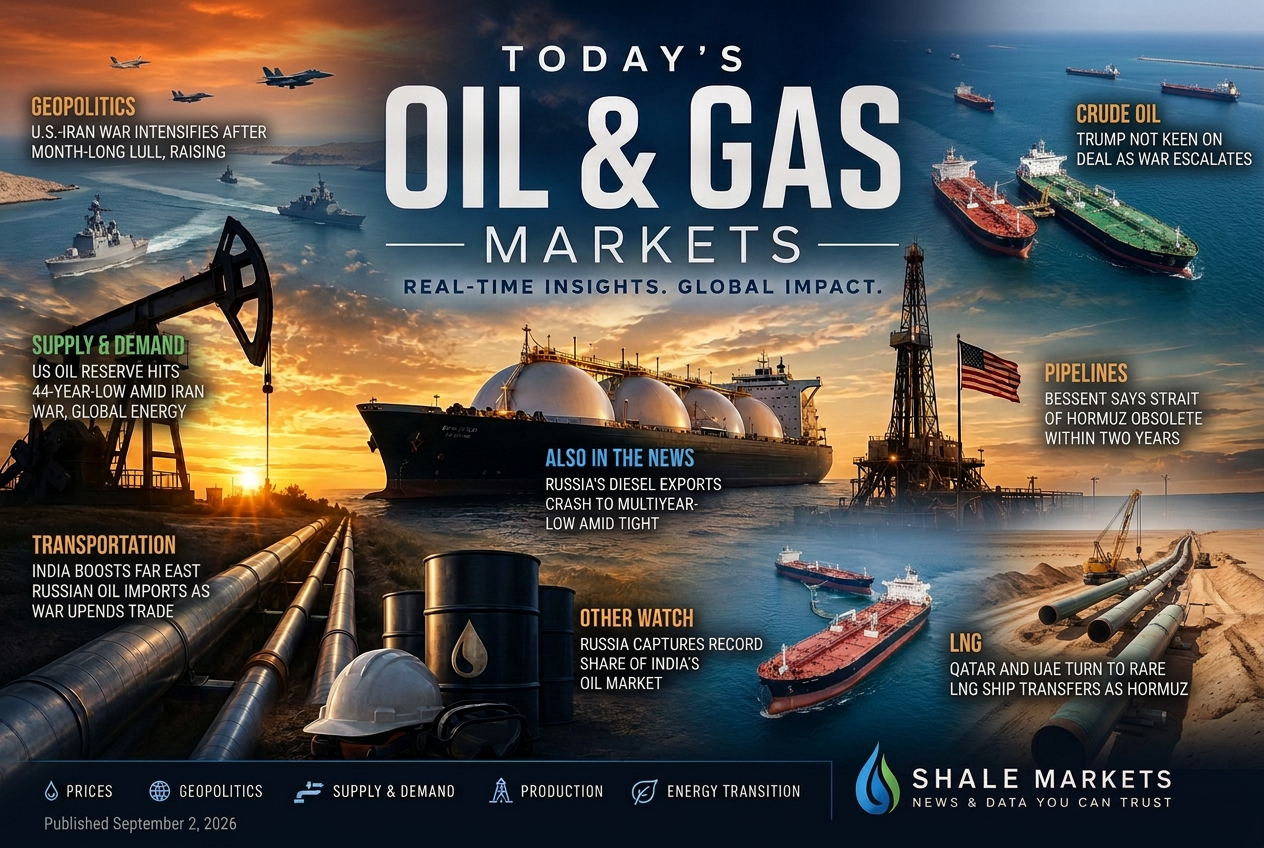
Today's briefing brings you 37 stories across crude oil, pipelines, lng and nuclear from across the global oil and gas market. Leading today: U.S.-Iran war intensifies after month-long lull, raising energy prices and inflation fears - The Globe and Mail.
Markets
The renewed fighting raises the risk of supply disruption and a higher risk premium across crude and refined products. For executives, it points to tighter attention on hedging, inventory, and exposure to wider Middle East escalation feeding inflation and demand uncertainty.
The Globe and Mail
The summit underscores how China, Russia and Iran are using regional diplomacy to deepen political and economic alignment outside US-led structures. For energy executives, that points to a tighter link between geopolitics, sanctions exposure and market access across Eurasia and the Middle East.
OilPrice.com
crude-oil
Escalating U.S.-Iran conflict raises the risk premium across crude and tanker markets and puts Middle East supply and transit routes back at the center of trading decisions. For executives, it signals potential volatility in prices, freight, and sanction exposure rather than a demand-led move.
RigZone
A depleted U.S. reserve tightens the margin for supply shocks and raises the stakes for how quickly barrels can be released if crude markets spike again. For executives, it signals a more fragile domestic backstop and a stronger link between geopolitical risk and near-term price support.
Yahoo
India’s increased buying of ESPO shows how disruption in Middle East flows can redirect crude demand toward alternative supply corridors. For refiners and traders, it underscores that Russian Far East barrels remain competitive when regional logistics tighten and spot availability shifts.
OilPrice.com
The reported U.S.-Venezuela deal matters because any easing of constraints on Venezuelan barrels would affect global crude supply and reshape where capital is directed in Latin America. For executives, it signals a potential shift in production outlook and competitive positioning for supply tied to sanctioned or politically sensitive sources.
RigZone
Potentially higher Venezuelan output would add barrels to a market that has been constrained by underinvestment and sanctions, which matters for pricing and for where traders expect incremental supply to come from. The mention of U.S. and foreign deals also signals a possible shift in capital allocation toward a higher-risk producing country with significant heavy crude potential.
OilPrice.com
Russia’s inability to keep refinery output steady is forcing it to look outside its own system for processing capacity, which signals strain in domestic fuel supply and export management. For executives, the bigger issue is that sustained disruption can alter regional crude flows, pressure margins, and strengthen the case for downstream and logistics diversification.
OilPrice.com
BSR’s move to expand Dung Quat signals continued capital being directed into refining capacity and product quality rather than upstream growth. For operators and traders, the project points to a more flexible supply source in Vietnam that could alter regional crude sourcing and clean-products competition.
OGJ - Refining & Processing
India's largest upstream producer moving into strategic crude storage signals a stronger state-backed role in supply security and inventory management. For executives, it suggests capital is being directed toward buffering import exposure and tightening the link between domestic production, reserves, and broader crude market resilience.
RigZone
Higher Iraqi crude exports indicate producers are leaning on sales volumes to support revenue as weaker prices attract demand. For refiners and traders, it points to more Middle East barrels competing in the market and adds pressure to regional crude balance.
Reuters
Chinese crude demand and inventory behavior can influence the global price floor, so any sign it is suppressing rallies matters for revenue assumptions and hedging across the industry. Executives should read this as a signal to watch Asia demand and broader supply-demand balance rather than assuming geopolitics alone will drive prices higher.
Yahoo! Finance Canada
Chevron's plan to expand in Venezuela signals that some international oil companies still see value in re-entering or growing in sanctioned and politically sensitive barrels. For executives, it points to potential shifts in capital allocation toward low-cost crude exposure and a small but notable easing in the competitive constraints around Venezuelan supply.
WQAD
U.S. crude balance remains tight as commercial stocks fall while SPR barrels continue to backfill the market. For executives, that points to a firmer near-term pricing backdrop and shows government inventory management still has a direct effect on physical supply dynamics.
OilPrice.com
Storms in the Gulf can force temporary shut-ins, evacuations, and logistics disruptions across offshore oil and gas operations. For executives, the key issue is near-term supply risk and whether the event materially affects Gulf production, processing, or pipeline flow.
RigZone
pipelines
A faster route around Hormuz would reduce a major chokepoint risk for Gulf exporters and weaken the leverage of any actor able to disrupt tanker traffic there. For oil executives, it points to more capital shifting into pipelines and export infrastructure that can re-route barrels away from the strait.
OilPrice.com
lng
The story signals that Gulf producers are taking operational steps to keep LNG moving despite heightened risk around the Strait of Hormuz. For executives, it highlights how geopolitics can force shipping and logistics changes that affect export reliability, freight costs, and regional supply security.
OilPrice.com
Pakistan’s refusal to buy an overpriced spot LNG cargo shows how strained utilities can be forced to choose between fuel affordability and outage risk. For producers and traders, it signals weaker emergency demand in South Asia and continued price sensitivity in a market where supply is tight enough to command premiums.
OilPrice.com
Russia is increasing the number of tankers available to move LNG from a sanctioned Arctic project, which shows how exporters are adapting shipping logistics to keep volumes moving despite restrictions. For executives, it signals continued pressure on LNG trade flows, vessel availability, and sanctions enforcement in global gas markets.
RigZone
Higher LNG export volumes should tighten the U.S. gas balance, but the article signals that domestic prices are still being capped by ample supply and the market’s ability to absorb more production. For executives, that points to continued support for liquefaction-linked gas demand without an immediate broad-based price lift for upstream sellers.
Natural Gas Intelligence
Higher LNG exports lifted Petronas’ first-half profit, showing that gas and product realizations still matter to upstream and integrated majors even when broader market conditions are uneven. For executives, it signals that exposure to LNG remains a useful counterweight to weaker oil-linked earnings and supports continued capital focus on gas-linked assets in Asia-Pacific.
RigZone
nuclear
Saudi Arabia is trying to shift domestic fuel demand away from crude and liquids, which would leave more barrels available for export and improve the kingdom’s flexibility in managing supply. The nuclear agreement also signals a longer-term capital shift into non-hydrocarbon power that could reshape electricity and fuel demand across the region.
OilPrice.com
Corpus Christi’s selection signals that major U.S. industrial sites are being considered as anchor customers for small modular reactors, which could open a new source of power demand tied to heavy energy users. For oil and gas executives, it matters because port and midstream hubs may start competing on access to low-carbon firm power as a factor in long-term capital planning.
OilPrice.com
oilfield-services
AI spending in oil and gas is moving from a back-office efficiency story to a capital allocation question for operators and service companies. If AI reduces labor and field activity tied to existing contracts, executives will need to decide where to deploy it first and how to protect margins as the value chain shifts.
RigZone
Ranger is using a modest acquisition to deepen its exposure to U.S. completion activity, which can improve utilization in two core shale basins. The deal suggests continued consolidation in pressure-pumping and coiled tubing services as operators favor providers with scale and local density.
World Oil - Latest News
natural-gas
Methanex’s decision to stop New Zealand output highlights how upstream gas availability can quickly reshape industrial demand for feedstock and force producers to reallocate capital away from constrained markets. For executives, it is a reminder that supply security is now a competitive issue for methanol and gas-linked manufacturing outside the core producing basins.
RigZone
data-centers
SLB is deepening its exposure to data-center infrastructure, which shows how oilfield-services companies are reallocating capital toward power and digital demand rather than only upstream spending. For executives, the deal signals a broader push to diversify revenue and compete for growth adjacent to the energy transition.
RigZone
power
Record U.S. storage additions signal that utilities and grid operators are committing more capital to flexibility assets as power demand rises and reliability concerns deepen. For energy companies, that points to stronger competition between batteries and other dispatchable resources in shaping the future load mix.
OilPrice.com
Midstream
The deal signals that operators are still paying up for scale in the Permian midstream network, especially where processing capacity and system connectivity support future gathering volumes. For executives, it underscores that basin infrastructure remains a strategic capital target as producers and processors position for growth in natural gas and NGL flows.
OGJ - General Interest
production
Capricorn is effectively choosing between two partners already active in Kurdistan to back its move into Egypt, which signals how regional incumbents are using asset swaps and corporate bids to extend their footprint. For executives, this is a reminder that capital is still chasing entry points in Africa and the Eastern Mediterranean where operators can convert deal access into new production exposure.
RigZone
exploration
The study signals fresh capital and technical attention toward onshore Sabah, which can help determine whether the basin deserves a larger exploration push. For executives, it is a marker of where Petronas and service providers are directing prospecting effort in Southeast Asia.
World Oil - Latest News
offshore
The approval removes a key closing risk for a larger offshore services platform and signals continued consolidation in a segment where scale and vessel utilization matter. For executives, the deal suggests customers and investors are still rewarding balance-sheet strength and broader service footprints in offshore activity.
World Oil - Latest News
Offshore operators are treating hurricane preparation as an asset integrity and uptime issue, not just a seasonal weather problem. The emphasis on predictive maintenance signals continued spending on monitoring and reliability work to protect production and reduce downtime risk in exposed basins.
World Oil - Latest News
The piece highlights that offshore assets are becoming a cyber risk surface as operators add automation and connectivity. That raises the cost of protecting production, supports spending on industrial security systems, and can influence where companies are willing to deploy capital offshore.
OGJ - General Interest
refining
Ongoing disruption at a major South African refinery signals continued pressure on domestic fuel supply and may keep import reliance elevated if the unit stays constrained. For executives, it is a reminder that operational reliability in downstream assets can affect regional margins and product availability even without a full shutdown.
RigZone
Gross refining margins are a direct signal for how much value US refiners can capture from crude-to-product spreads, which affects run rates, maintenance timing, and capital allocation across the downstream sector. For executives, this is a read on whether refining conditions are supporting stronger cash generation or pressuring margins in the US market.
OGJ - Refining & Processing
Drilling
Falling rig counts in North America point to a softer near-term drilling program and a more cautious capital stance across the region. That can slow production growth expectations and shift competitive focus toward the most efficient basins and operators.
RigZone