Shale Markets Briefing — September 3, 2026
Thursday, September 3, 2026
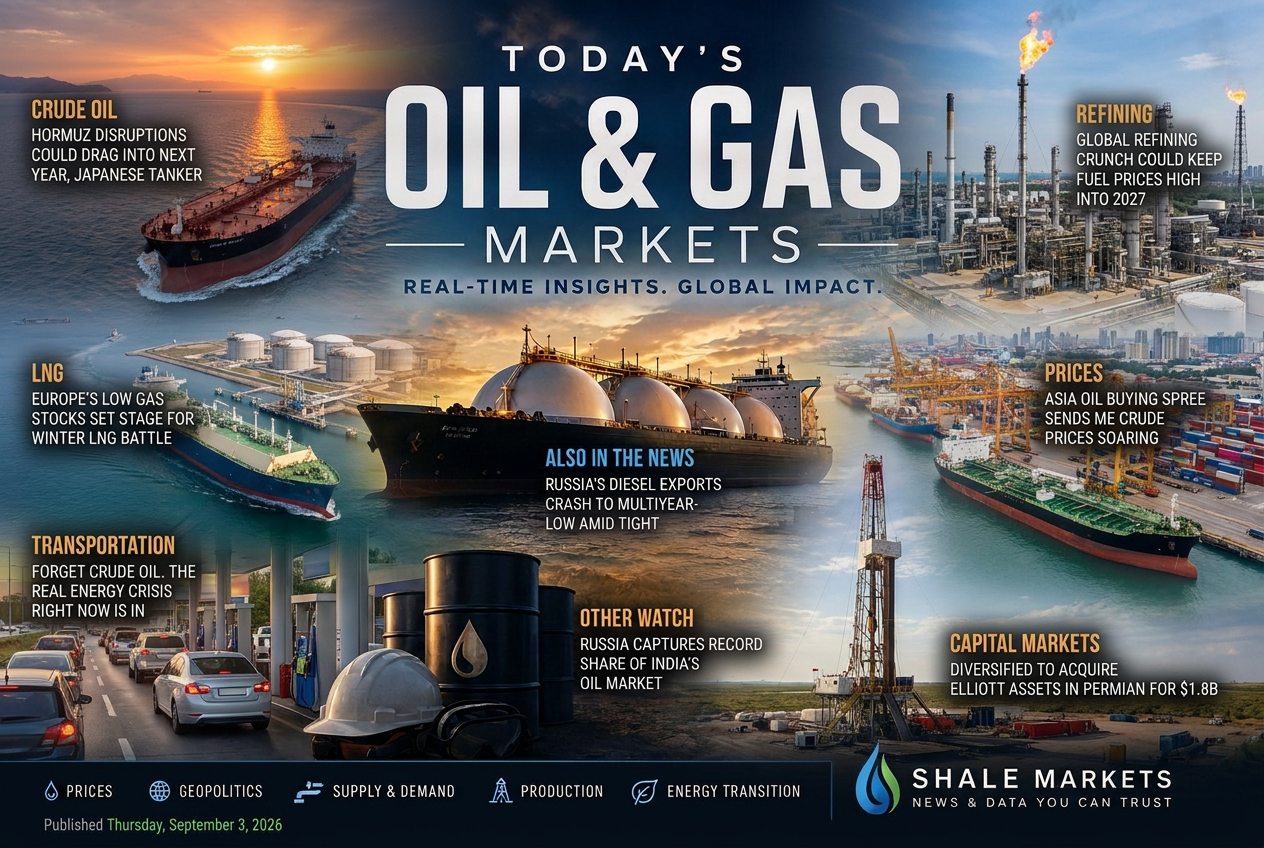
Today's briefing brings you 17 stories across crude oil, refining, lng and natural gas from across the global oil and gas market. Leading today: Hormuz Disruptions Could Drag Into Next Year, Japanese Tanker Giant Warns.
crude-oil
Extended disruption at the Strait of Hormuz raises the risk of higher freight costs and longer voyage times for crude and product flows moving out of the Gulf. For refiners, traders, and tanker owners, that keeps Middle East export routes exposed and can tighten seaborne supply even if underlying oil demand is steady.
OilPrice.com
Stronger spot buying from India and China points to firmer near-term crude demand in Asia and tighter pricing for Middle Eastern grades. For producers and traders, it signals improved outlet strength in a key export market and better leverage for sellers of regional barrels.
RigZone
The deal adds another sizable Permian consolidation trade, which signals that private and strategic capital still sees value in long-life shale inventory despite a tougher financing backdrop. For executives, it points to continued competition for basin positions and a willingness to use partnership structures to fund acquisitions.
RigZone
Iraq’s heavier use of the Hormuz route points to a near-term increase in accessible supply for Asian buyers and a reminder that regional chokepoints still shape export flows. For refiners, the discounts suggest more competitive crude economics, while for producers it signals a push to place barrels into a market that can absorb them quickly.
OilPrice.com
A thinner U.S. oil buffer means prices will be more exposed to any supply disruption, especially when geopolitical risk in the Middle East is already tightening the market. For executives, this points to more volatile feedstock costs and a stronger case for inventory discipline and hedging.
OilPrice.com
Public criticism of oil executives over pricing signals a tougher political and regulatory backdrop for the sector. For operators, the risk is heightened scrutiny of pricing behavior and a less forgiving environment for capital deployment and margin protection.
Madison's News/Talk Station
Chevron’s planned spending in Venezuela signals continued capital commitment to a politically constrained but resource-rich basin, which could support local output and keep the company positioned if access conditions hold. For competitors and suppliers, it is a reminder that capital is still being directed to sanctioned or high-risk geographies where future barrels may be relatively advantaged.
RigZone
Woodside’s move to broaden its cooperation with Pemex signals that more capital and technical attention may be directed toward Mexico’s offshore acreage beyond Trion. For executives, it suggests additional competition and possible reserve replacement opportunities in a basin where partnership structures will matter.
RigZone
refining
Refining outages in the Middle East and Russia point to a tighter global fuel balance, which supports elevated product margins for refiners with available capacity. For executives, the signal is that fuel pricing risk and supply disruption remain a capital allocation issue well beyond the immediate conflict window.
OilPrice.com
Diesel tightness signals a refined-products squeeze rather than a crude-only problem, which can pressure freight, industrial activity, and margins for refiners and fuel suppliers. For executives, it points to a need to watch refining utilization, distillate inventories, and regional supply routes rather than just upstream oil prices.
NBC News
lng
Europe’s depleted storage means utilities and traders will need to secure more LNG against Asian buyers, which can lift spot pricing and widen the pull on flexible cargoes. For producers and portfolio players, this points to stronger winter demand for LNG but also higher volatility in delivered margins and destination competition.
OilPrice.com
Higher U.S. LNG exports point to more gas moving into the global market as liquefaction capacity comes online. For executives, that supports stronger Gulf Coast midstream utilization and tighter competition for feedgas, while also reinforcing the U.S. role in balancing international LNG supply.
EIA Today in Energy
natural-gas
SOCAR’s entry into Haynesville signals continued international capital interest in U.S. gas shale, with the basin drawing investment tied to supply growth and LNG-linked demand. For operators and rivals, it points to stronger competition for acreage and a possible lift in transaction values for producing gas assets.
RigZone
Persistently high ERCOT demand signals sustained pressure on Texas power markets and raises the value of flexible generation, gas-fired supply, and grid infrastructure. For oil and gas executives, it is a reminder that heat-driven load growth can tighten the regional balance and influence power-sector fuel demand.
EIA Today in Energy
South Korea’s plan to merge state-run energy firms signals a push to reshape public-sector capital spending and reduce duplication in a market where power demand is rising. For executives, it points to a more centralized state role in the energy system and potential changes in how upstream and gas assets are managed.
RigZone
exploration
Shell is using minority farm-ins to widen its exploration portfolio in two high-profile offshore basins without taking on full block risk. For executives, that signals continued capital discipline alongside a push to secure optionality in Brazil and the U.S. Gulf if exploration results justify follow-on spending.
World Oil - Latest News
transportation
MOL’s consolidation of its ship management subsidiaries points to tighter control over fleet operations and a push for more consistent safety standards across its maritime business. For executives, this signals a preference for operational efficiency and risk management over fragmented service structures.
RigZone