Shale Markets Briefing — September 8, 2026
Tuesday, September 8, 2026
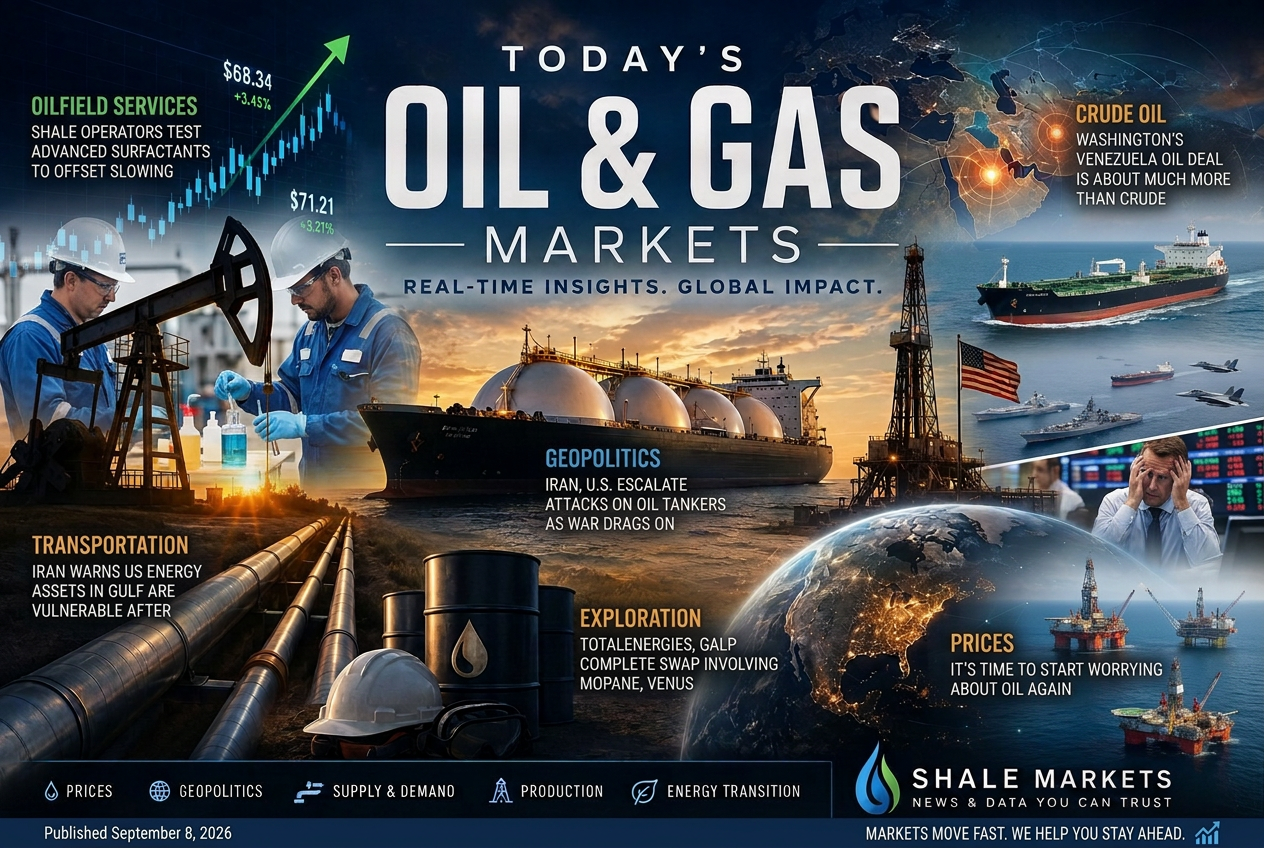
Today's briefing brings you 26 stories across oilfield services, crude oil, exploration and lng from across the global oil and gas market. Leading today: Shale Operators Test Advanced Surfactants to Offset Slowing Well Productivity Gains.
oilfield-services
ConocoPhillips, Diamondback and Devon are expanding surfactant chemistry programs in the Permian Basin as per-well productivity gains from drilling design alone begin to slow.
From Our Desk
crude-oil
This signals that Venezuela’s upstream resources are being pulled into a broader geopolitical and policy contest, not just a commercial crude transaction. For executives, it points to changing control over future barrels, potential shifts in trade flows, and a reminder that access to reserves can be reshaped by sanctions and diplomacy as much as by geology.
OilPrice.com
The warning raises the geopolitical risk premium on Gulf energy flows and reminds operators that regional tensions can quickly threaten upstream, midstream, and shipping assets tied to the world’s oil supply. For executives, it underscores the need to protect exposure routes and factor security risk into trading, contracting, and capital plans.
Reuters
Escalating attacks on tankers raise the risk premium for crude flows through the region and threaten shipping reliability for exporters and refiners that depend on those routes. It also signals that energy infrastructure and maritime logistics are becoming direct leverage points in the conflict, which can quickly tighten supply and unsettle pricing.
World Oil - Latest News
The piece signals that oil market fundamentals are tightening enough to matter again for capital planning, with a likely impact on upstream budgets, hedging, and asset allocation. Executives should read it as a reminder that crude price risk can quickly reshape spending priorities and competitive positioning across the supply chain.
AFR
GeoPark’s entry into Venezuela signals that capital is still finding a path into politically complex basins when the resource base and redevelopment upside are large enough. For executives, the bigger implication is potential incremental supply from an underdeveloped asset, which can affect regional competitive positioning and long-term production portfolios.
RigZone
The message is that Russia still expects to keep its crude flowing into India even as Washington considers secondary pressure on buyers. For refiners and traders, that points to continued discount-driven trade shifts and a risk of further disruption if tariff threats start changing procurement patterns.
OilPrice.com
The first cargo from Vostok Oil shows Rosneft is still moving major new barrels into market despite sanctions and the loss of Western partners. For executives, it signals added Russian supply potential from Eastern Siberia and a reminder that capital is still being deployed into long-cycle upstream projects with export implications.
OilPrice.com
China’s rebound in crude imports points to firmer refinery demand and a shift toward non-Middle Eastern barrels, which matters for exporters competing for those flows. The jump in fuel exports also signals that Chinese refiners are running more product through the system, supporting regional product balances even as crude buying remains below year-ago levels.
OilPrice.com
Kuwait’s ability to keep exporting despite Strait of Hormuz risk shows Gulf producers are building alternate logistics to protect crude sales and preserve market share. For executives, it signals that geopolitical friction is affecting export routing and transport costs more than it is suppressing regional supply.
OilPrice.com
The return of Venezuelan crude changes refinery feedstock options and puts more focus on coker utilization, blending strategy, and unit reliability. Executives should read this as a signal that crude sourcing and refinery margin management may shift as heavier barrels re-enter the market.
OGJ - Refining & Processing
exploration
The swap consolidates operator control over Namibia’s biggest offshore finds, which can improve development optionality and sharpen capital allocation in the Orange Basin. It also signals that the basin is moving from discovery value toward commercialization, with implications for competitive positioning among frontier offshore players.
RigZone
The proposal signals that federal land-use decisions can still open new leasing opportunities even in sensitive areas, which matters for companies watching future access to low-cost drilling inventory. It also shows that basin-level development plans can be slowed or advanced by the permitting and environmental review process rather than geology alone.
OGJ - General Interest
lng
The acquisition expands Williams' footprint in the Haynesville and improves its ability to move gas into Gulf Coast LNG, power and industrial demand. For executives, it points to continued capital shifting toward gas infrastructure tied to export and domestic load growth rather than pure upstream exposure.
RigZone
Cheniere is moving another LNG train toward full commercial operation, which signals continued capital conversion from construction into cash-generating export capacity. For executives, it reinforces that U.S. Gulf Coast LNG remains a major outlet for gas supply and a competitive lever in Asia-linked export flows.
OGJ - Pipelines and Transportation
Timor GAP’s larger position in Greater Sunrise signals a tighter national hold on a strategic offshore gas project and points to continued capital commitment in East Timor’s upstream development. For operators and investors, the deal suggests the project remains important to regional gas supply and future LNG optionality even as ownership consolidates.
OGJ - General Interest
Harvest Midstream’s LNG work in Alaska points to continued investment in gas handling and local fuel supply infrastructure in a market where logistics and energy access are difficult. For operators, it signals ongoing capital deployment in a remote basin and steady demand for midstream solutions that can support regional gas monetization.
Pipeline and Gas Journal
transportation
Any credible move by Sudanese forces into chemical weapons would raise the risk premium on Red Sea shipping and nearby energy flows. For operators and traders, it signals that conflict exposure in the region is no longer just a security issue but a direct threat to transit reliability and basin access.
OilPrice.com
natural-gas
A likely approval for Jackdaw would signal that the UK is still willing to back offshore gas projects, but the broader message is about whether the North Sea remains investable under the current tax and permitting regime. For executives, the real issue is whether Rosebank and other sanctioned developments can move without a clearer policy reset that supports capital allocation in the basin.
World Oil - Latest News
Russia is signaling that winter supply is covered, which should temper near-term concern about regional gas tightness and storage draws. For executives, it points to a steadier near-term market for Russian gas but also reinforces how storage levels remain a key lever in Europe-linked supply expectations.
RigZone
Markets
The lack of a firm North Sea tax timetable keeps capital planning on hold for operators and suppliers. Until Treasury gives clarity, the region faces a higher risk of deferred investment and slower field activity.
RigZone
Higher fuel prices in Iran point to domestic inflation pressure and the risk of softer local fuel consumption. For energy executives, it is a reminder that policy-driven price moves in a major producing country can affect domestic demand, subsidy burdens, and broader market stability.
Al Jazeera
A Venezuelan departure would matter because it would further weaken OPEC’s political cohesion and could change how the group manages quota compliance and messaging around spare capacity. For executives, the signal is that membership risk is becoming part of the supply and policy backdrop for a key Latin American producer.
RigZone
production
Venezuela’s production recovery depends less on geology than on whether infrastructure, electricity, and investment rules can support sustained project execution. For executives, that points to capital being concentrated first in lower-complexity barrels and only then in larger Orinoco opportunities if the operating and legal environment stabilizes.
OGJ - General Interest
refining
Tight refined-product markets point to sustained margin support for refiners and traders, while low inventories suggest supply flexibility remains limited even with more barrels moving out of the Persian Gulf. For executives, that signals a market where cargo optimization and optionality still matter more than incremental flow increases.
OilPrice.com
Midstream
The final investment decision on this compressor expansion shows shippers still value Permian takeaway capacity enough to back new midstream spending with long-term commitments. For executives, it signals continued support for incremental pipeline optimization rather than greenfield buildout, which can improve basin flow reliability and protect asset utilization.
OGJ - Pipelines and Transportation