
Shale Markets Briefing — September 15, 2026
Tuesday, September 15, 2026
Today's briefing brings you 29 stories across refining, crude oil, lng and offshore from across the global oil and gas market. Leading today: Kyiv Says No Deal Yet to Halt Strikes on Refineries.
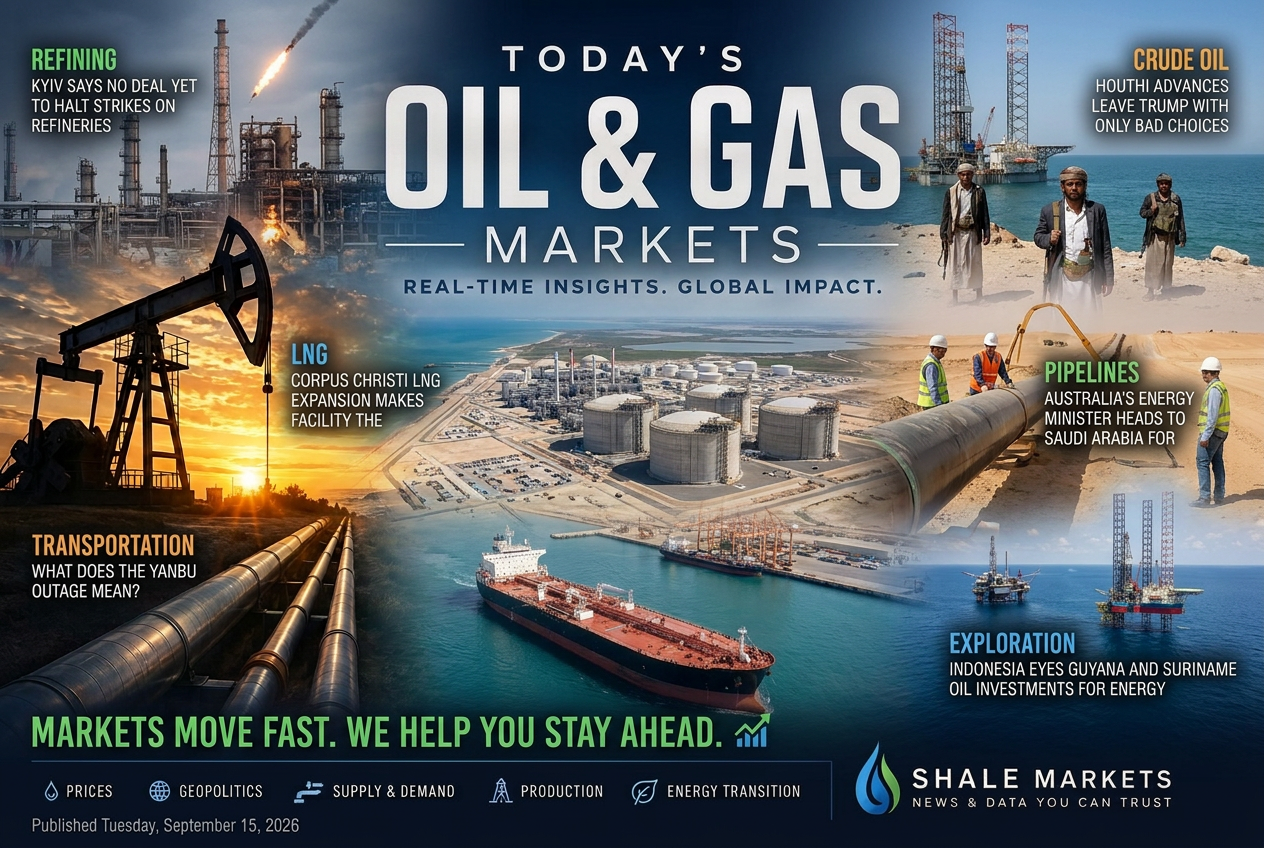
refining
Ongoing attacks on refinery infrastructure keep the market exposed to tighter diesel supply and reinforce the strategic value of downstream assets in the conflict. For operators and traders, the key issue is whether any pause in strikes is real enough to change product balances and repair risk across the region.
RigZone
Russian refining is becoming a more exposed link in the supply chain, which can tighten domestic product availability and force Moscow to use exports and product standards as pressure valves. For executives, it signals higher operational risk for Russian refining assets and a stronger chance of regional product-market disruptions if outages persist.
OGJ - Refining & Processing
YPF is spending on refinery upgrades to keep diesel output compliant with tighter sulfur rules, which supports its ability to defend domestic market share and avoid product quality constraints. For executives, it signals continued capital allocation toward refining capability rather than crude-only growth in Argentina.
OGJ - Refining & Processing
The piece signals that refineries are still being judged on operational discipline, not just throughput or margins. For executives, that means spending on safety systems, training, and leadership culture can be treated as a core protection of asset uptime and liability exposure rather than an optional cost.
OGJ - Refining & Processing
crude-oil
The piece signals that Red Sea disruption remains a direct strategic risk for oil and LNG shipping routes, forcing policymakers to weigh military escalation against continued trade insecurity. For executives, that means higher route risk, potential freight volatility, and more pressure on supply chains tied to Middle East exports.
Politico
The trip signals that pipeline outages in Saudi Arabia can quickly become a supply-security issue for major importers, especially when infrastructure comes under attack. For industry executives, it is a reminder that Middle East transit risk can affect crude availability and keep attention on alternative supply routes and contingency planning.
OilPrice.com
A shutdown on a major Saudi pipeline points to immediate exposure in the kingdom’s crude export system and raises operational and security risk for one of the region’s key transport links. For executives, the issue is less about the headline outage itself than about potential rerouting, tighter supply balances, and the cost of protecting critical midstream assets.
RigZone
Pertamina’s interest in upstream positions in Guyana and Suriname signals a push to secure reserves beyond Indonesia and reduce reliance on imported supply. For executives, it points to capital being directed toward high-growth offshore basins in Latin America and to a more competitive hunt for non-OPEC barrels.
OilPrice.com
The message is that a disruption narrative around Iran and the Strait of Hormuz should not be treated as a near-term supply fix, because alternative routes are already carrying substantial volumes. For executives, that points to continued exposure to regional transit risk and a need to keep contingency logistics and inventory plans in place.
World Oil - Latest News
Venezuela’s presence at the Houston summit points to continued attempts to reinsert its crude sector into international investment channels despite sanctions and political risk. For U.S. operators, the signal is that Caracas may be seeking partners, capital, and possibly a broader production reset that could affect future supply options.
World Oil - Latest News
This signals whether crude inventories are close to a floor, which matters for how executives think about storage economics and the timing of production and trading decisions. A durable bottom would point to tighter supply-demand balance and could support upstream cash flow and midstream utilization.
RigZone
Rising private wealth is increasing the pool of capital looking for hard-asset exposure, which can support valuations and funding terms for oil and gas deals. For operators and asset sellers, that points to continued investor appetite for reserves, production, and income-linked energy assets even if the broader energy market remains volatile.
OilPrice.com
Touchstone is keeping capital in Trinidad and Tobago focused on near-term output growth through drilling and optimization rather than new frontier acreage. For an executive, that signals a company using existing blocks to lift production and tighten operating efficiency in a market where incremental barrels and gas volumes can matter to portfolio returns.
OGJ - Drilling & Production
Shale and tight-oil output is a key signal for how much supply can be added quickly outside conventional fields. For executives, it speaks directly to capital allocation, basin competitiveness, and how much production growth can offset weakness elsewhere in the portfolio.
OGJ - General Interest
lng
The expansion lifts Corpus Christi into the top tier of U.S. LNG export terminals, reinforcing the Gulf Coast as a major destination for capital in gas liquefaction. For executives, it signals tighter competition for feedgas, shipping, and export capacity as U.S. LNG supply continues to scale.
EIA Today in Energy
This signals continued capital deployment into PNG LNG, which supports project continuity and contractor demand in a long-life gas export asset. For executives, it suggests ExxonMobil is still investing in operating reliability and construction work rather than slowing spending in a strategic LNG basin.
OGJ - General Interest
The restructuring removes a large debt overhang and leaves New Fortress Energy with a cleaner capital structure, which can improve its access to financing and reset how investors value the company. The separation of Brazilian assets also signals that the company is reallocating risk and control across its international gas-to-power portfolio.
RigZone
Long-term LNG supply and offtake agreements help Santos lock in outlet security and keep its gas portfolio tied to Asian demand. For executives, it signals continued capital commitment to LNG growth and a tighter link between upstream supply, liquefaction capacity, and regional market access.
RigZone
Weaker LNG demand in China and India would ease pressure on importers and soften near-term competition for cargoes. For producers and LNG traders, that signals a more balanced market and potentially less urgency to lock up supply at premium terms.
Egypt Oil & Gas
offshore
A change in the UK offshore tax regime would affect capital allocation decisions across the North Sea, because it alters the after-tax economics of continued investment and asset life extension. The push to accelerate the shift also signals that operators and investors are watching policy timing closely as they plan spending and decommissioning.
OilPrice.com
The proposed combination signals consolidation in offshore services, where scale and contract backlog can improve bidding power and utilization. For executives, it points to a market that still rewards balance-sheet strength and long-duration revenue visibility in offshore work.
World Oil - Latest News
This adds inspection spend and keeps offshore maintenance work moving in Norway’s North Sea, which supports ongoing subsea activity around Vår Energi’s portfolio. For executives, it signals continued operating discipline on existing assets rather than a new-build growth push.
World Oil - Latest News
This adds decommissioning work to the North Sea, which supports offshore services utilization even as mature basin activity shifts from development to abandonment. For executives, it signals continued spending on late-life asset management and a steady market for well-plugging capability in Europe.
World Oil - Latest News
exploration
The new discovery and operator change strengthen TotalEnergies’ position in a mature offshore basin where near-field tiebacks can add low-cost barrels. For executives, the signal is that capital is still being directed toward assets with existing production and infrastructure rather than greenfield risk.
OGJ - Exploration and Development
The award extends long-term operating rights over a gas-prone offshore block, which points to continued capital and technical focus on Southeast Asian supply growth. For executives, it signals more runway for exploration and development spending in the Malaysia-Thailand Joint Development Area and a push to secure regional gas volumes.
OGJ - Exploration and Development
Markets
The piece signals how local land access and community resistance can become a material operating risk for an oil company, even in a relatively small project area. For executives, it is a reminder that social license, permitting, and stakeholder management can affect timelines and capital deployment as much as geology does.
DW.com
Drilling
The delay pushes back near-term development spending and reduces visibility on when the asset can contribute production or reserves. The fundraising suggests Europa is preserving optionality, but it also signals a tighter financing path for a small-cap explorer with a deferred project timetable.
Dealroom
This signals that offshore drilling can face organized resistance from local businesses, which can complicate permitting and raise the cost of securing access to coastal acreage. For executives, it is a reminder that social license and coastal stakeholder alignment can affect project timelines and basin strategy.
Surfrider Foundation
transportation
China’s trade with Iran moving by rail through Central Asia points to a logistics workaround that can keep sanctioned commerce flowing even when sea routes are more visible. For energy executives, it is a reminder that Iran-linked supply chains can adapt, which matters for sanctions enforcement, regional transit competition, and the durability of cross-border trade routes.
OilPrice.com