
Shale Markets Briefing — September 17, 2026
Thursday, September 17, 2026
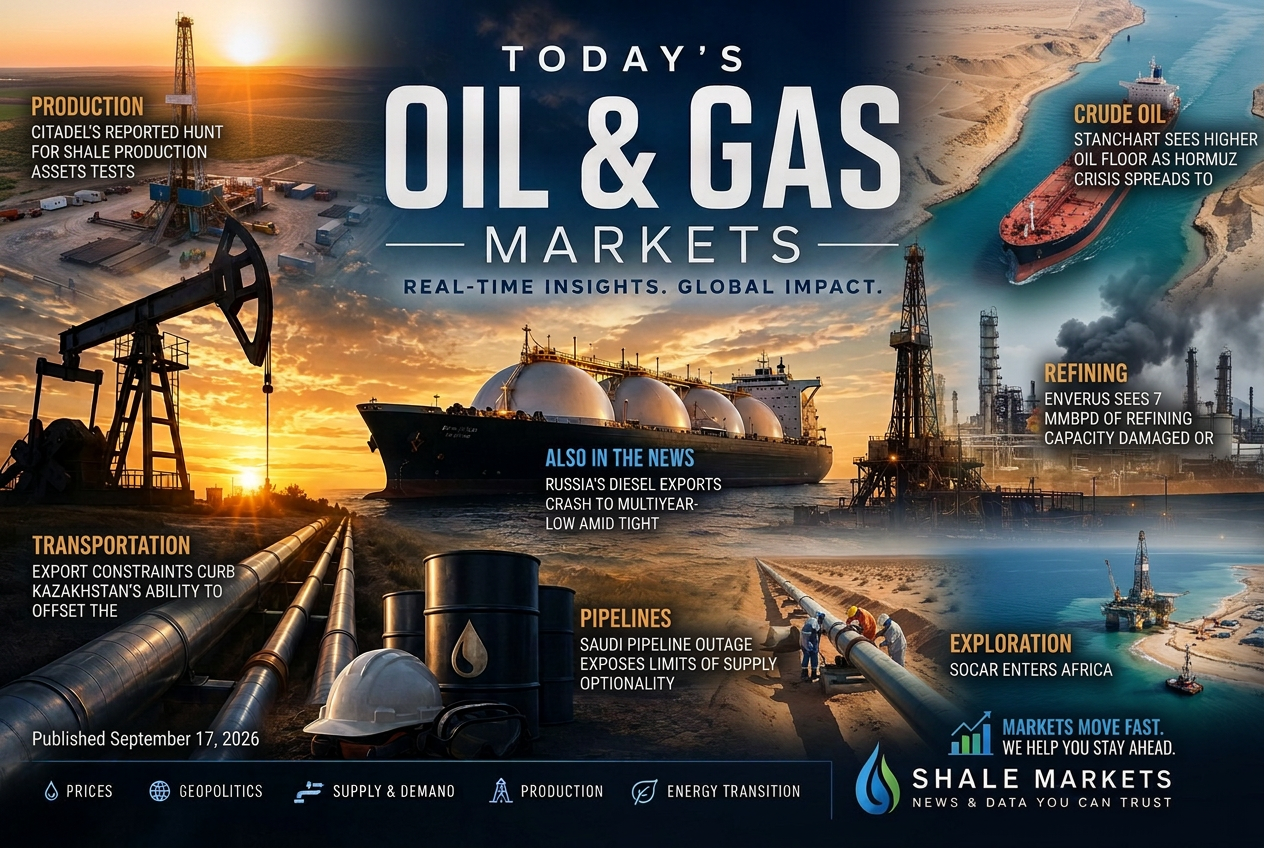
Today's briefing brings you 34 stories across production, crude oil, refining and exploration from across the global oil and gas market. Leading today: Citadel's Reported Hunt for Shale Production Assets Tests Whether Hedge Funds Can Outbid Traditional Buyers.
production
Diversified's $1.8 billion Birch Permian deal sets a 3.3x EBITDA benchmark just as Citadel is reported to be shopping for shale production assets of its own.
From Our Desk
crude-oil
A wider disruption to Saudi export routes raises the risk premium on crude and suggests the market may need a higher floor to keep supply moving. For producers and traders, that points to tighter routing risk across the Gulf and stronger support for upstream cash flows even if prices are volatile.
OilPrice.com
Kazakhstan’s export bottlenecks limit how much spare supply can reach the market if disruptions elsewhere tighten global balances. For executives, the signal is that regional production growth does not automatically translate into available barrels, which keeps support for prices and raises the value of reliable transport routes.
OilPrice.com
The outage highlights how a disruption on a key Saudi corridor can tighten crude flows even when producers have spare barrels elsewhere. For executives, it is a reminder that pipeline resilience and route flexibility still matter as much as headline supply capacity.
RigZone
Alberta is signaling it will use fiscal incentives to pull more capital into new upstream projects, which matters for producers weighing where to deploy drilling dollars in a higher-cost environment. If the framework is attractive, it could lift Canadian crude growth and support more export volumes to Asia, improving the province’s competitive position against other supply basins.
OilPrice.com
Record tanker rates signal a severe tightening in crude and product shipping capacity, which raises delivered costs and can disrupt arbitrage flows and physical supply routing. For producers, traders, and refiners, the premium to move barrels through the Gulf and other chokepoints is becoming a real constraint on export economics and supply security.
OilPrice.com
Vaca Muerta’s rising share of Argentina’s crude output signals that capital and drilling are concentrating in the shale play even as the broader economy weakens. For operators and investors, it underscores that Argentina’s upstream growth is increasingly tied to one basin, which can reshape export volumes and competition for rigs, services, and midstream capacity.
OilPrice.com
The attacks on Saudi Arabia’s east-west export line highlight how quickly a production disruption in the Gulf can ripple into Europe’s crude supply chain. For operators and traders, the key issue is not just lost barrels but the increased premium on alternate routes, storage, and cargo sourcing when Hormuz-linked flows are constrained.
OilPrice.com
The agreement signals another push by an upstream company to secure a foothold in Venezuela’s Orinoco Belt, where scale matters but so do political and operating risks. For executives, the key issue is whether this opens a path for capital to chase large resource upside in a sanctioned, high-friction basin if terms and control can be made workable.
OGJ - General Interest
Guyana’s export surge shows the country is becoming a material new source of crude barrels and foreign cash, which supports continued upstream investment and more confidence in the pace of basin buildout. For operators and service providers, it signals that offshore development in the basin is still translating quickly into cash generation and supply growth.
Upstream Online
The probe highlights cyber risk as an operational and security issue for tanker operators, with potential implications for cargo routing, insurance, and vessel uptime. It also signals closer scrutiny of maritime transport links that move crude and products to market.
RigZone
Kazakhstan is signaling a more conservative oil-price outlook as it builds its next medium-term budget, which matters because the assumption will shape how much fiscal room the government has for spending and how much it may lean on upstream revenues. For operators and investors, it is a reminder that national budget planning remains sensitive to crude-price volatility and could influence policy around the country’s energy sector.
Qazinform
The commerciality call on OMV’s Libyan discovery signals that new barrels in the Sirte Basin can still be converted into development opportunities, which matters for future capital allocation in a country where investment decisions are closely tied to reserve quality and operating risk. For executives, it is a reminder that North African exploration still offers meaningful upside if projects can clear viability hurdles.
RigZone
Plains is expanding its crude transportation footprint in the Powder River Basin, which should strengthen its position with regional producers and improve access to takeaway capacity. For operators, the deal points to continued capital flowing into midstream bottlenecks rather than new drilling alone.
OGJ - Pipelines and Transportation
Valeura appears to be extending its Southeast Asia footprint by proving up additional oil pay and considering a satellite development around the new find. For executives, that signals incremental capital may stay concentrated in a basin where tie-back style development can lift output without a full-scale frontier buildout.
Offshore-Energy.biz
refining
Damage and sanctions-related constraints on refinery capacity signal a tighter product balance that can support margins for surviving operators and favor regions with dependable throughput. For executives, the bigger takeaway is that recovery in Middle Eastern and Russian refining may be slower than the market expects, which affects capital allocation into turnarounds, supply contracts, and export flows.
World Oil - Latest News
Refining margins are a direct read on downstream profitability and can shift how much capital refiners are willing to allocate to runs, turnarounds, and incremental capacity. For executives, the signal is whether product spreads are strong enough to support operating rates and protect earnings in the refining chain.
OGJ - Refining & Processing
exploration
SOCAR’s move into Africa signals that national oil companies are still reallocating capital toward new upstream growth areas outside their home regions. For competitors, it is a reminder that African acreage remains attractive for long-cycle reserve replacement and international portfolio diversification.
RigZone
Thailand’s approval clears a new partner into PTTEP’s offshore blocks, which points to continued capital commitment in the Gulf of Thailand and a stronger push to replenish exploration inventory. For operators, it signals that farm-ins remain a practical way to share risk and keep offshore development moving in a tighter capital environment.
World Oil - Latest News
lng
This signals tighter global LNG fundamentals, with Europe’s weak storage and disrupted Middle East supply forcing buyers to compete harder for spot cargoes. For executives, that means stronger pricing, more volatility in procurement, and a higher premium on flexible supply and shipping access.
OilPrice.com
Thailand’s effort to line up new gas suppliers suggests buyers are trying to lock in alternative supply before higher prices tighten margins or expose them to spot-market volatility. For producers, LNG traders, and midstream counterparties, it signals a chance to win market share if they can offer reliable volumes and competitive terms.
Bangkok Post
A delayed LNG supply glut still points to weaker pricing power and more competition for new export volumes as the project pipeline catches up. For executives, that means sanction discipline and offtake security matter more than assuming a durable window for high utilization or elevated margins.
ieefa.org
LNG offtaker margins on the U.S. Gulf Coast matter because they shape how much room buyers have to absorb new export volumes and sign long-term contracts. For producers and terminal developers, tighter or wider margins signal whether cargo demand can support more liquefaction capacity and shipping commitments.
OGJ - Pipelines and Transportation
A softer LNG demand outlook in Asia points to weaker import growth and could pressure spot pricing, cargo flows, and contracting discipline across the LNG market. For exporters and developers, it is a reminder that new supply still needs firm long-term offtake or it may face a tougher market in key consuming regions.
UA.NEWS
Drilling
The audit suggests the East Sea drilling push may have advanced ahead of clear subsurface and commercial certainty, which matters for how much capital Korea will commit to frontier exploration. For executives, it signals that policy support can drive basin activity even when project risk remains unresolved, affecting partner interest and timing of investment decisions.
Korea JoongAng Daily
A new field discovery and nearby drilling success in the Gulf of Thailand point to follow-on capital being directed into the area rather than away from it. For executives, it signals a basin where appraisal and development activity can still add production and reduce subsurface risk around existing assets.
OGJ - Exploration and Development
The discovery adds to Aker BP’s inventory near an existing North Sea hub, which can support lower-cost tieback development if the volumes hold up in appraisal. For operators, it is another signal that capital is still being directed toward nearby offshore gas prospects rather than frontier exploration.
OGJ - Exploration and Development
carbon-capture
BKV has consolidated Barnett assets that combine production, gathering and carbon capture, which points to a strategy of controlling more of the value chain rather than just adding wells. For executives, it signals continued capital interest in mature gas basins where midstream and CCS optionality can improve economics and future positioning.
oilandgasmiddleeast.com
completions
The contract extends Halliburton’s exposure to a long-cycle deepwater gas project and signals continued spending on offshore development in Cyprus. For service companies, it supports backlog and reinforces where operators are still willing to commit capital in a tighter capital-discipline market.
World Oil - Latest News
natural-gas
This gives a foreign buyer direct control of a core Appalachian gas position with current production and reserve scale, which can tighten competition for high-quality dry gas inventory. For executives, it signals that capital is still chasing long-life U.S. gas assets in established basins where scale and operating momentum matter.
OGJ - General Interest
offshore
Easier TWIC access would lower a staffing bottleneck for offshore operators and contractors, which matters as Gulf projects compete for limited skilled labor. For executives, it signals a policy move that could improve crew availability and support ongoing offshore activity without changing the commodity backdrop.
World Oil - Latest News
This points to continued investment in deepwater Brazilian production infrastructure, with Petrobras backing equipment that supports water injection and gas lift in a technically demanding province. For suppliers, it signals ongoing spending around mature offshore assets where reliability and operating efficiency can matter as much as new drilling.
World Oil - Latest News
storage
Robotic tank inspection that avoids confined-space entry points to a clear safety and uptime gain for operators with above-ground storage assets. For executives, it signals a practical way to cut inspection risk and downtime while supporting maintenance compliance across storage fleets.
World Oil - Latest News
data-centers
Rising electricity demand from data centers could tighten U.S. gas balances and support prices, which matters for producers, processors, and LNG exporters competing for the same molecules. It signals that power load growth may become a new demand driver alongside export growth, influencing where capital flows in gas-rich basins and midstream systems.
Inshorts