
Shale Markets Briefing — September 24, 2026
Thursday, September 24, 2026
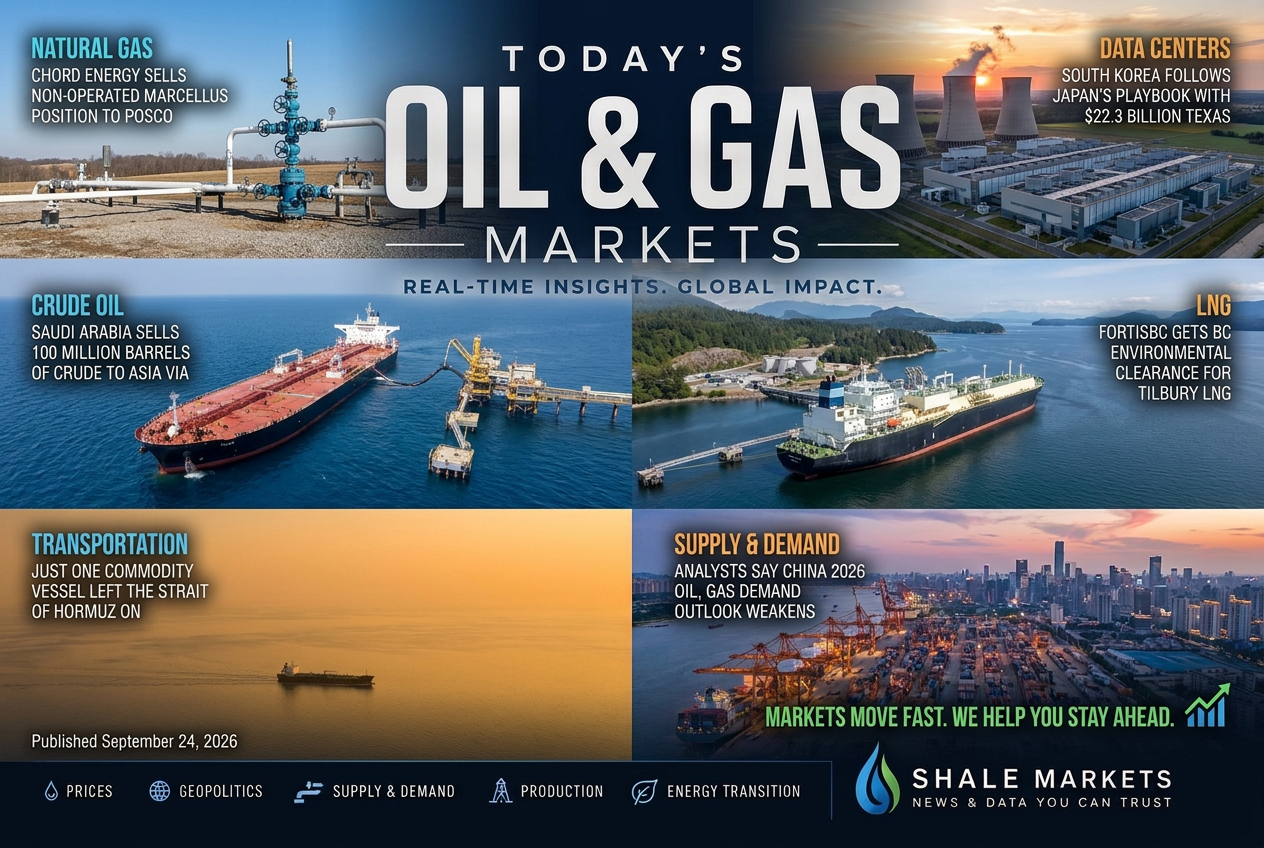
Today's briefing brings you 23 stories across natural gas, data centers, crude oil and lng from across the global oil and gas market. Leading today: Chord Energy Sells Non-Operated Marcellus Position to POSCO for $550 Million.
natural-gas
Chord Energy is selling its non-operated Marcellus position in northeast Pennsylvania to POSCO International for $550 million, a deal tied to POSCO's future LNG liquefaction plans.
From Our Desk
data-centers
This signals that foreign capital is still chasing U.S. gas-fired power assets where power demand is growing fastest, especially around data centers and chip manufacturing. For upstream and gas executives, it reinforces that electricity load growth can pull through major gas infrastructure investment even when the project is framed as a power complex rather than a pure gas development.
OilPrice.com
crude-oil
The sale underscores how Saudi barrels still matter to Asian refiners and how quickly trade flows can revert to the Strait of Hormuz when alternative routes are constrained. For executives, it is a reminder that pipeline outages and chokepoint risk can shift voyage economics, freight exposure, and near-term supply routing without changing underlying demand.
OilPrice.com
Reduced traffic through Hormuz signals tighter shipping and insurance conditions for crude, condensate, LPG, and other commodity flows, which can strain exporters in the Gulf and complicate supply planning for buyers. For executives, the key issue is whether the corridor is becoming a persistent bottleneck that can reroute trade, lift freight costs, and expose exposure to Middle East disruption.
OilPrice.com
A softer China demand outlook points to weaker pull on global crude and gas balances, which can pressure export plans and downstream utilization expectations across Asia and beyond. For producers and LNG sellers, it signals that capital and cargoes may need to be directed toward markets with firmer demand.
RigZone
A consolidation wave in Canada’s oil patch signals that capital is likely shifting toward scale and lower-cost inventory rather than new frontier spending. For executives, it points to a more active deal market in oil sands and Canadian upstream assets as producers reshape portfolios and seek operating leverage.
OilPrice.com
The piece shows how Middle Eastern exporters are rerouting crude around Strait of Hormuz risk, which keeps barrels moving but raises logistics costs and complicates netbacks. For executives, it signals that shipping resilience and alternate pipeline capacity are becoming strategic assets in a region where disruption can quickly reshape export flows.
OilPrice.com
Higher U.S. production forecasts for the next two years signal a looser domestic crude balance and reinforce the case for sustained drilling and completion activity. For operators and midstream players, it suggests more supply to move, process, and hedge, even if it can pressure prices and capital discipline.
RigZone
lng
The clearance removes a key regulatory hurdle for FortisBC’s Tilbury LNG expansion, signaling that the project can move further toward execution. For gas executives, it points to incremental LNG and storage capacity in British Columbia and reinforces provincial backing for export-oriented infrastructure.
RigZone
Higher LNG ship traffic through Hormuz signals Qatar is keeping export flows moving through a critical chokepoint, which matters for global gas balance and shipping risk. For executives, it is a reminder that Middle East LNG supply remains exposed to routing disruptions even when volumes are strong.
RigZone
This points to another step-up in U.S. LNG capacity and reinforces the Gulf Coast’s role as the main export engine for global gas supply. For executives, it signals continued capital flow into liquefaction, feedgas supply, and associated midstream infrastructure as the U.S. widens its competitive lead in LNG.
OGJ - General Interest
The FID signals fresh capital is being committed to Nigerian gas supply at a time when LNG-linked projects are still attracting long-cycle investment. For operators and LNG buyers, it reinforces that gas infrastructure tied to export expansion remains a priority in Africa despite broader upstream capital discipline.
OGJ - Exploration and Development
refining
A diesel export ban would tighten refinery economics in the U.S. and could lead refiners to cut runs, which would affect gasoline supply and pricing. For executives, it is a reminder that policy aimed at diesel can ripple through broader product balances and downstream margins across the Gulf Coast refining system.
OilPrice.com
OMV Petrom is moving a refinery-linked biofuels project closer to startup, which signals continued capital spending to adapt conventional downstream assets to lower-carbon fuel streams. For refinery operators, this is a sign that asset owners are using existing sites to preserve throughput and compete as product slates evolve.
RigZone
production
The report signals that the North Sea decline is becoming a labor and investment issue, not just an output issue. For executives, it highlights pressure to adjust tax and capital plans or risk losing skilled capacity before the basin can be repurposed or reworked.
World Oil - Latest News
offshore
Superior Energy Services is buying Welltec to add higher-value well intervention and completions capabilities, which signals a push to broaden its technology offering rather than compete only on conventional services. The deal also extends Superior’s reach in offshore and international markets, an area where operators still favor integrated service packages and differentiated tools.
World Oil - Latest News
The sale shows Shell continuing to reshape its Gulf portfolio and turn mature offshore positions into cash. For Talos and Ridgewood, it adds producing Gulf assets and signals ongoing capital recycling and consolidation in U.S. offshore operations.
World Oil - Latest News
Petrobras and Shell are validating composite pipe for offshore Brazil, which points to a push to lower corrosion risk and extend equipment life in high-CO2 fields. For executives, this signals where capital is going in subsea infrastructure and which materials could become standard in long-life developments.
OGJ - General Interest
The project signals ongoing capital being steered into lower-emissions offshore operations in Brazil rather than into new barrels alone. For executives, it points to infrastructure spending that can extend the competitive life of mature Campos basin assets while reducing the carbon profile of production.
OGJ - General Interest
Shell’s exit from a Gulf of Mexico platform points to ongoing portfolio pruning in a mature offshore basin, which can reshape who controls legacy production and where operators deploy capital next. For executives, it is a reminder that capital is still being rotated toward assets with stronger returns and cleaner strategic fit.
RigZone
oilfield-services
This contract signals continued capital spending in Oman's upstream sector and a push to add barrels through brownfield expansion rather than new frontier risk. For service providers like SLB, it also shows how regional operators are using outside technical execution to lift production capacity and protect competitive position.
OGJ - General Interest
exploration
The contract signals continued spending on seismic data acquisition, which is a leading indicator of future exploration and drilling decisions rather than near-term production. For operators and service companies in Southeast Asia, it suggests land-play activity is still attracting capital and equipment commitment.
World Oil - Latest News
Drilling
Petrobras restarting exploratory drilling in Bolivia signals a renewed push to test undeveloped gas and oil potential in a mature basin. For executives, it matters because new appraisal work can reshape where capital is allocated in Latin America and influence future supply options for the region.
BNamericas