Shale Markets Briefing — November 12, 2026
Thursday, November 12, 2026
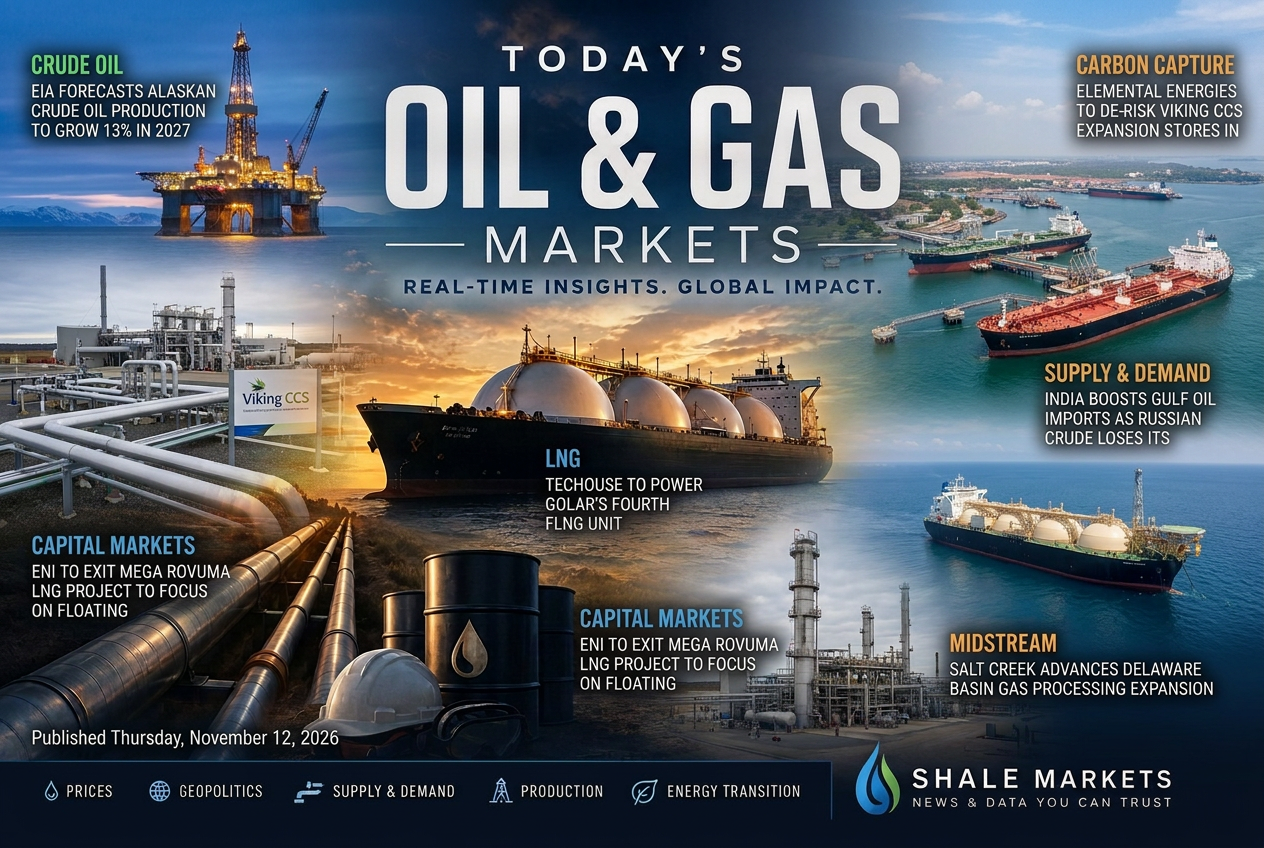
Today's briefing brings you 11 stories across crude oil, carbon capture, lng and midstream from across the global oil and gas market. Leading today: EIA forecasts Alaskan crude oil production to grow 13% in 2027.
crude-oil
Alaska’s North Slope is becoming a rare source of U.S. supply growth, which matters for producers competing for capital in a mature basin. Higher forecast output also points to more crude available into West Coast and export-linked markets, supporting regional logistics and pipeline utilization.
EIA Today in Energy
India’s shift toward Gulf barrels shows that cargo economics, not just geopolitics, are still steering Asian crude flows. For producers and traders, it is a signal that Russian crude is losing share when its discount no longer offsets routing and supply-chain risk through Hormuz.
OilPrice.com
Nigeria’s output level signals how much crude is actually available for exports and budget support, and the shortfall suggests upstream activity is still not delivering enough barrels to meet policy assumptions. For operators and service companies, it points to continued pressure on field reliability, investment discipline, and government revenue expectations.
LEADERSHIP Newspapers
carbon-capture
The study work signals that Viking CCS is moving from concept toward a final investment decision, which matters because it is the point where capital can start shifting from appraisal into execution. For North Sea operators, progress on storage readiness also helps define whether carbon capture can become a repeatable part of basin development rather than a one-off project.
World Oil - Latest News
lng
This shows FLNG builders are still investing in efficiency upgrades, not just adding liquefaction capacity. Lower fuel burn on Golar’s next unit should improve operating economics and help keep floating gas export projects competitive against land-based LNG options.
World Oil - Latest News
Eni’s move suggests it is reallocating capital away from a large conventional LNG buildout toward a smaller, more flexible development model. That matters because it can change how operators sequence spending in Mozambique and signal where floating liquefaction is gaining strategic preference over mega-project exposure.
Upstream Online
Midstream
Salt Creek is adding gas-processing capacity in the Delaware Basin, which signals continued capital spending behind Permian gas volumes rather than a pause in development. For producers, more takeaway and processing capacity can ease bottlenecks and support additional drilling activity if the project gets approved and reaches service in 2028.
OGJ - Refining & Processing
Drilling
Vår Energi is tightening control over offshore drilling execution by bringing planning, technology, and field operations into one service package. For operators in mature North Sea acreage, that usually points to a push for faster well delivery, lower nonproductive time, and better capital efficiency.
OGJ - General Interest
A new offshore drilling campaign off Mexico signals continued capital deployment in a basin where operators still see development potential. For service and equipment suppliers, it suggests near-term rig demand and a modest lift for offshore activity in the region.
Offshore Engineer Magazine
A Halliburton drilling program of this size signals continued operator spending in Egypt and more work for oilfield-service capacity in the country. For executives, it suggests the basin is still attracting capital for development rather than a pullback in activity.
Egypt Oil & Gas
Technology
Norway is extending scrutiny of how offshore operators use AI, which raises the bar for governance, model validation, and operational risk controls in upstream workflows. For executives, it signals that digital adoption in oil and gas now carries a clearer compliance burden and could slow or reshape automation rollouts in North Sea operations.
RigZone