Shale Markets Briefing — November 19, 2026
Thursday, November 19, 2026
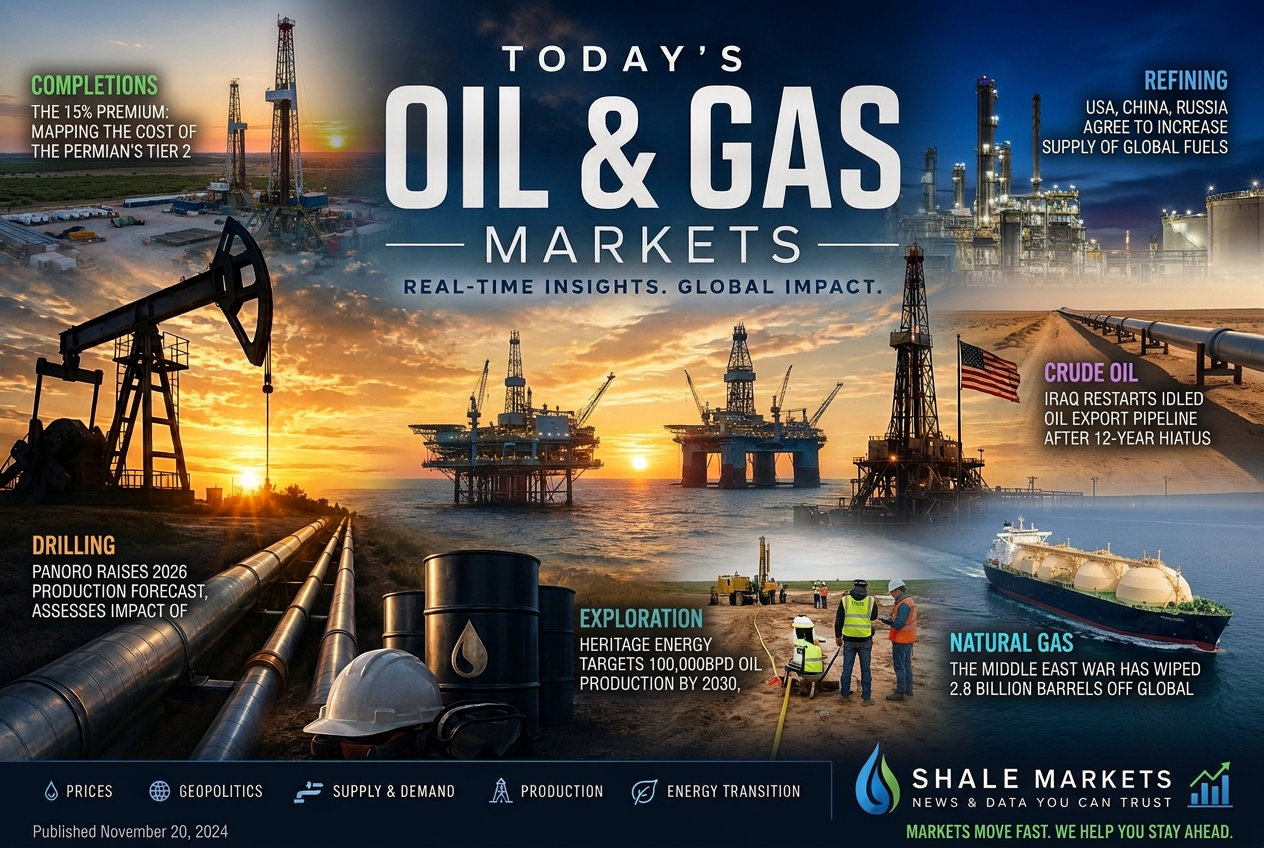
Today's briefing brings you 12 stories across completions, drilling, refining and crude oil from across the global oil and gas market. Leading today: The 15% Premium: Mapping the Cost of the Permian's Tier 2 Transition.
completions
Matador held D&C costs flat while peers absorbed rising gas and water volumes from longer Tier 2 laterals, exposing a widening execution gap across the Permian.
From Our Desk
The move signals a policy push to unlock more domestic supply by encouraging techniques that improve recovery in existing and harder-to-develop fields. For operators, it points to a friendlier upstream investment climate and potential work for drilling and completion service providers.
Egyptian Gazette
Drilling
Panoro’s higher forecast signals that its Gabon offshore program is still adding volumes even as the company works through rig disruption. The sinking of the Prospector 5 also highlights how a single offshore incident can delay appraisal and development work, affecting near-term capital deployment and execution risk.
World Oil - Latest News
Heritage Energy’s drilling push signals a capital commitment to grow output rather than just hold existing production. For upstream investors and rivals, a 100,000-bpd target suggests a longer-cycle development program that could lift Nigerian supply and strengthen the company’s position in local acreage and service demand.
LEADERSHIP Newspapers
refining
A coordinated push by the U.S., China, and Russia to raise fuel supply signals a policy response to tight global product markets rather than just a headline about crude prices. For refiners, exporters, and traders, it points to potential shifts in product balances and export flows that could affect margins and competitive positioning.
RigZone
crude-oil
Restarting an idle export line signals Iraq is trying to recover outbound crude capacity and reduce reliance on constrained routes. For operators and traders, it can ease takeaway pressure and shift expectations for regional supply availability if flows hold up.
Upstream Online
The piece signals that Middle East conflict is still a material swing factor for global crude and gas balances, which matters for upstream producers, LNG exporters, and trading desks planning supply exposure. It also underscores how policy assumptions on electrification versus continued hydrocarbon growth can reshape long-term capital allocation across the sector.
OilPrice.com
This is a signal that Angola’s offshore Kwanza basin may be opening a new exploration fairway in pre-salt reservoirs, which can pull capital toward the block if follow-up appraisal supports commercial volumes. For operators in the region, it also strengthens the case that offshore exploration remains a viable source of inventory outside the core shale basins.
OGJ - Exploration and Development
The delay gives importers more time before methane documentation becomes a compliance cost in Europe, easing near-term pressure on oil and gas suppliers that sell into the EU. It also signals that methane rules remain a policy risk, so producers with stronger emissions tracking could still gain an edge when the requirements eventually tighten.
RigZone
lng
This signals more FLNG capacity moving through the supply chain, which matters for LNG developers because conversion work is a step toward bringing additional export tonnage to market. For executives, it also points to continued demand for Asian yard capacity and supports the view that floating liquefaction remains part of capital allocation into gas export growth.
Upstream Online
exploration
Seismic work on the M47 block signals that Dune Oil is still in the appraisal phase, spending capital to refine subsurface data before committing to a drilling program. For executives, that points to a modest but important step in testing acreage quality and preserving optionality in southeastern Türkiye's upstream portfolio.
proactiveinvestors.com
offshore
This signals more decommissioning and recycling work in the North Sea supply chain, which creates contract flow for offshore services even as mature asset retirement becomes a growing capital line item. For operators, it also shows that end-of-life execution and yard capacity are becoming part of field lifecycle planning, not just a cleanup afterthought.
World Oil - Latest News