
Oil prices rise on Hormuz tensions as midstream, pipeline and drilling updates pile up
Friday, August 14, 2026
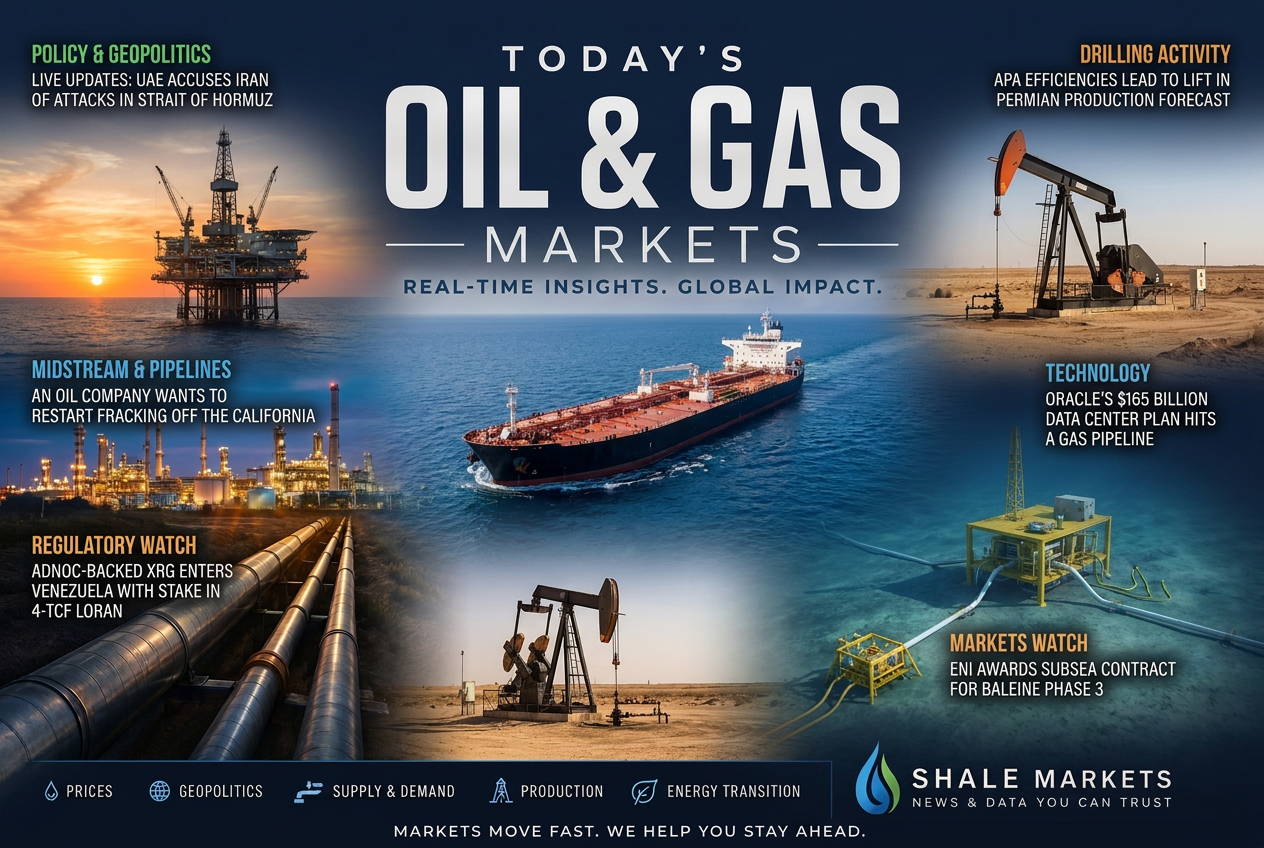
Oil markets are being driven by tanker attacks and rising Strait of Hormuz risk, while U.S. policymakers weigh sanctions and waivers amid supply constraints. On the North American side, CRC is set to buy Crimson Midstream’s California pipeline platform, Phillips 66, Kinder Morgan and HF Sinclair sanctioned Western Gateway, and drilling and production updates continued across the Permian, Delaware Basin and Alaska.
Midstream
Disruption risk in the Strait of Hormuz can quickly tighten global crude and LNG balances, which supports higher freight, insurance, and hedging costs for companies exposed to Middle East flows. The policy emphasis on cheaper oil and gas signals that energy prices are becoming a direct political priority, raising the stakes for upstream capital allocation and supply security.
Removed feeds
CRC is using midstream ownership to lock in takeaway capacity and reduce dependence on third-party infrastructure in California, which can improve operating reliability and market access for its barrels and gas. For an executive, the signal is that control of pipelines remains a strategic lever in a constrained basin where transportation can shape realized pricing and competitive position.
OGJ - Pipelines and Transportation
Europe’s LNG import balance still looks vulnerable if winter temperatures normalise, which keeps spot prices and storage economics sensitive to weather and cargo competition. For executives, that means capital and trading decisions still need to assume a tight market rather than a demand reprieve from macro climate patterns.
OilPrice.com
The waiver signals that US fuel and agricultural logistics remain tight enough to justify easing domestic shipping rules, which can affect freight costs and regional supply chains. For executives, it also shows regulators are willing to prioritize continuity of energy and commodity flows over strict Jones Act enforcement when market disruptions widen.
OGJ - General Interest
Higher crude prices tied to tanker attacks signal a fresh geopolitical risk premium, which can quickly alter hedging, procurement, and capital spending assumptions across the supply chain. For executives, the bigger issue is that unresolved Middle East tensions can tighten seaborne supply and keep volatility elevated even without a change in underlying demand.
EnergyNow.com
This signals additional midstream and processing investment in Vaca Muerta, which supports more associated gas and NGL output and can improve takeaway economics for producers. For executives, it also points to stronger export and domestic petrochemical supply from Argentina, which can tighten the competitive position of local gas and liquids projects.
OGJ - Refining & Processing
This signals another round of capital going into U.S. product and crude logistics, which can tighten competitive positions for the sponsors and improve takeaway or supply reliability in the West. For executives, the key implication is that midstream owners are still backing infrastructure that can reshape regional flows and protect margins for customers with secured transportation.
OGJ - Pipelines and Transportation
The first condensate shipment from Barossa shows the project has moved from construction into commercial output, which helps de-risk Santos’ capital spend and signals new liquids supply into the Asia-Pacific market. For executives, it is a cue to watch how quickly Barossa ramps and whether additional offshore gas and condensate projects in the region can compete for LNG-linked demand and refinery outlets.
OGJ - Exploration and Development
The move underscores how quickly Middle East shipping risk can reprice crude, even without a formal supply disruption. For executives, it is a reminder that exposure to tanker lanes and Gulf security can affect margins, feedstock costs, and hedging decisions faster than underlying demand trends.
Reuters
Seeking incentive status under Argentina’s investment regime signals the consortium is trying to lower fiscal and regulatory risk before committing large LNG capital. For executives, it is a read on whether Argentina can convert gas resources into export capacity and compete for global LNG capital against other sanctioned projects.
RigZone
Lower traffic through Hormuz signals a higher risk premium in crude logistics and a reminder that Gulf exports can be disrupted even without a formal supply cutoff. For executives, it raises freight, insurance, and routing uncertainty and can tighten near-term seaborne balances if the standoff persists.
OilPrice.com
A disruption at Ust-Luga threatens a major Russian export outlet, which can tighten crude and fuel flows into the Baltic and force traders to reroute barrels or reassess near-term availability. For executives, it is a reminder that geopolitical attacks can quickly affect export reliability, freight economics, and regional price spreads.
OilPrice.com
The hub reduces Orlen’s reliance on third-party logistics, which can lower handling bottlenecks and improve control over product flows at a key refining asset. For executives, it signals continued investment in downstream infrastructure that can support margin capture and supply flexibility in the region.
OGJ - Refining & Processing
US gas storage levels are a direct read on near-term supply-demand balance and can quickly affect prompt pricing and producer hedging decisions. For executives, this is a useful signal on whether the market is tightening or loosening heading into the next storage cycle.
OGJ - General Interest
The price move signals that Middle East risk is still a direct support to crude benchmarks and will shape near-term cash flow expectations for producers, traders, and refiners. It also suggests executives should keep capital and hedge decisions sensitive to shipping disruption and any further tightening in global supply routes.
OilPrice.com
This signals continued export demand for U.S. LPG and supports Gulf Coast processing and loading infrastructure tied to overseas buyers. For executives, it points to stronger visibility for NGL sales and a market that is increasingly shaped by Asian import requirements rather than domestic consumption alone.
RigZone
The TAPI delay shows how geopolitical risk and weak state capacity can keep major cross-border gas infrastructure from becoming investable, even when the strategic demand case is clear. For executives, it is a reminder that South Asian export corridors remain uncertain outlets for Central Asian gas and that capital may be better allocated to shorter-cycle or lower-risk midstream options.
OilPrice.com
Bottlenecks at the Panama Canal can alter freight economics for LNG, crude, and refined products by forcing shippers to pay up for access or reroute cargoes. For executives, that signals tighter logistics capacity and the risk of higher delivered costs for exports moving between the Atlantic and Pacific basins.
RigZone
Regulatory
This signals that California regulators remain willing to block offshore oil recovery efforts on environmental and permitting grounds, which raises the political and execution risk for any capital tied to coastal output. For executives, it underscores how regulatory resistance can keep offshore barrels offline and limit near-term supply options on the West Coast.
Los Angeles Times
Produced-water spills are a direct operating and regulatory issue for Bakken operators because they can trigger cleanup costs, reporting scrutiny, and tougher oversight of disposal and handling practices. For executives, this points to execution risk around water logistics and environmental performance rather than a change in production fundamentals.
Removed feeds
Drilling
Higher Permian output guidance from APA signals that operational efficiency is allowing the company to grow barrels without raising basin spending, which supports capital discipline. For executives, it also points to continued competition for high-return acreage and services in the basin even as overall budget levels stay flat.
OGJ - Drilling & Production
Battalion’s low leverage gives it room to shift capital back into drilling without stressing the balance sheet, which is the kind of signal investors watch for in smaller E&Ps. For competitors, it suggests the company may be able to defend or grow Delaware Basin activity while peers stay disciplined on spending.
Hart Energy
Suriname’s deepwater progress signals that capital is still being committed to emerging offshore provinces in the Guyana-Suriname basin, where success could reshape regional supply expectations. For operators and suppliers, it raises the stakes for acreage capture, development pacing, and competitive positioning against neighboring frontier plays.
World Oil - Latest News
Guyana and Suriname are becoming a meaningful new offshore growth center, which matters for executives tracking where capital is likely to concentrate outside the legacy U.S. shale and Gulf of Mexico plays. It also signals a shift in regional crude supply that can reshape competition for rigs, services, and export-linked barrels in the Atlantic basin.
World Oil - Current Issue
This signals that ExxonMobil is using AI to improve subsurface targeting and keep Guyana drilling inventory growing, which supports a longer capital runway in one of its most important offshore growth areas. For competitors, it reinforces that operators with strong data capability can extend basin productivity without waiting for new acreage.
World Oil - Latest News
Approval under Argentina’s investment regime would lower the fiscal and regulatory friction on a major shale spending program, which matters for how aggressively Vista can allocate capital into growth rather than defend returns. If sanctioned, the project adds visible production growth in a key non-U.S. shale basin and could tighten the company’s path toward its longer-term output target.
OGJ - Exploration and Development
This gives an early signal that major upstream capital is still being committed to Mediterranean gas supply, which matters for how quickly new volumes can offset European import dependence. For operators and investors, it also underscores that offshore gas developments remain competitive when they can support regional security-of-supply and long-life production.
OGJ - Exploration and Development
This signals that a major international operator is still willing to commit capital in Venezuela despite political and execution risk, which could modestly improve future gas supply optionality in the region. For executives, it is a reminder that reserve access and licensing progress can reshape competitive positioning even when the project timeline remains uncertain.
RigZone
A higher U.S. rig count signals that producers are leaning into drilling activity despite tighter capital discipline, which can slow the pace of supply declines and affect near-term oil and gas balance. For service companies, even a modest weekly increase can point to steadier basin utilization and pricing power ahead.
Seeking Alpha
Turkey’s onshore buildout signals a push to reduce import dependence and capture more domestic supply, which can influence regional crude balances and upstream capital flows. For operators and service providers, it points to a more competitive acreage and drilling environment in a country that may be trying to expand its strategic energy position.
Crux Investor
Automation in drilling signals where operators are directing capital to cut well construction costs and improve consistency, which can widen the advantage for fleets that can deliver faster cycle times with less human intervention. It also points to a competitive reset for service providers as digital rig control becomes part of the baseline offer rather than a premium feature.
World Oil - Current Issue
Progress at K-29 suggests Indonesia Energy is still committing capital to appraisal and development work at the Kruh Block, which can support future reserve addition and production growth if the well reaches the targeted zone. For executives, it is a signal to watch how small E&P spending is being concentrated on near-term drilling inventory in Asia rather than broader portfolio expansion.
World Oil - Latest News
A dry exploration well means capital spent on the prospect will not translate into near-term reserves, which can slow follow-on drilling decisions in the North Sea. For executives, this is another reminder that basin access and exploration budgets will favor prospects with stronger subsurface confidence and better risk-adjusted returns.
OGJ - Drilling & Production
A small move in the US rig count signals that operators are still willing to add drilling capacity, but not at a pace that would materially change near-term supply. For an executive, this is mainly a read on cautious capital deployment and a reminder that oilfield-services demand remains stable rather than accelerating.
Breakingthenews.net
Record U.S. crude output signals continued strength in domestic supply, which can keep pressure on prices and sustain drilling and completions activity in the most productive basins. For executives, it points to a market where capital discipline, efficiency gains, and takeaway access remain central to competitive position.
RigZone
Policy
An ADNOC-backed entrant taking a stake in a large Venezuelan gas asset signals that capital is still willing to flow into politically difficult markets when the resource base is compelling. For executives, it underscores competition for long-life gas positions and a potential shift in where international capital is willing to accept geopolitical risk.
World Oil - Latest News
The story signals potential policy and access shifts on federal land that could open a new natural gas growth area in Louisiana. For executives, it matters because land-use decisions can affect drilling inventory, permitting timelines, and competition for Gulf Coast supply.
The Center Square
Oil prices holding firm after conflict risk faded signals that the market still has adequate spare supply and can absorb geopolitical shocks without forcing a broader re-pricing of capital. For executives, that points to a market where discipline on production and inventory management matters more than headline-driven volatility.
Modern Ghana
Pikka adds a new source of Alaskan crude that can improve regional output and give upstream operators a clearer reason to keep capital committed to the state. For executives, the bigger signal is that production growth may come before a material boost to state revenues, which can affect permitting, fiscal expectations, and long-term investment planning.
Removed feeds
Rising Strait of Hormuz risk is a reminder that geopolitical shocks can quickly reprice crude and widen feedstock and freight costs for refiners, petrochemical producers, and import-dependent buyers. For executives, the signal is that supply security and hedging discipline matter more when Middle East transit risk threatens the oil balance.
INDIA New England News
Oil’s weekly direction is a reminder that geopolitical risk around the Strait of Hormuz can move crude pricing even without a change in physical barrels. For executives, that supports a higher-risk premium in budgeting, hedging, and near-term supply planning.
Oil & Gas 360
Tighter sanctions on Iran would raise the risk premium across seaborne crude markets and could support prices if enforcement meaningfully constrains exports. For executives, it signals a more volatile supply backdrop and a need to reassess exposure to Middle East barrels and freight routes.
RigZone
Persistent drone threats around Saudi energy infrastructure raise the risk premium for regional crude and product flows, which can affect refining reliability and export security even when physical damage is limited. For executives, this signals that Middle East conflict remains a direct variable in supply planning, freight exposure, and capital discipline around vulnerable assets.
OilPrice.com
Rising geopolitical risk around the Strait of Hormuz can add a temporary risk premium to crude even when underlying demand is softening. For producers and refiners, that means near-term pricing may stay volatile while the broader signal still points to weaker balance and less confidence in sustained upside.
OilPrice.com
Syria’s effort to regain oil output signals a shift in control over cash-generating assets, which can alter who captures revenue and who has leverage over redevelopment. For executives, it points to a tighter link between basin access, geopolitical influence, and future opportunities in a highly politicized market.
OilPrice.com
A sustained risk premium around the Strait of Hormuz raises the odds of a tighter global crude balance and forces refiners and traders to hedge for supply disruption rather than demand weakness. For executives, that means capital and inventory decisions could shift quickly toward protection against higher feedstock costs and freight disruption.
OilPrice.com
Russia’s growing share of India’s crude slate shows how discounted barrels can rapidly redirect trade flows and weaken alternative suppliers’ foothold in one of the largest import markets. For executives, it signals continued pressure on seaborne pricing, sourcing strategy, and geopolitical exposure in the Asian crude market.
OilPrice.com
Technology
The delay shows how data-center buildouts can be constrained by gas and pipeline availability, not just demand for compute capacity. For executives, it signals that infrastructure timing can affect site selection, power strategy, and the pace of capital deployment into AI-related projects.
OilPrice.com
bp’s emphasis on AI tied to low-cost engineering signals that major operators are still looking for operating leverage rather than broad spending growth. For executives, it suggests capital is being directed toward reliability and cost discipline, which can improve asset performance without requiring a new development cycle.
Oil & Gas IQ
This matters because power train efficiency is becoming a direct lever on frac economics as operators look to cut fuel costs and emissions without giving up pumping capacity. For service companies, better pump-to-power matching can lower operating expense and improve fleet competitiveness in basin work.
World Oil - Current Issue
This signals that operators are treating offshore project coordination software as a critical control layer for keeping complex developments on schedule and reducing execution risk. For executives, it highlights continued spending on digital operations tools that can protect capital efficiency and safety in large Gulf projects.
OGJ - Exploration and Development
For operators, this signals that AI investment is being constrained less by model performance than by the quality and consistency of underlying data, which can slow deployment and push capital toward data infrastructure instead of new applications. Companies that solve governance first will likely be better positioned to scale automation across operations and improve competitive efficiency.
Oil & Gas IQ
The delay pushes back gas demand tied to a major data-center buildout, which can defer takeaway and infrastructure spending in New Mexico. For executives, it is a sign that power-linked gas growth is still vulnerable to project timing and permitting risk.
Removed feeds
Markets
The award reinforces that Baleine remains a priority offshore growth engine for Eni in West Africa, signaling continued capital deployment into production expansion rather than a pause in spending. For service and equipment providers, it also points to a multi-year flow of subsea and FPSO-related work tied to a larger supply push from Côte d’Ivoire.
OGJ - Exploration and Development
Lower spending by shale producers signals a more disciplined capital environment and suggests US oil growth may slow even if prices remain supportive. For executives, that points to tighter competition for rigs, crews, and acreage growth, with less supply pressure in core basins.
EnergyNow
This shows that workover and optimization spending can unlock meaningful output gains from mature assets without a fresh drilling campaign. For executives, it signals a capital-efficient way to grow barrels and improve unit costs in a smaller international portfolio, which can sharpen returns versus new development.
World Oil - Latest News
India’s decision to trim export taxes on transport fuels points to a softer policy stance toward product exports and can improve refiners’ margins and export competitiveness. For executives, it signals a potential shift in gasoline, diesel, and jet fuel flows out of the country that could influence regional product balances and pricing.
Reuters
Higher crude prices alongside weaker equities can improve upstream cash flow and hedging economics, but the move matters more as a signal of shifting risk appetite than as a clear demand upgrade. Executives will read it as a reminder that oil can decouple from broader markets when macro stress alters asset allocation.
TradingView
Higher construction costs raise the price of building out wells, plants, pipelines, and other energy infrastructure, which can slow project approvals and pressure returns. For operators and service firms, persistent inflation shifts capital toward the most economic basins and favors companies with stronger pricing power.
Construction Dive
Mexico’s refining push is not translating into lower import dependence, which signals that domestic capacity additions matter less than utilization and reliability. For an executive, this points to continued demand for imported fuels and a tougher competitive position for Pemex and any domestic downstream assets until operating performance improves.
OilPrice.com
This signals a tighter global middle distillates balance, which can support diesel cracks and shift import demand toward alternative suppliers. For refiners and traders, it raises the value of production flexibility and exposure to export-constrained markets.
OilPrice.com
Diesel strength can matter more to refiners and crude traders than headline Brent prices because it points to tighter product balances that can support margins and keep refiners running hard. For executives, that signals capital should favor systems linked to distillate output, storage, and logistics rather than assuming crude weakness means broad market softness.
OilPrice.com
Repeated strikes on Russian refining capacity raise the risk of tighter product exports and more domestic fuel disruption, which can reshape regional price spreads and prompt import needs. For executives, it signals growing geopolitical pressure on Russia’s downstream system and potential shifts in trade flows and crude runs.
OilPrice.com
Earnings
The story points to improving economics in renewable diesel and biodiesel, which matters because it can shift capital toward lower-carbon fuels and support margins for refiners with compliant capacity. It also suggests policy credits and recovery in product demand are influencing how operators allocate capacity and portfolio focus.
Removed feeds