
Shale Markets Briefing — August 17, 2026
Monday, August 17, 2026
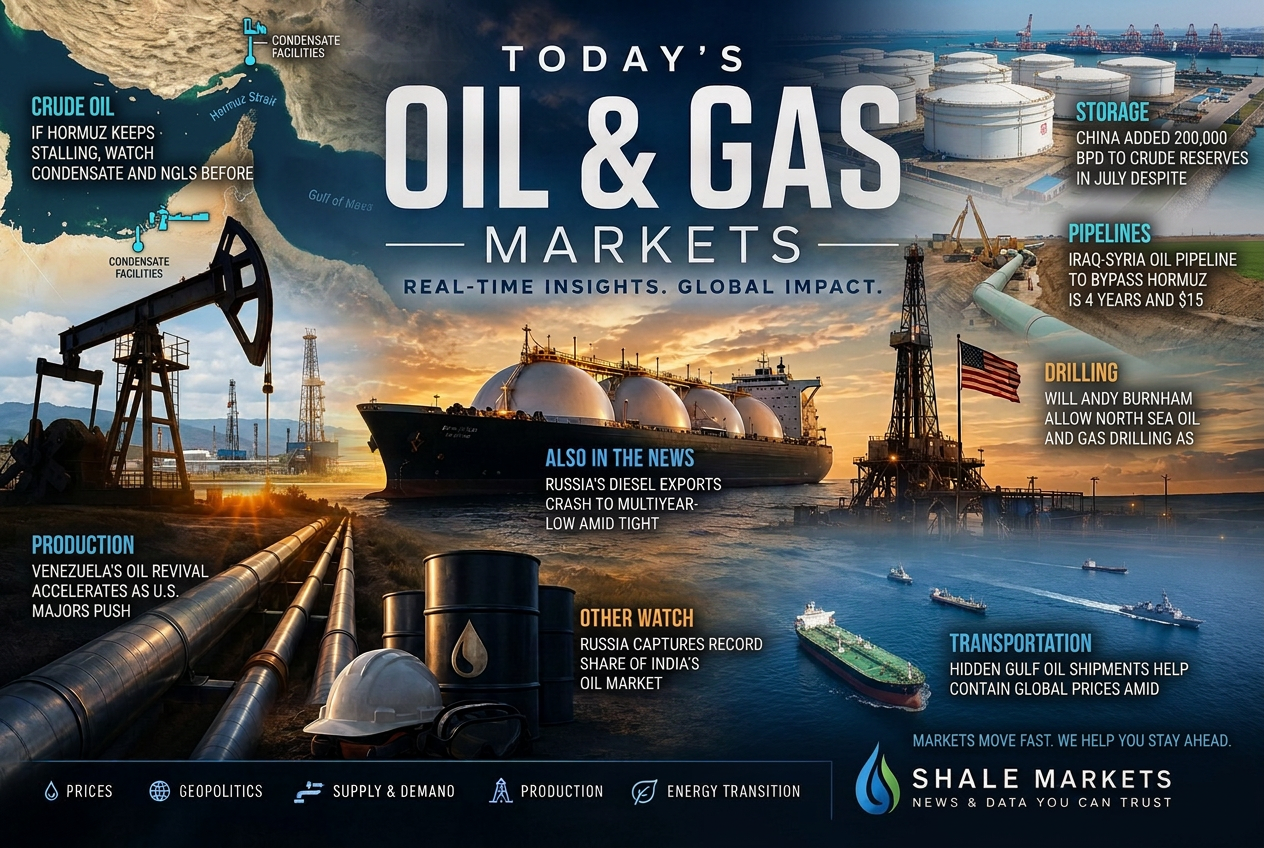
Today's briefing brings you 38 stories across markets, policy, midstream and drilling from across North American oil and gas. Leading today: If Hormuz Keeps Stalling, Watch Condensate and NGLs Before You Watch Crude.
Markets
As the Strait of Hormuz stalls, condensate and NGL markets are showing more strain than crude benchmarks, which have a substitution path light ends lack.
From Our Desk
Higher Chinese crude imports signal that refinery runs and stock-building can stay firm even when macro data softens. That supports global crude demand expectations and can tighten the balance for exporters competing for Asian barrels.
OilPrice.com
South Korea buying a larger share of U.S. crude signals that Atlantic Basin barrels are taking a larger role in Asian supply planning, which can support U.S. export flows and tighten competition for Middle East cargoes. For refiners and traders, it points to shifting crude slate economics and a more diversified procurement strategy among major importers.
finance.biggo.com
Higher oil prices would alter capital allocation across upstream portfolios, so analysis of why Brent has not reached extreme levels matters for understanding whether producers should keep prioritizing drilling and hedging or preserve discipline. It also signals how supply-demand balance and OPEC capacity are capping upside, which affects pricing expectations for the sector.
RigZone
Lower crude prices would ease import costs for refiners and downstream users in India, but they also signal softer global demand or looser supply conditions that can pressure producer revenues and capital budgets across the sector. For an executive, the main read-through is margin relief in consuming markets alongside a potentially weaker pricing environment for upstream investment decisions.
NDTV Profit
The divergence between major agency outlooks signals that executives should treat supply-demand forecasts with caution when setting hedges, capex, and inventory strategy. When the market cannot anchor on a single consensus view, price volatility and timing risk for upstream and midstream investment rise.
RigZone
China’s approach to insulating its economy from oil price shocks signals how large importers can blunt demand volatility and reduce immediate exposure to global crude disruptions. For executives, it matters because it can reshape import patterns, soften near-term pricing swings, and influence where incremental supply growth is needed.
Rediff
EQT is a bellwether for Appalachian gas capital allocation and cash generation, so a quarterly comparison against peers helps executives judge whether dry-gas spending and returns are improving relative to the group. It also signals whether gas-focused E&Ps are holding leverage to pricing, hedge books, and operating efficiency in a market where basin discipline matters.
Yahoo Finance
Lower spending by major U.S. shale producers, even with firmer oil prices, signals that capital discipline is still overriding volume growth. For executives, that points to a tighter drilling and completions outlook and less aggressive supply response from shale in the near term.
OilPrice.com
Foreign capital entering U.S. assets can be slowed when Treasury yields stay elevated and oil volatility weakens risk appetite. For an oil and gas executive, that points to tighter financing conditions and a less supportive backdrop for upstream and infrastructure investment even if global interest in U.S. energy remains strong.
조선일보
Policy
Venezuela’s crude restart matters because any sustained lift in output could add heavy barrels back into a market that is sensitive to supply losses and quality mismatches. For U.S. majors, it signals a chance to secure reserves and influence a strategic producer, but it also increases exposure to policy shifts and sanctions risk.
OilPrice.com
China’s ability to blunt oil-price shocks matters because it affects how much demand weakness can absorb higher crude costs and how quickly that pressure feeds back into global balances. For executives, it signals that policy and inventory management in China can alter trade flows, refinery runs, and pricing power across export markets.
Rediff
This signals that sanctioned international barrels are still accessible when U.S. licensing allows it, which can affect crude supply balances and the flow of capital back into politically risky export markets. For executives, it also underscores how compliance and geopolitics can reopen or constrain trading and investment opportunities outside the usual Middle East or North American supply chain.
oilprice.com
A visit like this suggests local policymakers are still treating Midland oil output as a core economic and infrastructure issue, which matters for permitting, roads, water, and broader basin competitiveness. It also signals that operators in the Permian remain important enough to draw official attention even when commodity markets are not the only story.
Midland Reporter-Telegram
Midstream
China’s continued reserve buildup signals persistent state-led crude buying that can support import demand even when geopolitical risk is already elevated. For producers and traders, it reinforces that China can remain a swing source of demand and a buffer against downside in global crude balances.
OilPrice.com
A proposed Iraq-Syria pipeline would matter because it could create an alternate export corridor that reduces dependence on the Strait of Hormuz and reshapes how crude moves out of the region. The timeline and capital burden also signal that any relief to supply security is distant, so near-term trade flows and pricing would remain tied to existing chokepoints.
OilPrice.com
The story points to Gulf supply still reaching the market despite conflict risk, which can keep a lid on prices and reduce the urgency for buyers to chase replacement barrels elsewhere. For executives, that signals that geopolitical disruption may be cushioned by rerouted or obscured flows, preserving near-term market balance but keeping enforcement and shipping risk elevated.
Межа. Новини України.
This signals that sanctioned or shadow tanker activity can keep physical barrels moving even during geopolitical shocks, limiting the upside in crude prices. For executives, it underscores that supply disruptions in the Middle East may not translate directly into stronger pricing power if covert logistics preserve flows.
investingLive
This signals a potential step toward a major new LNG export corridor in Latin America, which would affect long-term gas monetization and basin development decisions in Argentina. For executives, it also highlights where capital may be steered toward midstream and export infrastructure rather than domestic market growth.
OilPrice.com
This signals that Red Sea security risks are starting to affect crude logistics and could force Saudi volumes into longer, costlier routes. For refiners, that raises supply-chain risk and can tighten prompt market balances even without a change in underlying production.
OilPrice.com
This matters because carbon capture projects live or die on offtake contracts, transport access, and storage economics, not just capture technology. For executives, it signals that capital will favor integrated carbon infrastructure and commercial structures that can secure steady volumes and bankable returns.
OilPrice.com
This would give Libya a more direct route to monetize crude through Mediterranean refining and could alter export flows across North Africa. For executives, the key signal is whether new midstream infrastructure will shift basin access, attract foreign capital, and tighten regional competition for crude supplies.
OilPrice.com
Drilling
The Rosebank decision is a signal on how far UK policymakers will go in supporting new North Sea supply, which affects capital allocation into offshore projects and the pace of investment in the basin. For executives, it also speaks to regulatory risk around future drilling and the competitiveness of North Sea barrels versus imports and other low-cost sources.
The Independent
A rising rig count in Nigeria signals renewed upstream spending and a firmer operating environment for service providers, which can translate into more drilling demand and better asset utilization. For executives, it points to improving capital allocation toward production growth in a key African supply market, with implications for local supply balance and competitive positioning.
Business News Nigeria
A rig contract signals that Predator is committing capital to near-term appraisal or development work rather than preserving cash, which can indicate confidence in the prospectivity of the Trinidad acreage. For operators and service providers, it also points to incremental basin activity and potential tightening in local drilling demand.
uk.finance.yahoo.com
A new offshore hydrocarbon find for Petrobras suggests continued exploration success in Brazil’s frontier acreage and can support longer-term reserve replacement. For executives, it signals where capital may shift toward appraisal and development work in the Atlantic margin rather than purely producing assets.
OilPrice.com
Higher drilling activity in the Gulf signals that Gulf producers are still committing capital even with geopolitical risk elevated, which supports demand for drilling and oilfield-services names. For executives, it points to continued basin resilience and a steadier service-market backdrop than headline crude volatility alone might suggest.
Barron's
Moving eight wells toward drilling is a capital-allocation signal that the company is shifting resources into near-term inventory conversion in the Delaware Basin. For executives, it suggests continued competition for drilling slots and services in a core Permian area, which can influence timing of production growth and operating efficiency.
Inspenet
A major offshore discovery in Angola signals that international upstream capital is still being committed to frontier deepwater prospects, which can reshape reserve replacement priorities for large independents and national oil companies. For executives, it also points to renewed competition for African offshore acreage and future supply growth outside the shale basins.
OilPrice.com
A new offshore discovery in Brazil’s frontier acreage can shift capital toward the Atlantic margin and strengthen Petrobras’s position in future reserve replacement. For executives, it also signals that Brazil may be balancing growth ambitions with environmental and permitting scrutiny around the Amazon-adjacent basin.
WRAL
This signals that the Philippines is moving to de-risk frontier acreage with modern subsurface data before committing larger exploration dollars. For service companies and upstream operators, it points to a potential new basin opportunity in Asia-Pacific and a path to future licensing or farm-in activity.
World Oil - Latest News
A deeper re-entry in the Western Haynesville signals that operators still see value in extending the resource life of legacy acreage rather than relying only on new leases. For an executive, it highlights where capital may flow next in dry-gas development and whether this part of Texas can compete with other gas basins on deliverability and well economics.
World Oil - Latest News
Advancing a horizontal test after gas and possible liquids are found suggests ReconAfrica is still in appraisal mode, and the result will help determine whether Namibia can support commercial development or remain a speculative play. For executives, the signal is about basin optionality in frontier Africa and whether early capital can be justified by repeatable flow performance.
World Oil - Latest News
This points to continued capital spending on subsurface imaging for geothermal projects, which can support a broader shift toward lower-carbon energy development and create adjacent demand for oilfield services. For seismic and equipment suppliers, it signals that non-oil exploration budgets can still be a meaningful revenue stream in Europe.
World Oil - Latest News
Technology
Net Power’s shift toward gas-backed projects signals where near-term demand is concentrating: developers and power buyers are prioritizing quick, reliable capacity over more speculative low-carbon concepts. For gas producers and power infrastructure firms, that can support incremental demand tied to data center buildout and improve the competitive position of gas-fired generation in capital allocation decisions.
RigZone
This matters because tighter alignment on standards and certification can make cross-border project execution in Mexico more efficient while lowering compliance and safety risk for operators and contractors. The added focus on methane, carbon capture and offshore pipeline safety also signals where spending and regulatory scrutiny are likely to rise.
World Oil - Latest News
Power availability is becoming a gating factor for wider robotics deployment, which means operators may need to prioritize electrification and site infrastructure before they can capture labor and efficiency gains from automation. For executives, this points to a broader capital-allocation tradeoff between deploying new digital equipment and funding the grid, generation, and load capacity needed to support it.
RigZone
Regulatory
Lower-cost abandonment work in the North Sea should improve the economics of late-life asset management and free operator capital and vessel capacity for other offshore work. It also signals that decommissioning is becoming a more coordinated spending category, which can affect contractor pricing and the pace of well retirements across the basin.
World Oil - Latest News