
Shale Markets Briefing — August 19, 2026
Wednesday, August 19, 2026
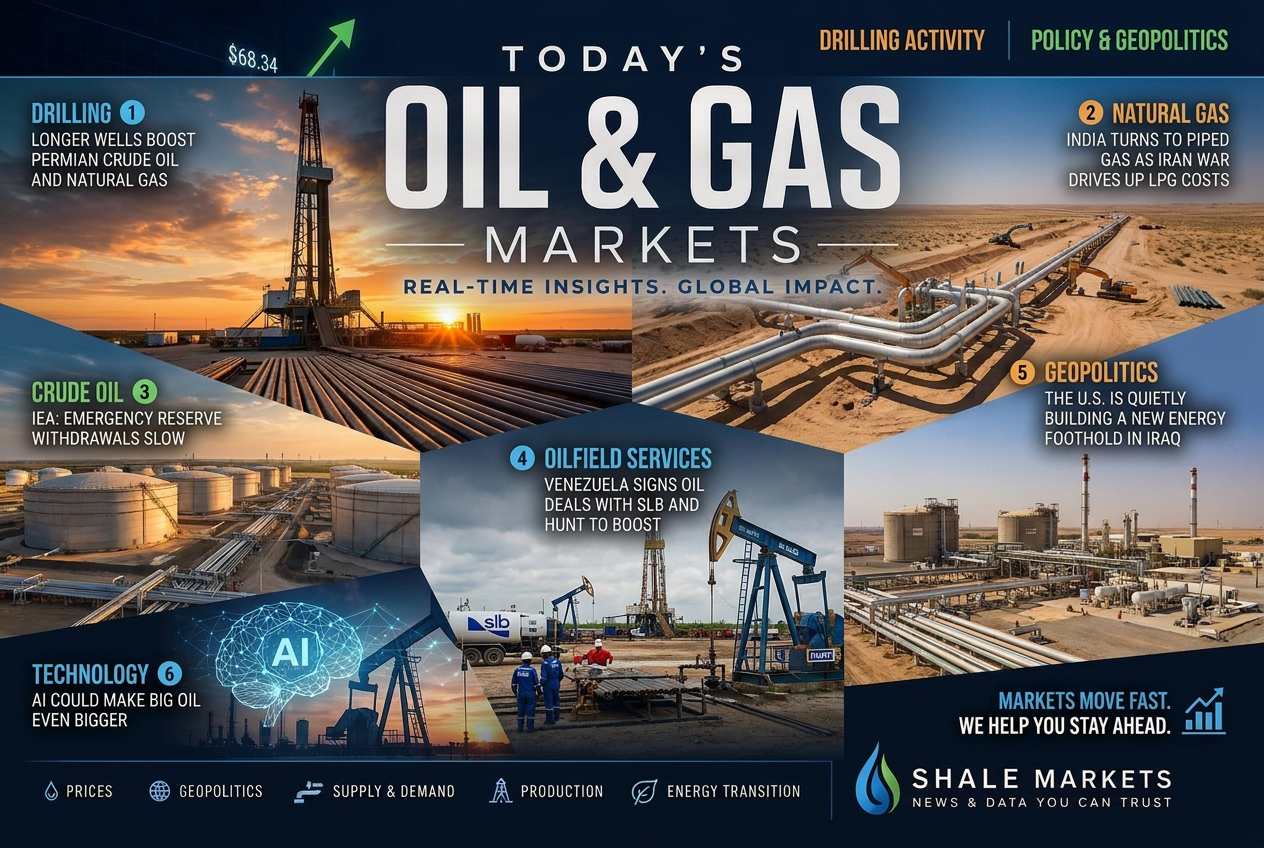
Today's briefing brings you 15 stories across drilling, midstream, policy and technology from across North American oil and gas. Leading today: Longer wells boost Permian crude oil and natural gas production.
Drilling
Longer laterals in the Permian point to continued capital efficiency gains, which can keep regional output growing even if rig counts flatten. For executives, that signals sustained competitive pressure on price, services demand, and pipeline and takeaway planning in the basin.
EIA Today in Energy
The expanded seismic survey signals continued capital flowing into early-stage exploration rather than near-term development, which can lift service demand but also suggests operators still need better subsurface definition before committing drilling dollars. For executives, it is a read on where frontier exploration interest is concentrating in Asia-Pacific and how that may shape future acreage competition in Sarawak.
World Oil - Latest News
Rig count data is a timely read on near-term drilling appetite and where operators are keeping capital active. For executives, it helps gauge service demand, basin competitiveness, and whether upstream spending is tightening or broadening.
OGJ - General Interest
Aker BP is adding undeveloped offshore discoveries to its portfolio, which signals a willingness to allocate capital toward high-quality North Sea inventory rather than only producing assets. For executives, it is a reminder that control of future project options in mature basins can be as important as current production growth.
RigZone
Advancing an exploration permit in the Taranaki basin signals that capital is still being committed to new gas-condensate supply opportunities in a mature but prospective market. For executives, it is a reminder that basin access and regulatory progress can affect where future drilling budgets are directed and how much regional gas supply may be available.
World Oil - Latest News
New Mexico remains a key upstream growth area, which signals continued capital concentration in the Permian and related state-level infrastructure, permitting, and services activity. For executives, the message is that production upside in the region still has room to absorb investment even as the broader U.S. market balances output growth with price discipline.
sourcenm.com
Midstream
India’s shift toward piped gas signals a policy response to imported LPG inflation and a push to lock in long-term domestic gas demand. For executives, it points to stronger downstream gas infrastructure investment and a potential rebalancing of household fuel competition away from LPG imports.
OilPrice.com
A LNG contract in Gabon signals continued investment in African gas monetization and a need for technical and compliance capability as project sponsors advance export infrastructure. For executives, it points to where service demand and competitive positioning are shifting in the global LNG buildout.
Upstream Online
Policy
Slower use of emergency crude stocks signals that policymakers are less willing to lean on strategic reserves to manage market tightness, which can leave more of the burden on OPEC supply and demand destruction. For executives, that affects price expectations and how quickly capital can be committed to new barrels or hedges.
OGJ - General Interest
The deals suggest Venezuela is trying to attract outside technical and capital support to slow the decline in its upstream base. For executives, that signals potential service and field-development opportunities in a high-risk market while also highlighting how any production recovery there could affect Latin American crude supply.
OilPrice.com
A deeper U.S. energy foothold in Iraq signals where Washington may be willing to back commercial and infrastructure access to strengthen influence over a strategically important supply source. For executives, it points to potential shifts in basin-linked investment, contracting, and competitive positioning across Iraqi upstream and gas projects.
OilPrice.com
Technology
AI adoption in upstream and midstream operations can lower operating costs and improve subsurface and planning decisions, which strengthens the producers that can deploy it at scale. For executives, the signal is that competitive advantage may shift toward firms with the best data, compute, and workflow integration rather than those relying only on volume growth.
OilPrice.com
It signals that safety spending is no longer limited to physical equipment and process controls; cybersecurity and digital monitoring are now part of core operational risk management for operators and service providers. For executives, that means capital allocation increasingly has to cover both field reliability and cyber resilience to protect uptime, insurance costs, and asset value.
OGJ - General Interest
Markets
This signals that Shell is spending to recover barrels from existing offshore assets rather than relying only on new drilling, which is a capital-efficient way to support near-term production. For service providers, it points to continued work on well intervention and production enhancement in mature offshore basins, not just greenfield development.
RigZone
The piece is relevant because it shows how a major oil-centered city can reset its capital base and competitive mix after a severe downturn. For executives, it is a reminder that commodity busts can reshape where investment, talent, and business formation concentrate for years.
Houston Chronicle