
Shale Markets Briefing — September 7, 2026
Monday, September 7, 2026
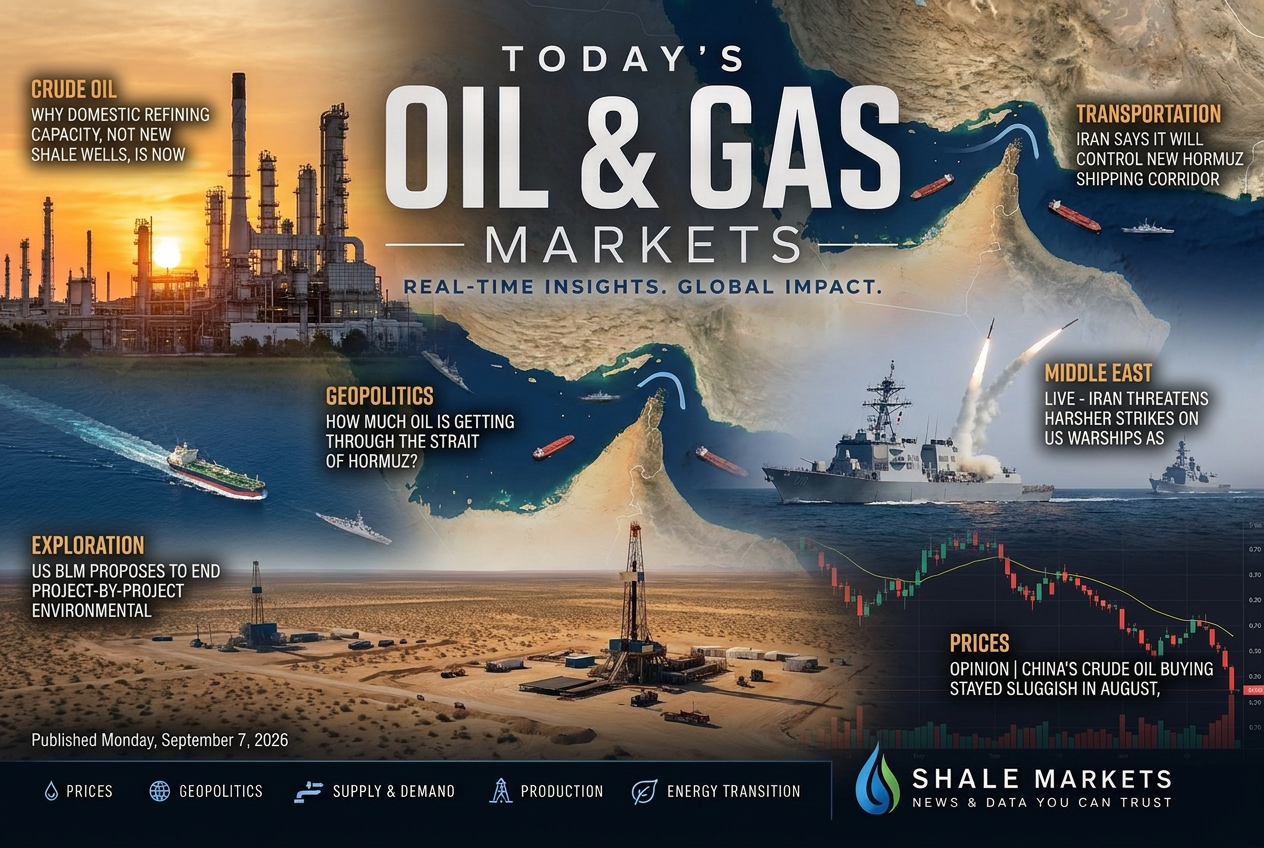
Today's briefing brings you 25 stories across crude oil, exploration, lng and drilling from across the global oil and gas market. Leading today: Why Domestic Refining Capacity, Not New Shale Wells, Is Now the Binding Constraint on U.S. Crude Realization.
crude-oil
U.S. refiners are running at near-record utilization while shale output climbs, pushing surplus crude toward export docks instead of domestic units.
From Our Desk
This signals a direct attempt to tighten Iranian leverage over a critical oil transit route, which raises the risk premium for crude and refined product flows through Hormuz. For operators and traders, the key issue is not the corridor itself but the added coordination requirement and potential for disruption in a chokepoint that underpins regional export economics.
OilPrice.com
The Strait of Hormuz is a critical chokepoint for global crude exports, so any discussion of throughput there signals risk to supply and freight flows. For executives, the issue is less the headline volume itself than the potential for disruption to Middle East barrels and a fast reaction in oil pricing.
DW.com
Rising threats around the Strait of Hormuz and US naval assets raise the risk of tanker disruptions and higher freight and insurance costs for crude moving out of the Gulf. That would tighten seaborne supply expectations and increase volatility for traders, refiners, and producers exposed to Middle East export flows.
Iran International
China’s weaker crude buying points to softer near-term import demand, which can pressure regional cargo flows and weigh on seaborne crude balances. For producers and traders, it raises questions about how much incremental demand will be available to absorb supply in the coming months.
Baird Maritime
Repeated attacks on Jizan highlight that Saudi refining and export logistics on the Red Sea remain exposed, which raises operational risk for a facility that helps the kingdom shift barrels away from the Strait of Hormuz. For executives, the bigger signal is that geopolitics is influencing where Saudi Arabia can safely process and move crude, with implications for route diversification and regional supply reliability.
OilPrice.com
Keeping OPEC+ policy unchanged signals a near-term supply stance that traders and refiners will treat as a hold on incremental barrels. For producers, it suggests the group is still prioritizing market management over volume gains, which supports a tighter focus on price discipline and competitor response.
cnbc.com
The headline signals a shift in control over Venezuelan oil assets, which could affect long-term capital allocation and bargaining power in a market where access to reserves matters more than near-term gasoline prices. For executives, the bigger implication is geopolitical leverage around crude supply rather than an immediate demand-side price response.
asiae.co.kr
Iranian export losses, if sustained, tighten global crude supply and can support prices, especially if other producers do not offset the barrels. For executives, the key signal is that sanctions and geopolitics still have direct pricing power and can alter near-term trade flows.
24/7 Wall St.
The company’s run of discoveries suggests continued exploration success and a stronger inventory of drilling locations, which supports future spending in its core basin. The move toward horizontal drilling points to a push to improve well productivity and lower per-barrel development costs, which matters for capital allocation and competitive positioning.
egyptoil-gas.com
The headline signals that any U.S.-Venezuela crude arrangement is being viewed as a longer-term supply and policy play, not an immediate way to replenish U.S. strategic stocks. For executives, that means Venezuelan barrels should not be counted on to quickly reshape near-term crude balances or import planning.
RigZone
The headline points to a continued rise in U.S. oil output, which matters because it can add barrels to the market and influence pricing assumptions. For executives, it is a reminder that domestic supply growth still shapes capital spending and competitive dynamics across U.S. shale.
Peak Oil Barrel
exploration
The proposal would reduce permitting friction in Alaska’s NPR-A, which could make future acreage and project economics more attractive to operators and shift capital toward faster-moving federal opportunities. It also signals a policy stance that prioritizes development pace over site-by-site review, with implications for basin activity and the pace of supply additions.
OGJ - Exploration and Development
Operators are shifting capital decisions away from a single core basin and toward a portfolio approach across U.S. shale. That points to more disciplined allocation based on economics and infrastructure, which can change which basins attract drilling and midstream spending.
OGJ - Exploration and Development
The resource upgrade signals that offshore Philippines exploration is moving from concept toward a more credible gas target, which can influence where capital is directed in Southeast Asia. For executives, it suggests the basin may deserve closer attention as operators refine subsurface risk and rank projects for appraisal.
OGJ - Exploration and Development
PETRONAS is using AI to shorten the cycle from subsurface data to investment decisions, which points to a push for faster capital deployment in Malaysia’s upstream sector. For competitors and service providers, it signals that digital workflows are becoming part of the operating advantage in screening exploration opportunities.
World Oil - Latest News
The pushback around a Falkland Islands oil project highlights how political resistance can slow frontier offshore development even when geology is attractive. For executives, it signals higher execution risk and a more difficult capital-allocation case for projects exposed to sovereignty disputes and regulatory scrutiny.
Reuters
lng
The operatorship shift signals a reset in control of a major LNG project, with ExxonMobil taking a larger role just as sponsors try to move the asset toward a final investment decision. For executives, it points to continued capital discipline and portfolio reshuffling among large LNG developers in Asia-Pacific.
RigZone
Markets
Strong corporate earnings across the GCC point to healthier cash generation for energy-linked businesses and reinforce the region’s investment capacity. For executives, it signals that oil income is still feeding balance sheets and supporting capital spending across the Gulf.
Arab News
A sanctions bill aimed at Russia would tighten the policy overhang on energy trade and shipping, which can alter crude, product, and LNG flows for suppliers and buyers with exposure to the region. The short congressional calendar raises the risk that markets face another period of uncertainty rather than a quick policy resolution.
OilPrice.com
Drilling
Drilling in PEL 93 signals continued exploration spending in onshore Namibia as companies test whether the basin can hold commercial hydrocarbons. For executives, the near-term implication is that recent data from nearby acreage is helping de-risk new wells and shape where capital is directed in a still-early frontier play.
OGJ - Exploration and Development
The well result shows a small independent is still spending on frontier-style exploration in Israel, which signals continued willingness to allocate capital to high-risk acreage outside the main North American basins. The next testing phase will determine whether the project can move from drilling activity to a meaningful production opportunity.
World Oil - Latest News
completions
This signals ongoing spending on North Sea well interventions and mature-field support rather than a shift toward greenfield growth. For executives, it points to continued demand for oilfield services tied to keeping legacy basins productive and extending the life of existing assets.
World Oil - Latest News
transportation
Dorian LPG is adding modern VLGC capacity, which signals confidence in long-haul LPG trade and a willingness to lock in fleet renewal well ahead of delivery. For competitors and cargo owners, the move points to tighter focus on fuel-efficient shipping capacity and future fleet positioning rather than near-term spot market conditions.
RigZone
natural-gas
The MOU signals that standards-setting and certification are becoming part of the competitive toolkit for gas and hydrogen markets, not just a technical side issue. For executives, cooperation between a U.S. industry group and Korea’s gas utility points to broader alignment around low-carbon fuel rules, workforce capability, and market access in Asia.
World Oil - Latest News