Shale Markets Briefing — October 6, 2026
Tuesday, October 6, 2026
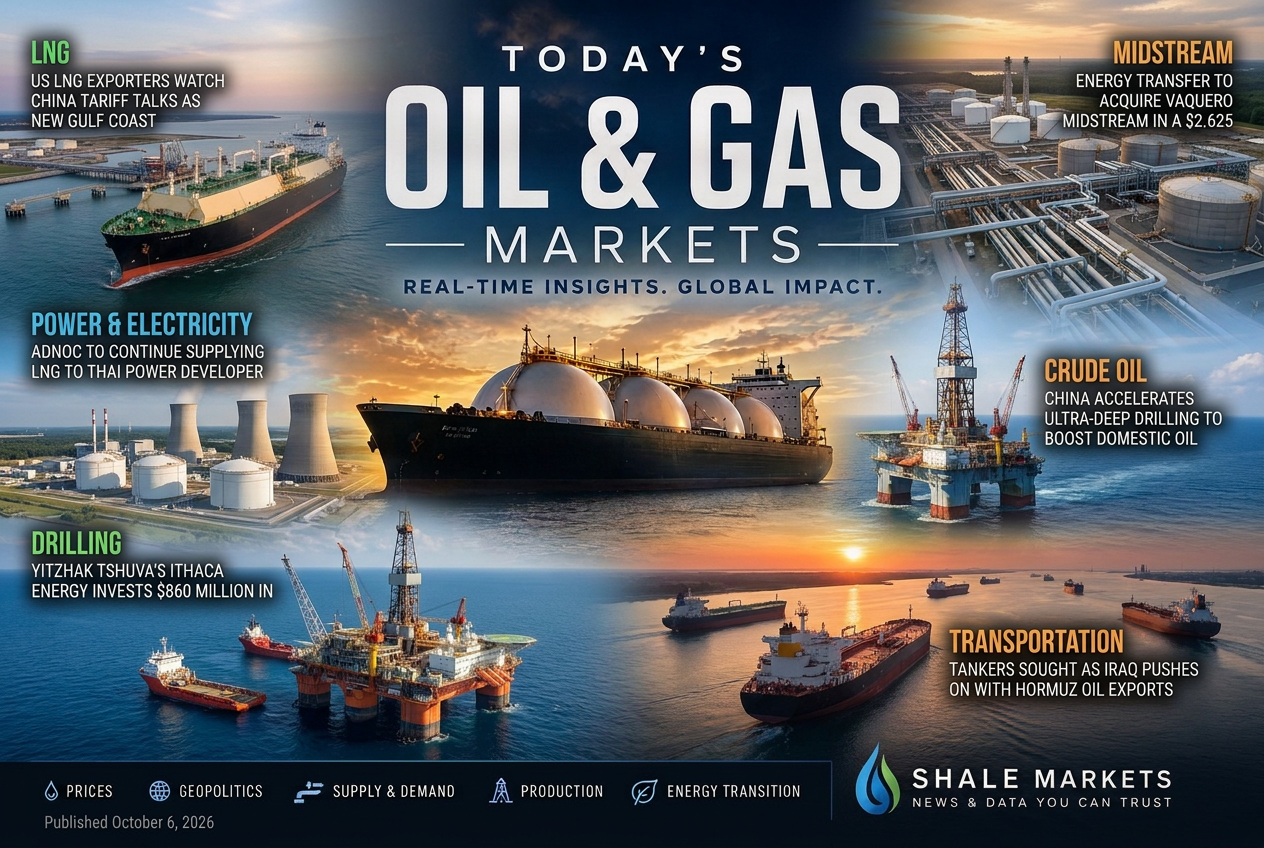
Today's briefing brings you 24 stories across lng, midstream, crude oil and drilling from across the global oil and gas market. Leading today: US LNG Exporters Watch China Tariff Talks as New Gulf Coast Capacity Nears Online.
lng
China's 15% tariff on U.S. LNG remains outside the latest Trump-Xi trade relief, leaving 24.5 million tonnes of uncontracted Gulf Coast capacity to find buyers elsewhere.
From Our Desk
The new LNG supply deal extends ADNOC’s role in Asian gas markets and gives Gulf a long-term feedstock line for power generation. For executives, it signals continued competition for contracted LNG volumes and supports investment confidence in export infrastructure and supply security.
RigZone
Sanctioned LNG volumes still reaching record levels signals that Russia can keep moving gas through restricted projects, even under Western pressure. For executives, it underscores how resilient supply can cap regional LNG upside and keep sanctions risk central to trading, shipping, and contracting strategies.
Upstream Online
Bringing in outside capital would signal that Venezuela’s gas projects still need fresh funding and risk-sharing to move toward growth. For executives, the bigger signal is whether Perla can support future LNG export plans and become a more material outlet for regional gas supply.
World Oil - Latest News
Baker Hughes is signaling that it still sees room to win work in Venezuela by tying its oilfield services, LNG, and midstream capabilities to future project development. For operators and investors, that points to a push to keep upstream and infrastructure activity moving if regulatory approvals and commercial terms line up.
OGJ - Exploration and Development
This signals that LNG developers still have access to large pools of growth capital, which supports new liquefaction and export capacity even in a tighter funding environment. For executives, it points to continued competition for capital behind gas supply growth and future LNG trade flows.
RigZone
Freeport’s return to normal feedgas shows a temporary outage at a major LNG outlet is ending, which helps restore U.S. gas demand and reduces near-term volatility in Gulf Coast export flows. For producers and LNG marketers, it signals that Gulf Coast infrastructure disruptions are still a key swing factor in domestic balances and export availability.
OilPrice.com
This signals ADNOC is pushing its LNG marketing reach deeper into Asia while locking in outlet growth with a local partner. For executives, it points to continued competition for long-term gas demand in Asia and the importance of integrated supply relationships that support downstream power and industrial sales.
OGJ - Pipelines and Transportation
Midstream
Energy Transfer is using a large midstream acquisition to add scale and likely tighten control over gathering, processing, and takeaway in a key U.S. gas and liquids corridor. For executives, it signals continued consolidation in infrastructure as operators position for steadier fee-based cash flow and broader basin connectivity.
Business Wire
The deal adds Haynesville gas acreage and associated midstream capacity to Centalion’s portfolio, which can strengthen its footing in a basin where takeaway and processing access shape asset value. For executives, it signals continued capital recycling into gas-weighted basins with infrastructure attached, not just acreage alone.
themountaineer.com
crude-oil
China is leaning harder on technically difficult ultra-deep drilling to offset reliance on imported crude and keep domestic supply growing. For operators and service providers, it signals continued capital spending into high-cost frontier reservoirs where technical capability can become a competitive edge.
OilPrice.com
Iraq’s decision to add tanker capacity underscores the premium producers are placing on export control and shipping resilience in the Strait of Hormuz. For executives, it signals that route security and owned or contracted marine capacity can affect crude flows, lifting the strategic value of flexible export logistics.
RigZone
The recovery in Gulf crude exports signals that Middle Eastern supply is normalizing faster than many had expected, which can ease pressure on seaborne crude balances and shipping routes. For producers, Saudi Arabia’s rebound also shows who is still carrying the region’s export growth and where market share is being regained.
OilPrice.com
A possible delay would show Brussels is weighing emissions enforcement against the risk of tightening Europe’s access to imported gas and crude. For producers and LNG suppliers, it would signal that compliance pressure can still be adjusted when energy security and supply competition become the bigger concern.
OilPrice.com
Aramco is signaling that spare capacity in the oil system is tight, which supports firmer crude pricing and leaves refiners more exposed to any further disruption through Hormuz. For upstream and trading executives, that points to a market where supply security and short-cycle barrels matter more, and where any reopening delay can keep pressure on both crude availability and product margins.
RigZone
This signals that Gulf exporters have found workarounds to keep crude moving even while Hormuz transit stays constrained, which matters for assessing route risk and the resilience of regional supply. For executives, the key issue is that export volumes can recover without normalizing the chokepoint, so shipping and contingency costs remain part of the competitive landscape.
OilPrice.com
A rising floor around $70 oil would support upstream cash flow and keep U.S. producers willing to add rigs and sanction more drilling. For executives, it signals a firmer capital-allocation backdrop and reinforces the competitive edge of U.S. supply if disruptions keep prices elevated.
OGJ - General Interest
Drilling
Ithaca is committing substantial capital to Canadian drilling, which signals confidence in the basin and a willingness to grow production despite a softer investment backdrop. For competitors, it suggests capital is still being directed toward higher-return upstream inventory rather than being held back or redeployed elsewhere.
The Jerusalem Post
Ratification gives Gran Tierra firmer legal cover to move from acreage control into subsurface work, which is the point where exploration spending starts to turn into a drill-or-pass decision. For industry executives, it signals that Azerbaijan is still open to upstream investment and that early-stage basin access can now be converted into a more concrete capital program.
World Oil - Latest News
The lease sale signals that federal land access in California remains a live source of upstream opportunity even amid state pushback. For operators, it is a reminder that regulatory approvals and environmental review can still shape where capital is deployed in mature U.S. basins.
OGJ - General Interest
exploration
This signals that Southeast Asia remains a live market for upstream capital, with buyers willing to take over assets that larger companies are exiting. For operators, it points to continued portfolio rotation, more bidding for producing and late-life acreage, and a chance to reset competitive positions in the region.
OilPrice.com
Markets
An asset swap between the Norwegian state and an oil and gas company points to active portfolio management in a mature North Sea market. For executives, the signal is that governments and operators are still reshaping asset ownership to concentrate capital in the most strategic barrels and infrastructure.
Upstream Online
offshore
LADOL’s move into a Liberia shore base signals fresh capital being committed to West African oil logistics rather than upstream drilling. For operators, it points to growing support infrastructure around offshore activity and a possible bid to capture service work tied to basin development.
Billionaires.Africa
oilfield-services
Flowco is using acquisitions to broaden its artificial lift offering, which can deepen its share of operator spending on production optimization and well intervention. For upstream executives, it signals continued consolidation in oilfield services around equipment that can lift mature wells more efficiently and protect production.
World Oil - Latest News