Shale Markets Briefing — October 8, 2026
Thursday, October 8, 2026
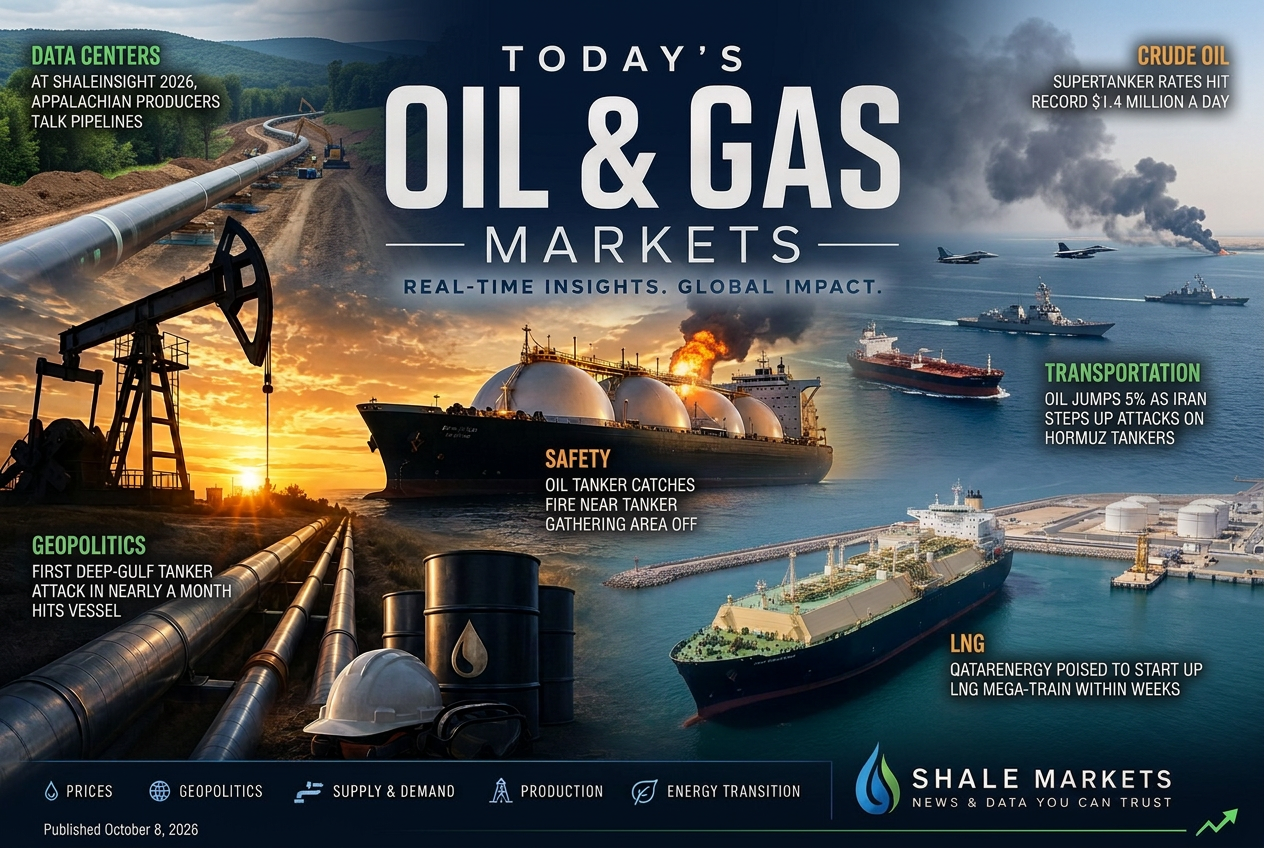
Today's briefing brings you 21 stories across data centers, crude oil, lng and natural gas from across the global oil and gas market. Leading today: At ShaleInsight 2026, Appalachian Producers Talk Pipelines and Power Contracts, Not Just Barrels.
data-centers
Appalachian producers are hedging an unresolved timeline on LNG, power demand, and pipeline capacity rather than betting on when it resolves.
From Our Desk
crude-oil
Record tanker rates signal that crude shipping is becoming a bottleneck, not just a cost item, for moving barrels out of the Gulf. For producers, traders, and refiners, tighter vessel availability can change routing economics, widen regional differentials, and complicate export flows from key supply hubs.
OilPrice.com
The spike highlights how quickly Hormuz security can tighten the physical crude balance by threatening tanker flows and forcing operators to protect output and processing assets. For executives, it is a reminder that supply-route risk and Gulf Coast weather can move near-term pricing and operating plans at the same time.
OilPrice.com
An attack on a tanker near Qatar raises immediate concern for shipping security in a corridor that matters for crude and LNG flows from the Gulf. For operators and traders, it signals renewed transit risk that can add insurance costs, slow movements, and complicate export planning across the region.
OilPrice.com
A fire on a tanker near Fujairah highlights operational and marine safety risk in one of the world’s most important crude shipping hubs. For operators and traders, any disruption there can affect vessel routing, insurance costs, and confidence in regional export flows.
WANA News Agency
This signals that shipping risk in the Strait of Hormuz is still shaping Gulf crude flows and adding hidden costs to moving barrels out of the region. For producers and traders, it underscores that export security and route optionality now matter as much as nominal supply recovery.
OilPrice.com
Syria’s plan to raise oil output by investing in existing fields signals a push to restore upstream capacity rather than chase new discoveries. For operators and service providers, it points to incremental basin work in a higher-risk market that could tighten local supply and shift regional export optionality if execution improves.
RigZone
Tighter global inventories mean the market has less cushion against any new disruption from the Middle East, which supports a higher crude price floor even if supply looks adequate on paper. For producers, that signals improved revenue resilience and a stronger case for disciplined capital allocation rather than growth at any cost.
OilPrice.com
This signals a push to restore output from mature Venezuelan onshore blocks, which can add incremental barrels at low capital cost if field rehabilitation works as planned. For executives, the bigger point is that PDVSA is still relying on outside operators to unlock existing acreage, which keeps Venezuela a watch area for supply additions and contractual risk.
OGJ - Exploration and Development
The story matters because hurricanes can force shut-ins, evacuations, and logistics delays across Gulf Coast energy operations, temporarily tightening regional supply and disrupting offshore and refining activity. Executives watch these storms for exposure at facilities, workforce safety, and how quickly operators can restore production and marine transport.
Hart Energy
Higher Algerian crude flows to South Korea signal a shift in Asian crude buying that can support Algeria’s export outlet and alter competition among suppliers into the region. For refiners and traders, it is a reminder that marginal barrels are still being redirected by pricing, availability, and refinery crude slate needs.
الشروق أونلاين
lng
This signals another tranche of new LNG supply from Qatar, which matters because it can tighten competition for future export volumes and shape contract and price dynamics across the global gas market. For operators and LNG investors, a start-up like this is a reminder that long-cycle capacity additions are still coming online and will influence basin and project economics well beyond the Middle East.
Upstream Online
The project’s fate now hinges less on geology than on who will write the check, which makes it a test case for how much state-backed pressure can unlock capital for a long-delayed LNG megaproject. For operators and investors, it signals that Alaska LNG may be moving back onto the radar as a strategic export option, even if the financing burden remains the main obstacle.
OilPrice.com
Tighter LNG balances heading into winter point to stronger competition for Atlantic Basin cargoes and less room for supply disruption. For exporters and contract holders, China reopening talks also signals that long-term offtake is still in play even as spot market tension rises.
OGJ - General Interest
Qatar positioning empty LNG carriers in the Gulf suggests it is preparing shipping capacity and staying flexible on near-term cargo flows. For executives, that points to tighter attention on export scheduling, vessel availability, and how regional logistics can support or delay LNG sales into the market.
RigZone
natural-gas
This signals another round of federal rulemaking pressure on U.S. producers, with the most immediate impact likely on compliance costs and how operators treat marginal wells and associated gas. It also matters for basin economics because any change to the Super Emitter Program could affect monitoring, reporting, and enforcement risk across shale operations.
World Oil - Latest News
exploration
Petrobras’ spending to influence Brazil’s concession round signals that the company is willing to commit capital early to secure future acreage and protect its upstream inventory. For competitors, it suggests Brazil remains an important deepwater growth arena where licensing terms and operator positioning will shape long-term basin access.
Upstream Online
Drilling
The update to API’s pipe-threading standard matters because it tightens the quality bar for casing, tubing and line pipe used across drilling and well construction. For operators and suppliers, it signals higher inspection expectations and a need to align procurement and QA programs with evolving integrity requirements.
World Oil - Latest News
offshore
Guardian’s role in removing the Bullwinkle platform points to more Gulf offshore decommissioning work, which supports a steady niche market for well abandonment, plugging, and removal contractors. For operators, it signals continued capital being shifted from legacy offshore production into end-of-life asset retirement and balance-sheet cleanup.
World Oil - Latest News
The updates show how a hurricane can quickly affect offshore operators’ continuity planning, even when the immediate impact is uncertainty rather than a confirmed outage. For executives, the key signal is exposure of Gulf assets and the need to protect production, personnel, and logistics during storm season.
RigZone
This shows how quickly Gulf of Mexico output can be taken offline when a storm threatens, which can tighten near-term offshore supply and raise the value of hurricane-response planning. For operators, it is a reminder that platform resilience, evacuation procedures, and restart timing are part of production reliability in the basin.
OilPrice.com